


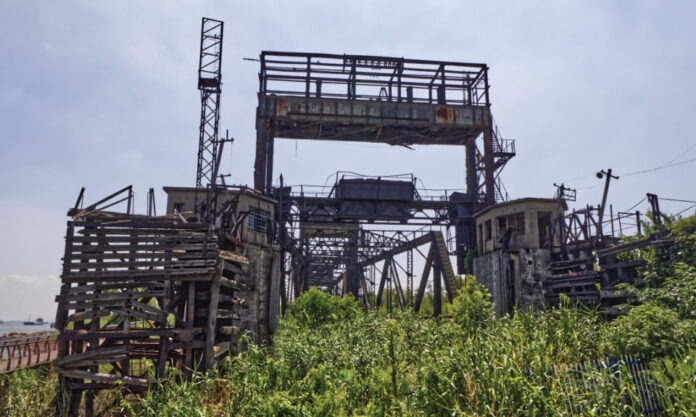
Getting a train onto a ferry is a big deal, even today. Apart from the fact that trains are just plain heavy, they require the building of trestle bridges for the embarking/disembarking of locomotives and carriages. All very well, but in Nanjing, there was a problem.
即使在今天,坐火车上渡轮也是一件大事。 除了火车很重之外,它们还需要建造跨桥来装载/下机车和马车。 一切都很好,但在南京,出现了一个问题。
In October, 1930, the Ministry of Railways of the National Government established the “Xiaguan-Pukou Railway Ferry Special Design Committee”. It looked at the water levels of the Yangtze River in Nanjing during years prior and found a 14.872-metre fluctuation. That’s one heck of a tide.
1930年10月,国家政府铁道部成立了“下关-普口铁路轮渡特别设计委员会”。 它查看了前几年南京长江的水位,发现波动为14.872米。 那真是一场大潮。
The back story to this is that the Jinpu (Tianjin-Pukou) Railway came to its southern terminus on the northern bank of the Yangtze in Nanjing. And it really needed to be connected with then up-and-coming Shanghai. The solution was simple; put the train on a boat. This, however, was easier said than done.
背景故事是,金浦(天津-浦口)铁路在南京长江北岸的南端。 它真的需要与当时新兴的上海联系起来。 解决方案很简单;把火车放在船上。 然而,这说起来容易做起来难。
For the construction would need to be able to extend out over the river to reach the boat when waters were at their lowest, and rise up to serve the boat when at their highest.
因为施工需要能够在水位最低时延伸到河面上,以便到达船,并在水位最高时上升,为船服务。


After comparing various design plans, the Committee decided to adopt the “movable approach bridge” plan proposed by Zheng Hua, who was then head of the design section of the Ministry of Railways.
在比较了各种设计方案后,委员会决定采用当时的铁道部设计科科长郑华提出的“移动通道桥”方案。
China may be trumps in the world of bridges today, but back then it was the British. Hence, the north and south bank trestle bridges for the Nanjing Railway Ferry were designed and constructed by Dorman Long which concurrently worked on the Sydney Harbour Bridge.
中国可能是当今桥梁世界的王牌,但那时是英国。 因此,南京铁路渡轮的北岸和南岸跨桥是由多曼·朗设计和建造的,同时在悉尼海港大桥上工作。
Said firm decreed that the maximum incline of the bridge be 2.6 degrees, necessitating the length of the approaches.
该公司下令,桥梁的最大斜度为2.6度,这需要通道的长度。
Construction began on 1 December, 1930, and was completed in September of 1933. The Nanjing Railway Ferry was officially opened to trains the following month.
施工于1930年12月1日开始,并于1933年9月完工。 南京铁路渡轮在下个月正式向火车开放。
Regarded as the throat of cross-river links at the time, Chairman Mao Zedong himself inspected the Ferry on the evening of 15 December, 1962.
毛泽东主席本人在1962年12月15日晚视察了渡轮,当时被视为跨河连接的咽喉。
As the first railway ferry in China and indeed, all of Asia, the Ferry was selected as one of China’s “Top Ten Projects” during that glorious period known as “The Nanjing Decade”, from 1927 to 1937. Today, it sits all alone, protected, but rightfully left to rust.
作为中国乃至整个亚洲的第一艘铁路渡轮,该渡轮在1927年至1937年被称为“南京十年”的辉煌时期被选为中国“十大项目”之一。 今天,它独自一人,受到保护,但理所当然地让它生锈。