


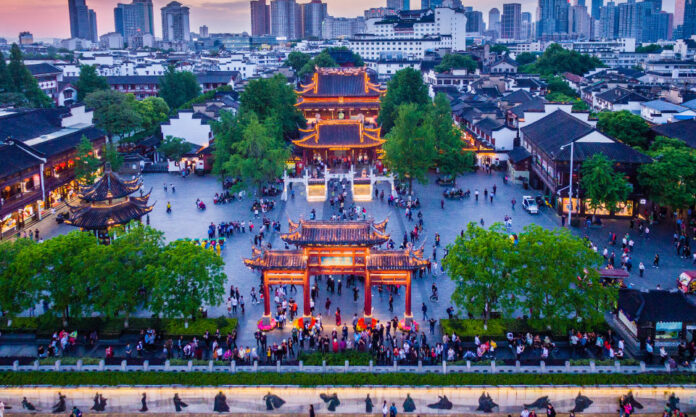
Intended as a place to worship and consecrate Confucius, Fuzimiao in Nanjing has seen its share of violence, the area around it having gone through ravishing epochs of change.
南京的福子庙旨在作为崇拜和奉献孔子的地方,它经历了暴力的份额,其周边地区经历了令人陶醉的变革时代。
The essence of Qinhuai River scenery and one of Nanjing’s two 5A scenic spots, the 4.2-kilometre long inner Qinhuai River from Dongshuitou to Xishuiguan has been associated with the dwellings of prominent families ever since the Six Dynasties and as a gathering place for merchants, scholars and Confucianism.
秦淮江风景的精髓和南京两个五A景区之一,从东水头到西水关的4.2公里长的秦淮河内河自六代以来就与著名家族的住宅联系在一起,是商人、学者和儒家的聚集地。
Those scholarly connections are the key. In ancient times, Confucius should be worshipped whenever a school is established.
那些學術聯絡是關鍵。 在古代,只要建立一所學校,就應該崇拜孔子。
Nanjing’s Confucius Temple was first built in 337CE with Wang Dao to thank. Wang was the Marquis of Wugang, a politician, calligrapher and a founding hero of the Eastern Jin Dynasty. It was his idea that “governing a country should focus on cultivating talent”.
南京的孔庙最早建于公元337年,由王道感谢。 王是武冈侯爵,政治家、书法家和东晋的创始英雄。 他的想法是“管理一个国家应该注重培养人才”。
Hence, the Imperial College was established on the south bank of the Qinhuai River. It was moved to the north bank in 1034 , whereupon a temple was built in front of the Imperial College for that all-important worship of Confucius.
因此,帝国学院建在秦淮河南岸。 它于1034年被移到北岸,随后在帝国学院前建造了一座寺庙,用于对孔子的崇拜。


But the great sage would turn out to have other matters on hand from time to time. For Nanjing’s Fuzimiao was destroyed by fire during the Jianyan years of the Southern Song dynasty. Such destruction would continue regularly; on four occasions in total, the last being at the hands of the Japanese in 1937, with their artillery fire.
但这位伟大的聖人会不时地手头有其他事情。 南宋建燕年間,南京的福子庙被大火烧毁。 这种破坏将定期持续下去;总共四次,最后一次是在1937年日本人的炮火。
While the current buildings date from the 19th century during the Qing Dynasty, with various additions made since, that we know today is the result of reparations and rebuilds which took place since 1984; efforts which would lead to Confucius Temple in Nanjing being rated as one of the “Top 40 National Tourist Attractions” in 1991.
虽然目前的建筑可以追溯到19世纪的清朝时期,但从那时起进行了各种补充,我们今天知道这是自1984年以来进行的修补和重建的结果;这些努力使南京的孔庙在1991年被评为“国家十大旅游景点”之一。
Used on and off in the late 1920s and 1930s as army barracks for the KMT, Confucius Temple nevertheless still seems to be unable to free itself from the shackles of conflict.
孔子庙在20世纪20年代末和30年代断断續續地被用作国民党的军营,但似乎仍然无法摆脱冲突的枷鎖。
Therein, and with the Kuiguang Pavilion to the east and the Juxing Pavilion to the west, stone pillars are to be found in front of the temple, inscribed with the words, “Civil and Military Ministers Dismount Here”, ostensibly to show respect for he called the “Most Holy King of Literature and Propaganda”.
在那里,东边是奎光阁,西边是巨星阁,在寺庙前可以找到石柱,上面刻着“文武部长在此下山”字样,表面上是为了表示对他被称为“最神圣的文学和宣传之王”的尊重。
Among Fuzimiao’s other highlights is the large screen wall that dates from 1575. It is 110 meters long and is the longest of its kind in all of China.
富子庙的其他亮点之一是可以追溯到1575年的大屏风墙。 它长110米,是全中国同类中最长的。
Confucius Temple today stands at not only the cultural and educational centre of Ming and Qing Nanjing, but also as a building complex that is up there with the best of anything China has to offer.
孔子庙今天不仅矗立在明清南京的文化和教育中心,而且是一个建筑群,拥有中国所能提供的一切。