



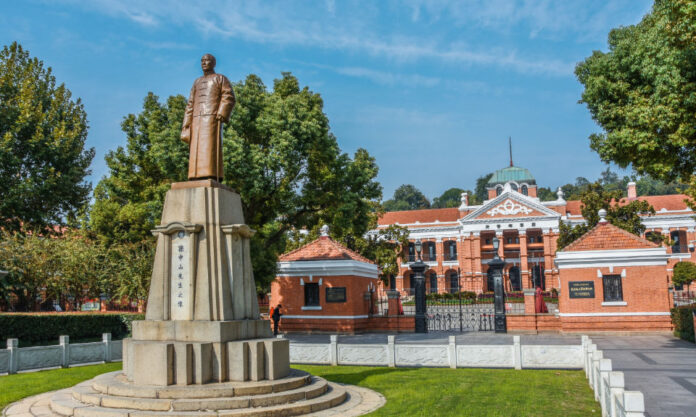



Sun Yat-sen registered at a hotel in Japan in 1897 under a Japanese name a friend invented to protect him from the authorities hunting him; the surname on that hotel register, Nakayama, became his adopted name Zhongshan, and later the name of the city where he was born.
一八九七年,孙中山在日本投宿一家旅馆时,友人为保护他免遭当局追捕,替他登记了一个日本姓氏;这个登记时用的姓氏”中山”,后来成了他自己采用的名字,而这个名字,最终又成了他故乡这座城市的名字。
Sun was born in 1866 to a peasant family in Cuiheng village, and was known through much of his life by his school name, Sun Wen, or by the Cantonese rendering by which he became best known in the West, Sun Yat-sen. He went on to become a leading figure in the revolution that brought Qing imperial rule to an end in 1911, and served as the first provisional president of the Republic of China.
孙中山一八六六年出生于翠亨村一户农家,名文,字德明,青年时期以学名”孙文”行世,在西方则以粤语发音的”Sun Yat-sen”之名最为人熟知。他后来成为辛亥革命的重要领导者之一,这场革命最终推翻了清朝统治,他随后出任中华民国临时大总统。
A month after Sun’s death in Beijing in March 1925, the Guangzhou-based Generalissimo Government approved the renaming of his home county, Xiangshan, as Zhongshan County in his memory, making it one of only a small number of Chinese cities ever renamed after a single person. His former residence in Cuiheng, whose construction he personally directed and which blends traditional Lingnan architecture with Western elements, still stands within what is now a protected heritage district.
一九二五年三月孙中山在北京逝世,一个月后,广州中华民国陆海军大元帅府批准将他的故乡香山县更名为中山县,以示纪念——这也使中山成为中国为数不多、以个人姓名命名的城市之一。他亲自督建的翠亨村故居,融合了岭南传统建筑与西式元素,至今仍完好保存在如今已被列为保护区的旧址之内。



A City with No Counties, Governing Towns Directly
一座没有下辖县级单位、直接管理镇区的城市
Zhongshan has never had county-level subdivisions since becoming a prefecture-level city in 1988; it directly administers 15 towns and eight subdistricts, a territory that also contains the national-level Torch High-tech Industrial Development Zone and the Cuiheng New Area built around Sun’s own birthplace, an administrative structure shared by only a handful of Chinese cities.
自一九八八年升格为地级市以来,中山便从未设立过县级行政区划,而是直接管辖十五个镇、八个街道,辖区内还设有国家级的火炬高技术产业开发区,以及围绕孙中山出生地建设的翠亨新区——这种行政架构,在中国仅有少数几座城市采用。
One of those towns, Guzhen, accounts for well over half of China’s domestic lighting fixtures market, earning it the name China’s Lighting Capital; its international lighting fair was first held in 1999 and has run twice yearly since 2014.
其中的古镇,所产灯饰占据中国国内市场半数以上份额,由此获得”中国灯饰之都”的美誉;国际灯饰博览会始办于一九九九年,自二零一四年起改为每年春秋两届。
According to the city’s own 2024 economic communiqué, Zhongshan’s GDP reached ¥414.3 billion that year, up 3.7 percent, with per capita output at ¥92,558; the permanent population stood at 4.4946 million, up 36,400 on the year before.
据该市自身发布的二零二四年经济统计公报显示,当年中山市GDP达四千一百四十三点二五亿元,同比增长百分之三点七,人均产值为九万二千五百五十八元;常住人口为四百四十九点四六万人,较上年增加三点六四万人。
The Shenzhen-Zhongshan Link, a 24-kilometre bridge-and-tunnel crossing opened on 30 June 2024, cut the road journey between Shenzhen and Zhongshan from around two hours to about 30 minutes.
深中通道是一座桥隧结合的跨海工程,全长二十四公里,于二零二四年六月三十日通车,将深圳至中山的车程,从约两小时缩短至约三十分钟。