


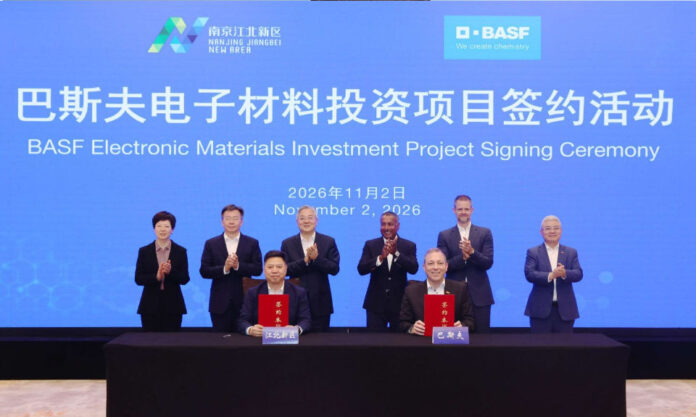
German chemical giant BASF will build a semiconductor materials plant in Nanjing, with start-up expected by the end of 2028. It signed the investment agreement with Jiangbei New Area on 2 November but has not said how much it will spend.
德国化工巨头巴斯夫将在南京建设一座半导体材料工厂,预计2028年底投产。巴斯夫已于11月2日与南京江北新区签署投资协议,但尚未披露投资金额。
BASF announced the deal on 3 November. The new electronic materials site will stand in Jiangbei New Area’s materials park, and is meant to support China’s growing semiconductor industry through local manufacturing, technical expertise and reliable supply. It will also serve as a platform for closer work with customers and partners across the semiconductor value chain. The company’s statement names no products and gives no capacity.
巴斯夫于11月3日公布了这一消息。新的电子材料生产基地将建在江北新区的新材料园区内,旨在通过本地制造、技术专长和可靠供应,支持中国不断壮大的半导体产业,同时作为与半导体产业链上客户和合作伙伴深化合作的平台。公司声明未提及具体产品,也未给出产能。
As Nanjing Daily reports, Nanjing Party Secretary Zhou Hongbo and Mayor Li Zhongjun met the BASF delegation before witnessing the signing in the city.
据《南京日报》报道,南京市委书记周红波、市长李忠军会见了巴斯夫代表团,并见证了签约。
A Gateway for German Business
中德合作的门户
Zhou told the delegation that Nanjing is an important gateway for China–Germany trade and industrial cooperation, and that the city is steering its petrochemical industry towards new materials and downstream end products. He called BASF a benchmark Sino-German joint venture and said the project would back Nanjing’s integrated circuit and new materials industries, before inviting German firms to dig deeper into the city.
周红波表示,南京是中德经贸及产业合作的重要门户,正推动石化产业向新材料和下游终端产品转型。他称巴斯夫是中德合资合作的标杆企业,项目将为南京集成电路和新材料产业发展提供有力支撑,并欢迎德国企业深耕南京。
On the BASF side, Gops Pillay, president of its Global Operating Division, called the investment “another important milestone in BASF’s ‘local-for-local’ strategy”. Jens Liebermann, who heads the Global Electronic Materials business, said the company was “strengthening our local manufacturing footprint”.
巴斯夫方面,全球营运总裁葛毕莱(Gops Pillay)称,此次投资是巴斯夫“本地生产服务本地市场”战略的又一重要里程碑。全球电子材料业务部高级副总裁黎博曼(Jens Liebermann)表示,公司正在强化在本地的生产布局。
BASF’s electronic materials business supplies high-purity process chemicals and formulated solutions to chipmakers, functional materials to display makers and metal systems to the electronics industry. Gasgoo links the Nanjing move to expanding wafer fabrication and packaging capacity in China, which is raising demand for locally made upstream materials.
巴斯夫的电子材料业务向芯片制造商提供高纯度工艺化学品和配方解决方案,向显示面板厂商提供功能材料,并向电子电气行业提供金属系统。盖世汽车网认为,此次落子南京,与中国晶圆制造和封装产能的扩张有关,后者正推高对本地化上游材料的需求。
The park is familiar ground. In November 2025 BASF commissioned a high-performance dispersant line in the Jiangbei New Material Technology Park, and the company says its Nanjing site has been a specialty chemicals base for China and Asia Pacific since 2007. The cracker complex it built with Sinopec stands in the same park.
这片园区对巴斯夫并不陌生。2025年11月,巴斯夫在江北新材料科技园投产了一条高性能分散剂生产线,并表示其南京基地自2007年起就是服务中国及亚太地区的特种化学品生产基地。它与中国石化合资建设的裂解装置一体化基地也坐落在同一园区。
The US$2.9 Billion Beginning
29亿美元的起点
BASF’s Nanjing story starts at the turn of the century. The BASF-YPC joint venture, owned 50:50 with Sinopec, was founded in 2000; ground was broken on a 220-hectare site on 28 September 2001; and in July 2002 it raised US$1.4 billion in loans from banks including Citibank and ICBC, toward a total investment of US$2.9 billion.
巴斯夫的南京故事始于世纪之交。与中国石化各持50%股份的扬子石化-巴斯夫合资公司成立于2000年,2001年9月28日在占地220公顷的厂址上动工;2002年7月,该公司获得14亿美元贷款,银行包括花旗银行和中国工商银行,用于总投资29亿美元的项目。
When the steam cracker and nine downstream plants entered full commercial production on 28 June 2005, BASF-YPC described the project as the largest single investment in BASF’s 140-year history. Chemical & Engineering News called it BASF’s largest investment outside Germany. The US$2.9 billion was the total for the 50:50 venture.
2005年6月28日,蒸汽裂解装置和九套下游装置全面投入商业运营,扬子石化-巴斯夫称该项目是巴斯夫140年历史中最大的单笔投资。《化学与工程新闻》则称其为巴斯夫在德国以外的最大投资。这29亿美元是这家50:50合资公司的总投资额。
A US$500 million (¥4 billion) expansion agreement followed in July 2006, and the cracker’s ethylene capacity has since risen from 600,000 to 740,000 tonnes a year. BASF says expansions in 2012, 2014 and 2023 have lifted the total investment at Nanjing to US$6 billion, though Zhanjiang in Guangdong, at about €8.7 billion, is now its largest current project.
2006年7月,双方又签署了5亿美元(40亿元)的扩建协议,此后裂解装置的乙烯产能已从每年60万吨提升至74万吨。巴斯夫表示,经过2012年、2014年和2023年的扩建,南京基地的总投资已达60亿美元;不过,广东湛江基地投资约87亿欧元,目前是其最大的在建投资项目。
The plant signed on 2 November is due to start up by the end of 2028, more than 27 years after ground was broken on the cracker complex in the same park. This time, the investment is aimed at semiconductor materials.
11月2日签约的这座工厂预计于2028年底投产,距离同一园区内裂解装置一体化基地动工已逾27年。而这一次,投资瞄准的是半导体材料。