



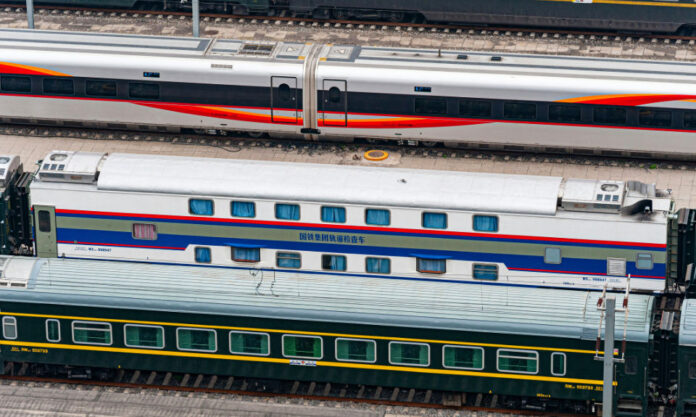



China is giving its fastest trains a letter of their own. A new X prefix, read xīn (新, “new”), will mark Fuxing bullet trains able to exceed 350 km/h, as national train numbers are rewritten in two batches before the year ends.
中国正为最快的列车设立专属字母。新增的X字头读“新”(xīn),将用于最高运行时速350公里以上的复兴号动车组;全国列车车次将在年底前分两批重新编排。
China State Railway Group announced the reform on 16 October. In late November the first batch covers ordinary passenger, tourist and freight trains; in late December the second covers high-speed, intercity, suburban and power-concentrated EMU services, plus EMU express freight. The new X numbers will run from X1 to X9998.
国铁集团于10月16日宣布这项改革。11月下旬的第一批涉及普速旅客列车、旅游列车和货物列车;12月下旬的第二批涉及高速、城际、市郊和动力集中动车组列车,以及动车组快运列车。新增的X字头车次编号为X1至X9998。
The reason is congestion. On peak days such as the May Day and National Day holidays, G trains take up more than 90 percent of usable train numbers, and some prefixes and number ranges are running short. The fleet of 300 to 350 km/h standard sets has grown from 1,018 in 2014 to 3,149 in 2025, a rise of 209 percent.
原因是车次拥挤。在五一和国庆等高峰期,G字头(gāo)列车占用了超过90%的可用车次资源,部分字头和号段已经紧张。时速300至350公里的标准动车组从2014年的1018组增至2025年的3149组,增幅达209%。
As Science and Technology Daily reports, the new scheme raises the number of EMU passenger prefixes from four to seven and adds nearly 40 percent more usable numbers. It ranks trains by top speed. X (xīn) is for Fuxing EMUs above 350 km/h and G (gāo) for Fuxing at 350; T (tè) is for EMUs at 300 and K (kuài) for EMUs at 200 to 250; D (dòng), the letter of 动, is for power-concentrated EMUs at 200 or below.
据《科技日报》报道,新规则将动车组旅客列车字头由4个增至7个,可用车次增加近40%,并按最高时速为列车分级。X(xīn)用于时速350公里以上的复兴号,G(gāo)用于350公里的复兴号;T(tè)用于时速300公里的动车组,K(kuài)用于200至250公里的动车组;D(dòng)取“动”字,用于时速200公里及以下的动力集中动车组。
Every Letter Has a Past
每个字母都有来历
None of these letters began as a speed grade. K (kuài) arrived in 1997 with the first national speed-up, when 11 pairs of fast trains ran at up to 140 km/h. T (tè) became the mark of 特快 (tèkuài, express) trains after the 2000 speed-up and Z (zhí) of 直达特快 (zhídá tèkuài, direct express) in 2004; D (dòng) came with EMUs in 2007. G (gāo), for 高 (high), is older than most passengers assume; in 1998 it labelled the Swedish X2000 tilting trains on the Guangzhou–Shenzhen line, which ran at up to 200 km/h, before the Beijing–Tianjin line made it the badge of high-speed rail in 2008, according to Jiemian.
这些字母最初都不是速度等级的标记。K字头(kuài)随1997年的首次全国大提速出现,当时开行了11对时速最高140公里的快速列车。T字头(tè)在2000年提速后成为特快列车的标志,Z字头(zhí)则在2004年用于直达特快列车;D字头(dòng)随动车组在2007年出现。G取“高”字(gāo),历史比多数乘客以为的更久;1998年它曾用于广深线上最高时速200公里的瑞典X2000摆式列车,2008年京津城际铁路开通后才成为高速铁路的标志,界面新闻对此作了介绍。
The twist is that T and K are being repurposed. Both began on conventional trains, T (tè) for 特快 and K (kuài) for 快 (fast), and both lived on beside the bullet trains. Under the new scheme T will mark EMUs at 300 km/h and K EMUs at 200 to 250 km/h, so letters long tied to slower services will now sit on bullet trains. The Paper reports that conventional T trains will become N, for fast passenger trains at up to 140 km/h, and conventional K trains V, for 120 km/h services, in the late November batch.
转折在于T和K被重新定义。两者最初都用于普速列车,T(tè)代表特快,K(kuài)代表快速,而且在高铁出现后继续沿用。新方案中,T将对应时速300公里的动车组,K对应时速200至250公里的动车组,于是长期与较慢列车相连的字母,如今将落在动车组身上。据澎湃新闻报道,现行普速T字头列车将改为N,代表最高时速140公里的快速旅客列车,普速K字头列车改为V,代表时速120公里的列车,均在11月下旬的第一批调整。
Other letters keep their jobs but gain precise limits. C (chéng, 城, “city”) marks intercity EMUs at up to 200 km/h within one railway bureau and S (shìjiāo, 市郊, “suburban”) suburban trains at up to 160; Y (yóu, 游, “tour”) marks tourist trains. Z stays for 160 km/h fast trains but will now be read as the English letter rather than 直 (zhí), as will N and V, which The Paper says may confuse passengers who rely on station announcements rather than smartphones. Freight shuttles will all use B and EMU express freight DH.
其他字母保留原有用途,但划定了更明确的界限。C(chéng,城)用于路局管内最高时速200公里的城际动车组,S(shìjiāo,市郊)用于最高时速160公里的市郊列车,Y(yóu,游)用于旅游列车。Z字头仍用于时速160公里的快速列车,但今后按英文字母读音而非“直”(zhí)读出,N和V也同样按英文读音;澎湃新闻指出,这可能让依赖站内广播而非手机的乘客感到困惑。货运班列将统一使用B,动车组快运列车使用DH。
The Train Still on Trial
仍在试验的列车
China State Railway Group’s announcement does not name the CR450, saying only that X is for future trains above 350 km/h, but the South China Morning Post reads the change as a hint that the model’s commercial debut is near. The CR450 was unveiled in December 2024. It has been tested at up to 450 km/h and is designed to run commercially at 400 km/h, against 350 km/h for the CR400 Fuxing in service since 2017. CGTN reports energy use of under 22 kWh per km at 400 km/h.
国铁集团的公告并未点名CR450,只说X字头用于未来时速350公里以上的列车,但《南华早报》认为这一调整暗示该车型的商业首秀临近。CR450于2024年12月亮相,试验最高时速达450公里,设计商业运营时速为400公里,而自2017年投入运营的CR400复兴号为350公里。CGTN报道称,其在时速400公里下的能耗低于每公里22千瓦时。
No service date has been given. The CR450 must run 600,000 km with all indicators within limits before it carries passengers. China Business News reported in January that about 300,000 km were done, roughly half, and that the railway group planned to finish the rest and complete design finalisation in 2026. Tencent News says whole-train tests were completed in late September and that passenger service can begin only after the assessment ends.
目前尚未公布投入运营的时间。CR450必须在各项指标合格的前提下跑满60万公里,才能载客。《第一财经》1月报道称,已完成约30万公里,约为一半,国铁集团计划在2026年跑完剩余里程并完成设计定型。腾讯新闻报道称,整车试验已于9月下旬完成,运用考核结束后才能开通客运。
Nor has anyone named the route. The only line described as built for 400 km/h is the 292 km Chengdu–Chongqing middle line, with a design speed of 350 km/h and 400 km/h reserved; the China Academy of Railway Sciences said in January that CR450 sets would undergo comprehensive tests on it in 2026, though no opening date has been announced. A July 2025 Caijing headline suggested the Beijing–Shanghai line could see the train in 2026, but the railway group’s announcement names no line at all.
具体线路同样没有公布。唯一被描述为按时速400公里预留条件建设的线路是全长292公里的成渝中线,设计时速350公里,并预留400公里;中国铁道科学研究院1月表示,2026年CR450动车组将在该线进行综合测试,但开通时间尚未公布。2025年7月,财经网的一则报道标题称该车有望在2026年于京沪线投用,但国铁集团的公告并未提及任何线路。
Passengers will notice the change before they notice any speed. The railway group says routes, operating sections and timetables stay as they are, and that the timetable will be redrawn later with the new numbers; travellers are told to check train numbers, stations and times during the transition. The 2026 to 2030 railway science plan also calls for at least 20 demonstration projects, including one for the 400 km/h high-speed train system.
乘客先感受到的是车次的变化,而非速度的提升。国铁集团表示,列车的径路、运行区段和时刻表保持不变,此后将按新车次重新编制运行图;旅客在过渡期内应留意车次、车站和时间。2026至2030年铁路科技规划还提出,至少建成20个典型应用场景或示范工程,其中包括时速400公里高速列车系统。
For now the X (xīn) sits in the rulebook with 9,998 numbers reserved and not one passenger train to carry them, while the CR450 it was created for is still finishing its 600,000 km.
目前,X字头(xīn)只存在于规则之中,预留了9998个车次,却没有一列客运列车使用;为它而设的CR450仍在跑完60万公里的路上。