



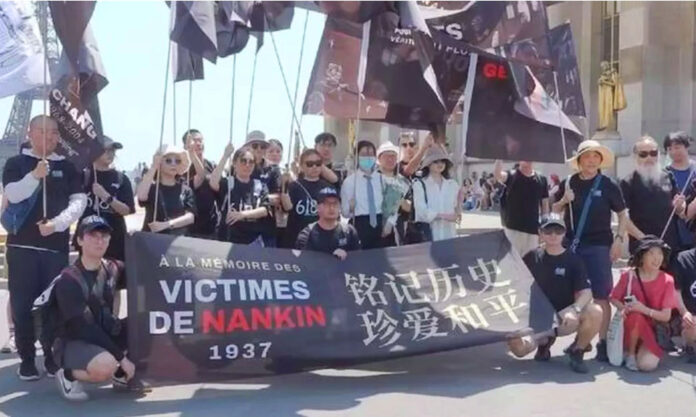



Memory walked through Paris on Saturday as a small but determined crowd crossed the city in tribute to the victims of the Nanjing Massacre. But a quiet civic gesture instead became a public reminder that history still has a long walk to make.
记忆在周六走过巴黎,一小群却很坚定的人穿城而行,向南京大屠杀遇难者致意。原本可能只是一次安静的公民纪念,最后却成了一次公开提醒,历史仍有很长的路要走。
The march began at the Trocadéro Esplanade, also known as the Parvis des Droits de l’Homme, and ended at Place Victor-Hugo. Along the way, participants carried banners calling for remembrance and peace rather than forgetfulness and drift.
游行从特罗卡德罗广场出发,也就是人权广场,终点是维克多·雨果广场。沿途,参与者举着标语,呼吁铭记与和平,而不是遗忘与淡化。
That Saturday timing mattered. Weekend streets give a memorial more room to breathe; they also give ordinary passers-by a chance to stop, listen and join. For a subject still little known in France, that wider public stage was part of the point.
这个周六的时间安排很重要。周末的街道更适合纪念活动展开,也更容易让路人停下脚步、听一听、跟着走一段。对于在法国仍不算广为人知的话题来说,扩大公众接触面本身就是目的之一。



Why Echoes of the World Chose Paris
“世界回声”为什么选在巴黎
The event was organised by Echoes of the World, a small association led by Bastien Ratat, Marcus Detrez and Zhong Haosong. Their message was simple and direct. They want the Nanjing story to travel beyond specialist circles and into the wider European conversation about war, memory and responsibility.
这场活动由“Echoes of the World”组织,核心人物包括巴斯蒂安·拉塔、马库斯·德特雷斯和钟浩松。它的表达很直接,也很简单。他们希望南京这段历史,不只停留在研究者圈子里,而是进入欧洲更广泛的战争、记忆与责任讨论中。
Ratat said Paris was chosen because of its timing and setting, while Detrez argued that younger audiences in Europe still hear too little about the Nanjing Massacre. The association’s leaders did not treat the walk as theatre; they treated it as an act of public instruction.
拉塔说,选择巴黎,是因为时机与地点都合适;德特雷斯则认为,欧洲年轻人对南京大屠杀仍然了解太少。协会负责人并没有把这次游行当成表演,而是当作一次面向公众的历史教育。


A Small Group, A Large Claim
一支小队伍,一条大命题
At the end of the route, a minute of silence was held for the victims. The moment was simple, almost spare; yet that restraint gave the march its force. Participants also wrote messages on a banner, then the group prepared to continue its commemoration in Marseille on 4 July.
行程结束时,现场为遇难者默哀一分钟。这个时刻很简单,甚至可以说很克制;可正是这种克制,反而让游行更有力量。参与者还在横幅上留言,之后这场纪念活动还将于7月4日在马赛继续。
Bastille Post Global deserves mention too. It is the English-language arm of the Hong Kong-based Bastille Post, which describes itself on its own About Us page as a web-native newspaper. In other words, it is not a random reposting platform; it is a standing outlet with its own editorial identity.
巴士的报全球版也值得一提。它是香港巴士的报的英文平台,而巴士的报在自己的“关于我们”页面中将自己描述为网络原生报纸。换句话说,它不是随手转载的平台,而是有自己编辑身份的正规媒体。
A search of major mainland outlets turned up no independent report on the march at the time of writing; other than Bastille Post Global’s own account, which framed the event around remembrance, peace and historical memory. That is telling in itself; some histories still cross borders faster than the news that should carry them.
截至写作时,对主要大陆媒体的检索没有找到这场游行的独立报道;能公开看到的,主要还是巴士的报全球版自身的稿件,它将这场活动框定在“铭记、和平与历史记忆”之中。这一点本身就很说明问题;有些历史跨越边界的速度,甚至快过本应承载它们的新闻。