



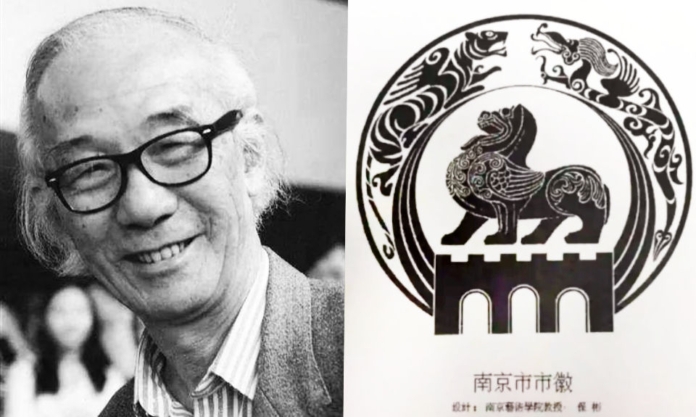



Former Dean and Painter of the Nanjing Academy of Arts, Bao Bin (保彬), passed away at 09:48 on 2 January, 2023. He was 87. The Baidu Baike (China’s Wikipedia equivalent) entry for Bao has today been made greyscale in his honour.
南京艺术学院前院长、画家保彬于 2023 年 1 月 2 日上午 9 点 48 分去世,享年 87 岁。今天,百度百科(中国的维基百科)中的保彬条目已灰度化,以纪念他。
Credited as the creator of the Nanjing emblem, during his lifetime, Bao received a special allowance from the State Council of the People’s Republic of China and had staged numerous exhibitions of his paintings in countries and regions far and wide.
包先生被誉为南京市徽的创造者,生前享受中华人民共和国国务院特殊津贴,并多次在世界各地举办画展。
Born March, 1936 in Baojiaxiang, in Nantong of Jiangsu, Bao was of Mongolian ethnicity. Admitted to the East China Art College in 1957, Bao transferred to the Fine Arts Department of the Nanjing Academy of Arts, from which he graduated in 1961. Remaining in the Academy to teach, Bao became that institution’s dean in 1983, reports the Yangtze Evening News.
1936年3月出生于江苏南通鲍家巷,蒙古族。据《扬子晚报》报道,包先生于1957年考入华东艺术专科学校,后转入南京艺术学院美术系,并于1961年毕业。包先生留在南京艺术学院任教,并于1983年担任该学院院长。
As a prolific and respected painter, Bao’s works have been exhibited in Canada, Indonesia, Japan, Singapore and USA, as well as Hong Kong and Taiwan.
作为一位多产且受人尊敬的画家,包氏的作品曾在加拿大、印度尼西亚、日本、新加坡、美国以及香港和台湾展出。
In Nanjing, the touch of Bao can be seen everywhere. The design of the lacquerware screen in Nanjing’s iconic Jinling Hotel is from the hand of Bao, comprising four Han Dynasty cypresses and 37 vibrant red crowned cranes.
在南京,包的感动随处可见。南京标志性金陵饭店的漆屏设计出自包先生之手,由四棵汉柏和37只生机勃勃的丹顶鹤组成。
Bao’s work is also to be found on another Nanjing icon, the famed Nanjing Yangtze River Bridge. It was his hand that brought us the relief works that adorn the Bridge’s guardrails.
鲍的作品也出现在南京的另一个标志性建筑——著名的南京长江大桥上。正是他的手给我们带来了装饰大桥护栏的浮雕作品。
But Bao will be best remembered for his work designing the city emblem for Nanjing, “Bixie” (辟邪).
但包先生最为人所铭记的是他为南京设计市徽“辟邪”的作品。
According to Bao’s personal memories, Nanjing began to seek out a possible city emblem in November of 1986. With nothing satisfactory received, Bao, who was one of the judges for the initiative, came up with his own concept. His plan was for a tiger to occupy a dragon’s seat in order to win over the past.
据包先生个人回忆,南京从1986年11月起就开始寻找可能的市徽。由于没有收到满意的结果,作为该倡议评委之一的包先生提出了自己的想法。他的计划是虎占龙座,以胜过往。
With the ancient city wall below the mythical creature, crowned by a tiger and dragon, so Nanjing’s official emblem was born. While less common today, it is still commonplace on account of its distinctive and unique Nanjing characteristics.
古城墙下有神兽,头戴虎龙,南京的官徽由此诞生。虽然现在已经不那么常见了,但由于其鲜明而独特的南京特色,它仍然很常见。
Bao was also a member of the China Artists Association, while his personal biographies are included in the Directory of Contemporary Chinese Artists, the Dictionary of Contemporary Chinese Painters, the Dictionary of Chinese Arts and Crafts, and the Dictionary of International Celebrities (国际名人大辞典).
鲍先生还是中国美术家协会会员,个人传记被收录于《中国当代美术家名录》、《中国当代画家辞典》、《中国工艺美术辞典》、《国际名人大辞典》等。