







Nanjing’s neighbouring city of Yangzhou is stereotypically famed for two things; pretty ladies and fried rice. While there is a lot to be said for both, in the bigger scheme of things, the city of Yangzhou was, historically, one of the wealthiest in China, and up there with the best as regards links with the outside world.
南京的鄰近城市揚州以兩件事而聞名;美女和炒飯。 虽然两者都有很多话要说,但从大局来看,从历史上看,扬州市是中国最富有的城市之一,在与外部世界的联系方面,它处于最佳城市。
In part, the city’s skills with lacquerware were responsible for its prolific domestic and international profile. During the Tang dynasty, Yangzhou lacquerware was in high demand, both as an imperial tribute and as an export. Lacquer colouring, lacquer carving, and the creation of cloth-inlaid, hollow-core pieces, among other techniques, grew increasingly sophisticated during this period.
在部分情况下,这座城市的漆器技能是其国内和国际知名度的多产原因。 在唐朝时期,扬州漆器的需求量很大,无论是作为皇室贡品还是作为出口品。 漆面着色、漆刻和制作布镶嵌、空心作品等技术在这一时期变得越来越复杂。
By the time the Republic of China was founded in 1912, sales of Yangzhou’s lacquerware had grown so large that on average a ship laden with products was sent out from the city’s port 2-3 times a month.
到1912年中华民国成立时,扬州的漆器销量已经如此之大,平均每月有一艘装有产品的船从该市的港口出港2-3次。
Yangzhou lacquerware has seen a renaissance in recent decades, with the sity China’s most important production centre for lacquerware, standing out as the most deeply-imbued with local culture, reflecting its grace and elegance, and demonstrating the exquisite and refined tastes of the city’s inhabitants. By way of example, tens of thousands of lacquerware art pieces discovered during the excavation of Han dynasty tombs can be seen in the Yangzhou Museum today.
近几十年来,扬州漆器经历了复兴,作为中国最重要的漆器生产中心,作为最深厚的当地文化脱颖而出,反映了其优雅和优雅,展示了城市居民精致品味。 举例来说,今天在扬州博物馆可以看到在发掘汉朝古墓时发现的数以万计的漆器艺术品。



But the story of the city’s growth is not without flaw. A major port for foreign trade since the Tang dynasty (618–907 CE), with many an Arab and Persian merchant within the then city walls, in the 7th century, Yangzhou’s only chink in its armour was the massacre, in the thousands, of many of the aforementioned in 760 during the An Lushan Rebellion.
但这座城市的发展故事并非没有缺陷。 自唐朝(公元618-907年)以来,作为对外贸易的主要港口,当时的城墙内有许多阿拉伯和波斯商人,在7世纪,扬州唯一的缺口是760年安禄山叛乱期间,上述许多人被屠杀了数千人。
The tourists keep on coming, however, for the food, the city’s canals as a poster child showing that Jiangsu’s water towns are not only confined to areas south of the Yangtze, and for the hot spas that are also something of a local delicacy.
然而,游客们不断前来,为了美食,城市的运河作为海报儿童,表明江苏的水乡不仅局限于长江以南地区,还有温泉,这也是当地美食。
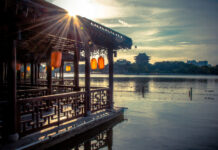
They can be found around Slender West Lake, with its weeping willows entirely surrounding the snaking waters. Here, the number 24 is a big deal for Yangzhou and its Slender West Lake. During Emperor Qianlong’s reign of the Qing Dynasty (1644-1911 CE), the lake became well known for 24 scenic spots. The best known of all is 24 Bridge, named as a nod to its 24 parapets and 24 steps. The Five Pavillion Bridge, therefore, also needs no further introduction.
它们可以在斯伦德西湖周围找到,它的垂柳完全环绕着蛇水。 在这里,数字24对扬州及其纤细的西湖来说是件大事。 在清朝(公元1644-1911年)乾隆皇帝位期间,该湖以24个景点而闻名。 最著名的是24桥,因其24个护栏和24个台阶而得名。 因此,五亭桥也不需要进一步介绍。

Yangzhou is also famed for being the home town for much-respected former Chinese leader Jiang Zemin, while in 2019, UNESCO granted Yangzhou status as World Capital of Gastronomy. Responsible for this, the aforementioned fried rice, in addition to local classics such as Lion’s Head Meatball.
扬州还以备受尊敬的中国前领导人江泽民的故乡而闻名,而2019年,联合国教科文组织授予扬州世界美食之都的地位。 对此负责的是上述炒饭,以及狮子头肉丸等当地经典菜肴。
As testament to its culinary standing, Yangzhou cuisine can be found served up as both a taste of home for some and treat for visitors to Jiangsu, with authentic local dishes often available on select high-speed trains operating in the region.
作为其烹饪地位的证明,扬州美食既可以作为对某些人的家的味道,也可以作为对江苏游客的美食,在该地区运营的精选高速列车上经常提供正宗的当地菜肴。
It’s a development which serves well as a metaphor for the city’s recent growth. In fact, it was not until 2004 that a railway linked Yangzhou with Nanjing for the first time. Similarly, it was only in the past few years that the Yangzhounese could finally take a direct train to Shanghai.
这是一个很好的发展,可以作为城市最近增长的隐喻。 事实上,直到2004年,一条铁路才首次连接扬州和南京。 同样,直到过去几年,揚州人才终于可以乘坐直達上海的火车。
Yangzhou is 1 hour by high-speed train from Nanjing and about 2 hours from Shanghai. Yangzhou also shares an airport with neighbouring Taizhou City, the Yangzhou Taizhou International Airport, often simply called Yangtai Airport, about 30 kilometres from downtown Yangzhou.
扬州距离南京高铁1小时,距离上海约2小时。 扬州还与邻近的台州市共享一个机场,扬州台州国际机场,通常简称为扬台机场,距离扬州市中心约30公里。