

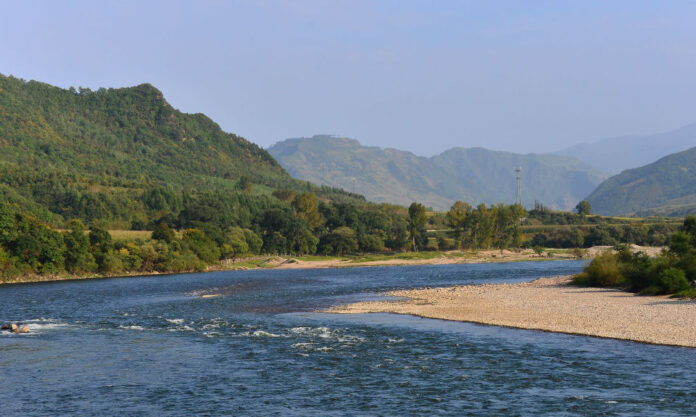

Nearly 200 springs in the mountains around Baishan flow a combined 455,000 cubic metres of water a day, and the city says an international drinking-water organisation named it China’s International Mineral Water City in 2004.
白山境内近两百处泉眼,日流量合计达四十五万五千立方米;当地称,二零零四年一家国际饮水资源保护组织将白山命名为”中国·白山国际矿泉城”。
Jingyu county got there first: in 2000 the mineral water committee of the China Mining Association named it the country’s first mineral water city. Today Jingyu, Fusong, Linjiang, Changbai and Jiangyuan all sit inside the protected origin zone for Changbai Mountain natural mineral water.
靖宇县起步更早:二零零零年,中国矿业联合会天然矿泉水专业委员会授予它”中国长白山靖宇矿泉城”的称号,这是全国第一座”矿泉城”。如今,靖宇、抚松、临江、长白和江源,都在长白山天然矿泉水地理标志保护范围之内。
Baishan’s 30 bottlers hold more than 70 percent of Jilin’s mineral water capacity and produce more than 80 percent of its output, the Jilin Daily reports, so the city is less one producer among many than the place most of the province’s water comes from. Fusong produced 1.62 million tonnes in 2024, about half its 3.21 million tonnes of design capacity, according to China Jilin Network, and Jingyu 1.68 million tonnes worth ¥2.028 billion, according to the Jilin government.
据《吉林日报》报道,白山的三十家矿泉水企业占吉林全省产能的七成以上、产量的八成以上,与其说白山是众多产区中的一个,不如说它就是全省大部分矿泉水的来源地。据中国吉林网报道,抚松县二零二四年产量一百六十二万吨,约为其三百二十一万吨设计产能的一半;据吉林省政府介绍,靖宇县产量一百六十八万吨,产值二十点二八亿元。
Bottling Lines and a Ski Resort
灌装线与滑雪场
The scale becomes clearer at the bottling plants. Quanyangquan, which fills at Fusong, sold 1.5 million tonnes in 2025 and wants more than 2 million this year, according to People’s Finance Network, and Nongfu Spring’s Linjiang plant, built for 1.19 million tonnes a year, began production in 2023.
灌装厂的规模更能说明问题。据人民财经网报道,在抚松灌装的泉阳泉二零二五年销量达一百五十万吨,今年力争突破二百万吨;年产一百一十九万吨的农夫山泉临江工厂,则已于二零二三年投产。
Fusong is also home to the Wanda Changbai Mountain International Resort, whose ski area opened on 30 November 2012 with 43 trails stretching more than 30 kilometres and seven lifts.
抚松还是万达长白山国际度假区所在地,其滑雪场于二零一二年十一月三十日开业,拥有四十三条雪道,总长超过三十公里,另有七条缆车线路。
A Dam, a Border County and a Shrinking City
一座大坝、一个边境县与不断缩小的城市
The Baishan Dam stands on the Second Songhua River where Jingyu county meets Huadian, 149.5 metres high and 676.5 metres along its crest. Engineers closed the river in 48 hours on 21 October 1976, and the reservoir began filling in November 1982. With 1.5 gigawatts installed, it is described as the largest hydropower station in north-east China. The city is younger than the dam; it took the name Baishan only in April 1994, when Hunjiang was renamed.
白山大坝矗立在第二松花江上、靖宇县与桦甸市交界处,坝高一百四十九点五米,坝顶弧长六百七十六点五米。一九七六年十月二十一日,工程人员用四十八小时截断河流,水库于一九八二年十一月开始蓄水;电站总装机一百五十万千瓦,被称为东北地区最大的水电站。这座城市比大坝还年轻:直到一九九四年四月,浑江市更名,才有了”白山”这个名字。
Across the Yalu from Hyesan, Changbai Korean Autonomous County has been China’s only Korean autonomous county since 15 September 1958. Its 260.5-kilometre border follows the river, and the county says it is the only border county in China that directly adjoins a neighbouring country’s provincial capital, with only the river between them. Koreans make up 16.8 percent of its 70,200 registered residents.
隔着鸭绿江与惠山相望的长白朝鲜族自治县,自一九五八年九月十五日设立以来,一直是全国唯一的朝鲜族自治县。其二百六十点五公里的边境线沿江延伸;据县政府介绍,这里是我国边境线上唯一与邻国省会城市”零公里毗邻”的县份,两地之间只隔一条江。全县户籍人口七点零二万人,朝鲜族占百分之十六点八。
Baishan itself is shrinking. It ended 2025 with 875,300 permanent residents, 13,500 fewer than a year earlier, after 2,300 births and 9,500 deaths, more than four deaths for every birth, according to its statistical communiqué; GDP for the year was ¥59.017 billion.
白山自身的人口正在减少。据白山市二零二五年统计公报显示,年末常住人口八十七点五三万人,比上年少一点三五万人;全年出生二千三百人,死亡九千五百人,每出生一人就有四人多去世;全年GDP为五百九十点一七亿元。
Until 28 September 2025 Baishan had no high-speed rail. That day the Shenyang–Baihe section of the Shenyang–Jiamusi line opened, with stations in the city at Baishan East, Jiangyuan East and Changbai Mountain West.
二零二五年九月二十八日之前,白山不通高铁。这一天,沈佳高铁沈白段开通运营,线路在境内设有白山东、江源东和长白山西等车站。
Of Changbai county’s 260.5-kilometre border, only 3.5 kilometres is on land; the other 257 kilometres run down the Yalu, whose water surface the two countries share, according to the county’s profile.
据县情介绍,长白县二百六十点五公里的边境线中,陆界仅三点五公里,其余二百五十七公里沿鸭绿江水界延伸,江面为中朝两国共有。