







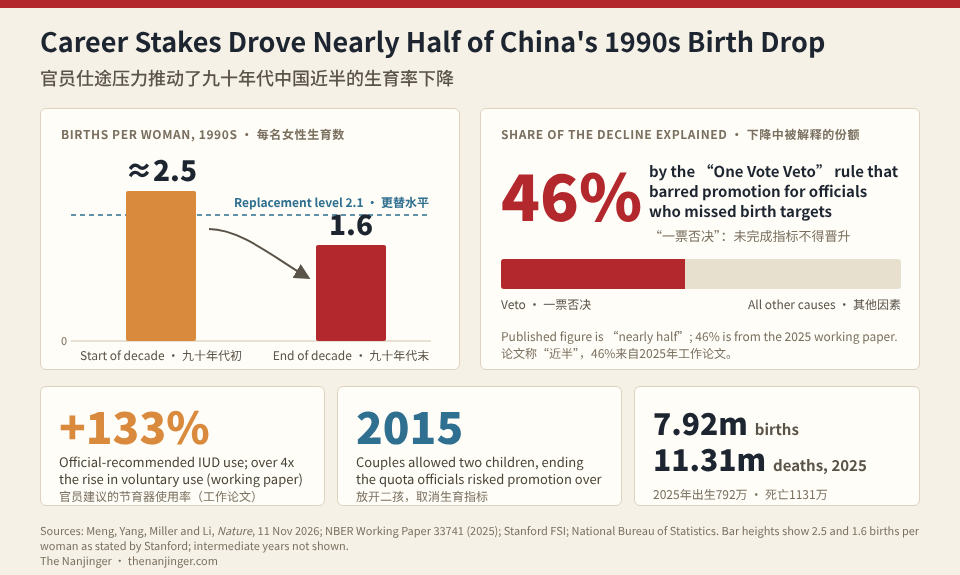
Chinese local officials in the 1990s could be barred from promotion if their area missed its birth targets, and that single rule is now estimated to explain nearly half of the sharp fall in China’s fertility that decade.
九十年代,中国地方官员若所辖地区未完成生育指标,就可能失去晋升资格;据最新估算,仅这一条规定就能解释当年生育率急剧下降的近一半。
It was known as the One Vote Veto (一票否决).
这条规定被称为“一票否决”。
The One Child Policy began in 1979 and 1980, yet fertility barely moved for another decade. Then it fell from about 2.5 births per woman to 1.6 during the 1990s, well below the replacement level of about 2.1. Leaders had been worried; the population had nearly doubled from about 540 million in 1949 to almost a billion by 1980, and planners expected more than 1.3 billion by 2000.
独生子女政策始于1979年至1980年,但此后十年生育率几乎没有变化。到了九十年代,它才从每名女性约2.5个孩子降至1.6个,远低于约2.1的更替水平。决策者当时忧心忡忡;全国人口已从1949年的约5.4亿几乎翻番,到1980年接近10亿,规划者预计到2000年将超过13亿。
The Rule that Froze Careers
冻结仕途的规定
As a paper in Nature published on 11 November reports, researchers from Stanford University and Renmin University of China set out to explain that delay. The authors are Lingsheng Meng, Hanmo Yang, Grant Miller and Hongbin Li. They noted that provinces adopted the veto at different times, which let them compare places with the rule against places without it.
据11月11日发表于《自然》的一篇论文介绍,斯坦福大学和中国人民大学的研究人员试图解释这一滞后现象。作者为孟令生、杨汉墨、格兰特·米勒和李宏彬。他们指出,各省实行“一票否决”的时间并不一致,因此可以把已实行的地区与尚未实行的地区进行对比。
Their finding is that the veto explains nearly half of the 1990s decline. An earlier 2025 working paper by the same four authors put the figure at 46 percent. IUDs, the most common modern contraceptive in China, were a key channel, particularly those recommended by local officials. In the working paper, officials’ recommended IUD use rose by 133 percent, more than four times the rise in voluntary use.
他们的结论是,“一票否决”解释了九十年代生育率下降的近一半。同四位作者2025年的一份工作论文给出的数字是46%。宫内节育器是中国最常见的现代避孕方式,也是一个关键渠道,尤其是由基层官员“建议”使用的那一类。在这份工作论文中,官员建议使用节育器的比例上升了133%,增幅是自愿使用增幅的四倍多。
Abortions did rise in later years, but that increase did not closely match the timing of the first drop in births.
引产和人工流产的数量在随后几年确实有所上升,但这一增长与最初生育率下降的时间并不吻合。
Li said the policy “became much more effective when local officials faced strong career incentives to enforce it”. Yang said the effectiveness of government policies “depends not only on their design” but on the incentives of the officials who carry them out.
李宏彬表示,当地方官员面临强烈的仕途激励去执行时,这项政策“变得有效得多”。杨汉墨则说,政府政策是否有效,“不仅取决于设计”,还取决于执行官员的激励。
What that looked like on the ground is described in a 2018 account republished by China Digital Times. In 1991, Guan county in Shandong ran a campaign called “100 days without babies”, from 1 May to 10 August. Before it began, the county Party secretary told township leaders to step aside if they could not meet the target; two township Party secretaries who cited local difficulties were reportedly handcuffed, held for half a month and investigated, and the county was put under a “yellow card” warning.
这在基层是什么样子,中国数字时代转载的一篇2018年文章有所描述。1991年,山东冠县开展了“百日无孩”行动,从5月1日持续到8月10日。行动开始前,县委书记要求乡镇领导完不成指标就让位;两名以当地困难为由推脱的乡镇党委书记据称被戴上手铐、关押半个月并接受调查,该县也被亮了“黄牌”。
Fewer Births, Fewer Rules
生得越来越少,规矩越来越少
The authors say economic development and social change also mattered, but that enforcement explains more of the fall than earlier research suggested. Other work points the other way on what drives births today. A paper summarised by Stanford’s Center on China’s Economy and Institutions found that China’s 2016 two-child policy raised births by only about 4.1 percent in 2016 and 2017, and concluded that low desire for children, not policy restrictions, is now the main constraint.
作者表示,经济发展和社会变迁同样起了作用,但执法力度对生育率下降的解释力比以往研究所认为的更大。至于如今是什么在左右生育,另有研究给出了不同方向的答案。斯坦福大学中国经济与制度研究中心介绍的一篇论文发现,中国2016年的全面二孩政策只使2016年和2017年的出生人口增加了约4.1%,并得出结论称,当前的主要制约是生育意愿低,而非政策限制。
That paper drew on the 2017 China Fertility Survey, which covered 249,946 women. It found that 32 percent wanted one child and 55 percent wanted two, and it estimated that even if every woman had exactly the number she wanted, births would rise by at most 24 percent above 2015 levels.
该论文使用了2017年中国生育状况调查的数据,覆盖249,946名女性;结果显示,32%的女性希望生一个孩子,55%希望生两个,并估算即便每位女性都生下自己理想的数量,出生人口也最多只比2015年高24%。
The quota that officials once risked their promotions over was lifted in 2015, when couples were allowed two children. In 2025 China recorded 7.92 million births against 11.31 million deaths, leaving a population of about 1.405 billion, down 3.39 million on the year.
曾让官员冒着晋升风险去完成的生育指标,在2015年放开二孩时被取消。2025年,中国出生人口为792万,死亡人口为1131万,年末总人口约14.05亿,比上年减少339万。