



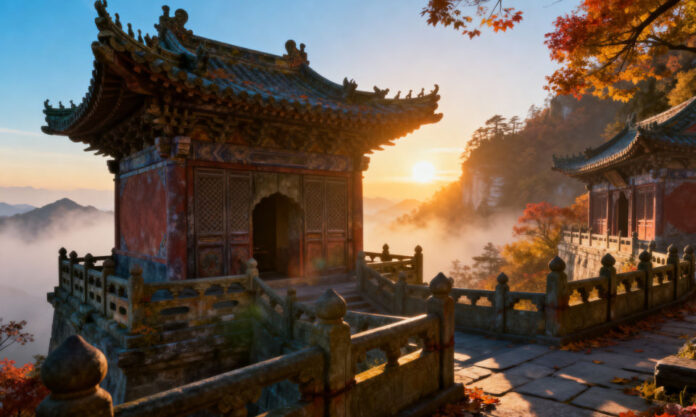



Monks at Wudang’s Golden Peak still light incense at 1,612 metres, on one of the steepest summits in the Taoist canon; Mi Fu, a Song dynasty painter, is said to have called this range the foremost mountain under heaven.
武当山金顶海拔一千六百一十二米,僧人至今仍在此焚香祈福,是道教名山中地势最为险峻的峰顶之一;相传宋代书画家米芾曾赞誉这座山为”天下第一山”。
The Yongle Emperor ordered large-scale construction of Taoist temples and monasteries here in 1412, and the complex that resulted, spread across some 400 square kilometres, is now listed by UNESCO as a World Heritage Site; popular tradition also credits the mountain, and the monk Zhang Sanfeng in particular, with the origins of tai chi.
明成祖朱棣于一四一二年下令在此大规模营建道观庙宇,由此形成的建筑群占地约四百平方公里,如今已被联合国教科文组织列入世界遗产名录;民间传统也普遍将太极拳的起源,归功于这座山与武当道士张三丰。
In the 1960s, the Chinese government chose the mountains just west of Wudang for the Second Automobile Works, predecessor to today’s Dongfeng Motor Corporation, part of the state’s “Third Front” programme of relocating industry inland, away from China’s coastline. Large-scale construction began on 28 September 1969, and the surrounding settlement, built up around the factory’s scattered production sites, was formally established as Shiyan city in 1975.
二十世纪六十年代,中国政府将武当山以西的山区,选定为第二汽车制造厂(即今日东风汽车公司的前身)的厂址,这正是国家”三线建设”战略的一部分,旨在将工业设施迁往远离沿海的内陆地区。工厂于一九六九年九月二十八日正式开工建设,而围绕分散布局的各个生产厂区逐渐形成的聚落,于一九七五年正式设市,定名十堰。
Built to Hide from a War that Never Came
一座为躲避一场未曾发生的战争而建的城市
According to an account published on Dongfeng’s own corporate website, Chen Zutao, the factory’s chief engineer and effectively the city’s designer, later reflected that building in the mountains had been meant to avoid creating a city at all; the presence of hundreds of thousands of workers and their families made that impossible, and Shiyan grew up regardless. By 1985, the same account notes, the factory’s output, profits and tax contributions each accounted for more than 60 percent of the entire Chinese automobile industry’s totals.
据东风汽车公司官网发布的相关报道,该厂总工程师、事实上也是这座城市规划者的陈祖涛,后来曾回忆道,当初选址山区,原是为了避免建成一座城市;但数十万工人及其家属的现实存在,令这一设想终究落空,十堰还是发展成了一座城市。据同一篇报道显示,到一九八五年,该厂的产量、利润与税收,均占到了全国汽车工业总量的六成以上。
A City that Watched Its Own Valleys Fill with Water
一座眼见自家河谷蓄水成湖的城市
Roughly 345,000 people living around the Danjiangkou reservoir, upstream of the city, were relocated to more than 600 newly built villages to make way for the South-to-North Water Diversion Project’s central route, which began sending water north from here in December 2014. Ten districts of Beijing have since built long-term partnership agreements with Shiyan, contributing ¥2.25 billion in aid over the following decade, according to a report carried by China Daily.
丹江口水库上游一带,约有三十四万五千名居民为南水北调中线工程让路,搬迁至六百多个新建村庄;该工程于二零一四年十二月正式通水北送。据《中国日报》报道,作为回馈,北京十个区此后与十堰建立了长期对口合作关系,十年间累计提供援助资金二十二亿五千万元人民币。
Nearly two out of every three cups of water drunk in Beijing now trace back to this reservoir, arriving after a fifteen-day journey along canals and pipelines that pass beneath the Yellow River itself.
如今,北京市民所饮用的每三杯水中,便有近两杯源自这座水库,历经十五天的旅程,沿运河与管道一路北上,途中甚至要穿越黄河河底。
According to the city’s own 2024 economic communiqué, Shiyan’s permanent population stood at 3.1422 million that year, with GDP reaching ¥256.6 billion, up 6.5 percent on the previous year; per capita output came to ¥81,515.
据该市自身发布的二零二四年经济统计公报显示,当年十堰常住人口为三百一十四点二二万人,GDP达二千五百六十五点八四亿元,同比增长百分之六点五;人均产值为八万一千五百一十五元。
Getting to Shiyan changed considerably in 2026; the Xi’an-Shiyan high-speed railway opened on 30 June that year, a 255.7-kilometre line running at speeds up to 350 kilometres per hour and crossing the Qinling Mountains through a tunnel measuring 23 kilometres, the longest on the route. Wudangshan Airport, closer to the mountain itself, continues to handle domestic flights for pilgrims and tourists who would rather skip the drive entirely.
前往十堰的交通,在二零二六年发生了显著变化;西十高铁于当年六月三十日正式通车,全长二百五十五点七公里,最高时速达三百五十公里,沿线穿越秦岭山脉的隧道长达二十三公里,是全线最长的隧道。距武当山更近的武当山机场,则继续为不愿驱车前往的香客与游客提供国内航班服务。
Pilgrims still climb to the Golden Peak on foot, incense in hand, past a factory town, a submerged valley and a mountain tunnel that between them explain most of what Shiyan has become.
香客们至今仍手持香火,徒步登上金顶,沿途经过一座因工厂而兴的城镇、一片被淹没的河谷,以及一条穿山而过的隧道——这三者,几乎道尽了十堰之所以成为今日模样的全部缘由。