



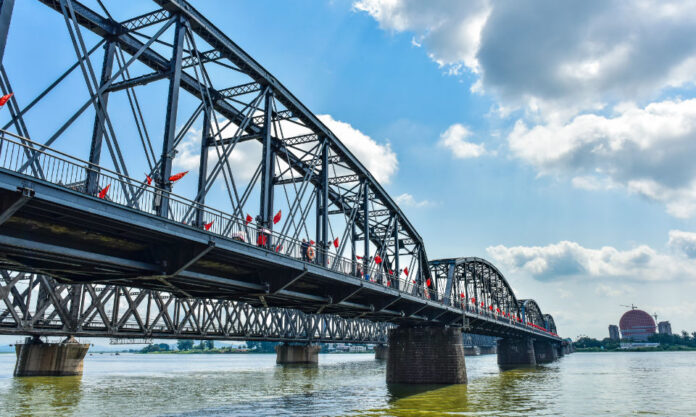


Ferries do not run here anymore, but the crowd on the Broken Bridge does not seem to mind. By eight each morning, tour groups are already three deep at the ticket gate, ¥30 apiece, craning for a look at Sinuiju on the far bank.
渡船早已不再运营,但这并不妨碍断桥边的人潮。每天早上八点,旅行团已在售票口排起三层长队,每人¥30,只为一睹对岸新义州的模样。
The Yalu River Broken Bridge stops abruptly at the halfway point; beyond it, only a line of bare support pillars marches out across the water, all that survives of the section American bombers destroyed in November 1950. Bullet scars still pit the remaining girders. Visitors walk to the end, take the obligatory photograph with North Korea as a backdrop, then turn back the way they came, because there is nowhere else to go.
鸭绿江断桥在河道中央戛然而止;桥的尽头之外,只剩下一排光秃秃的桥墩延伸至江面,那是一九五零年十一月被美军炸毁的部分留下的仅存痕迹。残存的桥梁上仍可见弹痕累累。游客们走到桥的尽头,以朝鲜为背景拍下必不可少的照片,随后原路返回,因为再无他处可去。
That contrast is the whole point of the visit. On the Dandong side, neon signs burn late into the night, plenty of them in Korean script aimed squarely at the view from across the water. On the Sinuiju side, after dark, there is mostly darkness. North Koreans on their own riverbank can see all of it; the lights, the restaurants, the tour boats; close enough to make out, far enough to stay forever out of reach.
而这种反差正是此行的意义所在。丹东一侧,霓虹灯彻夜燃亮,不少招牌上还印着朝鲜文字,径直对着河对岸的方向。新义州一侧,入夜后则多是一片漆黑。朝鲜人站在自己的江岸边,能将这一切尽收眼底——灯光、餐馆、游船——近得看得清楚,却远得永远无法触及。
A City Built around Its Border
一座因边境而生的城市
Dandong itself is easy to overlook on a map, tucked into the southeastern corner of Liaoning where the Yalu meets the Yellow Sea, yet it is China’s largest city bordering North Korea, home to some 2.2 million people. According to a Baiduwiki entry compiled from local government records, the prefecture-level city recorded a GDP of roughly ¥100 billion in 2024, with port operations, logistics and manufacturing carrying the load once cross-border trade with North Korea slows.
丹东在地图上并不起眼,坐落于辽宁省东南角、鸭绿江与黄海交汇之处,却是中国与朝鲜接壤的最大城市,人口约二百二十万。据地方政府资料汇编的百度百科词条显示,该地级市二零二四年GDP约为一千亿元人民币,港口运营、物流与制造业撑起了经济,尤其在对朝贸易放缓之时。
That trade runs through Dandong Port, which reportedly connects with more than 100 harbours across over 90 countries, and through the ordinary shopfronts of Zhenxing District, where signage runs in Mandarin, Korean and, on the older buildings, faded traces of Manchu script; a reminder that the city’s Han majority shares its streets with sizeable Manchu and ethnic Korean communities.
这些贸易往来经由丹东港展开——据称该港与九十多个国家的一百余个港口通航——也体现在振兴区寻常商铺的招牌上,那里同时使用汉语、朝鲜语,老建筑上偶尔还能瞥见满文的残迹,提醒人们这座以汉族为主的城市,街头也生活着为数不小的满族与朝鲜族群体。
A Museum That Leaves Little Room for Doubt
一座不留质疑余地的博物馆
Getting to the bridge means passing through the Museum to Resist US Aggression and Aid Korea first, since most tour buses stop there before the river. The exhibits are unambiguous about who won and by how much. Visitors move through room after room of dioramas and captured weaponry, and few appear to pause over the casualty figures on display, though independent historians have long disputed the scale of losses attributed to either side.
前往断桥之前,大多数旅游大巴会先在抗美援朝纪念馆停留。馆内展陈对于谁赢了、赢了多少毫不含糊。游客们穿行于一间又一间的场景模型与缴获武器展厅之间,鲜有人在展出的伤亡数字前驻足细想,尽管独立史学界长期以来对双方伤亡规模的说法存在争议。
According to a report carried by China Daily, the museum has become one of the most visited patriotic education sites in the country’s northeast, drawing school groups by the coach load throughout the year. Nothing in the building invites a visitor to ask where those numbers came from.
据《中国日报》报道,该馆已成为中国东北地区参观人数最多的爱国主义教育基地之一,常年吸引一车又一车的学生团体前来。馆内没有任何展陈会促使参观者去追问这些数字的来源。
Out on the river, tour boats loop close to the mid-point, close enough that operators sometimes gesture at fishermen and soldiers on the North Korean bank as though they were exhibits too. One boat pilot, asked how near he was permitted to sail, simply shrugged and said the border was “wherever the water gets shallow”; not an official answer, but the one visitors actually get.
江面上,游船会绕行至江心附近,近到船工有时会指着朝鲜岸边的渔民和士兵,仿佛他们也是展品一般。被问及船只被允许驶近到何种程度时,一位船工只是耸耸肩,说边界”哪里水浅就到哪里”——这并非官方说法,却是游客实际得到的答案。
Moored near the new bridge is the destroyer Dandong, hull number 543, retired from active service and turned into a floating museum of its own. It draws a smaller crowd than the Broken Bridge, and for good reason; foreigners are not allowed aboard. Even holders of Chinese permanent residence permits are turned away at the gangway, a rule enforced without much explanation beyond a pointed look at the relevant passport page.
新桥附近停泊着已退役的丹东舰,舷号543,如今被改建为一座水上博物馆。它吸引的游客比断桥少得多,原因也很明确;外国人不得登舰参观。即便持有中国永久居留身份证的外国人,也会在舷梯口被拦下,理由并不多加解释,顶多是对护照相关那一页多看几眼。
Getting to Dandong at all has become considerably easier in recent years. High-speed trains from Shenyang cover the roughly 220 kilometres in under two hours, while a separate line reaches Dalian along the coast; Dandong Langtou Airport, closed for a runway extension through much of 2025, resumed flights in April 2026 with domestic routes to Beijing, Shanghai and several other cities. Summers are mild and green, winters cold and dry, and locals often describe their city, only half-joking, as the most liveable in China’s northeast on account of its clean air and forest coverage.
如今前往丹东已比过去容易许多。从沈阳出发的高铁,大约二百二十公里的路程,不到两小时即可抵达;另有一条线路沿海岸直通大连;丹东浪头机场在二零二五年因跑道扩建工程停飞大半年后,已于二零二六年四月恢复运营,开通往返北京、上海等多个城市的国内航线。当地夏季温和多绿,冬季寒冷干燥,本地人常半开玩笑地说,凭借清新的空气与森林覆盖率,丹东堪称中国东北最宜居的城市。
None of these restrictions, or the traffic, seem to dampen the tourist trade. Dandong’s economy leans heavily on the flow the border generates, from souvenir stalls selling fake North Korean banknotes to restaurants advertising “authentic Korean” barbecue; whatever the provenance of the meat, after three decades of eating across China, this correspondent rates Dandong’s barbecue the best found anywhere in the country.
无论是这些限制,还是交通的不便,似乎都未影响旅游生意。丹东的经济在很大程度上依赖边境带来的人流,从贩卖仿制朝鲜纸币的纪念品摊位,到打着”正宗朝鲜”烤肉招牌的餐馆,不一而足;但无论肉的来源如何,在中国生活三十三年、吃遍大江南北之后,本记者认为丹东的烤肉是全国最好吃的。
What stays with a visitor, more than the museum or the warship, is the bridge itself; specifically, the moment of standing at its broken end, looking at a country close enough to throw a stone into and impossible to reach any other way. Sinuiju’s rooftops are visible, ordinary and still, while behind you Dandong’s lights are already coming on for the evening.
比起博物馆或军舰,真正让人久久难忘的还是那座桥本身;确切地说,是站在断桥尽头的那一刻——望着一个近得仿佛投石可及、却又无从抵达的国度。新义州的屋顶清晰可见,普通而静止,而身后丹东的灯光,已在为夜晚悄然亮起。
That gap, ¥30 wide and a few hundred metres across, is what draws the queues back every morning at eight. Whatever else changes in Dandong, the crowd at the Broken Bridge keeps forming before the gates even open.
那道鸿沟,宽不过¥30一张门票,横跨不过几百米江面,却正是每天早上八点吸引人群再度排队的原因。不论丹东其他方面如何变化,断桥前的人潮,总是在大门开启之前便已聚集。