



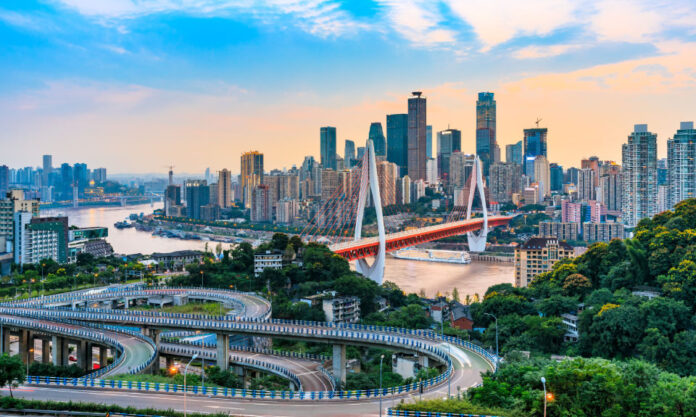



Every few minutes a monorail train glides into the side of a residential tower block at Liziba, stops to let passengers off inside the building and glides out the other side. In late 1937, those same hills offered refuge to a national government forced to abandon Nanjing.
每隔几分钟,就有一列轻轨驶进李子坝的一栋居民楼,在楼里停车上下客,再从另一侧驶出。一九三七年末,正是这片山地,为被迫撤离南京的国民政府提供了庇护。
The hills shaped the trains. The war shaped the city.
山塑造了轻轨,战争塑造了这座城。
Chongqing is China’s only inland municipality directly administered by the central government, separated from Sichuan in 1997. Its administrative territory, which includes extensive rural and mountainous areas, covers some 82,400 square kilometres, roughly the size of Austria. It had 31.87 million residents at the end of 2025, 73 percent of them in towns and cities. The old centre sits on a peninsula where the Jialing River meets the Yangtze.
重庆是中国唯一地处内陆的直辖市,一九九七年从四川划出。其行政辖区包括广阔的乡村和山地,面积约八万二千四百平方公里,与奥地利相当。二〇二五年末常住人口三千一百八十七万,城镇化率百分之七十三。老城区坐落在嘉陵江与长江交汇处的半岛上。
A Capital in the Fog
雾中陪都
On 20 November 1937, just over three weeks before Nanjing fell to Japanese forces, the Nationalist government announced its relocation to Chongqing. The Paper recounts that on 5 September 1940 the city was formally designated the auxiliary capital, and that by the end of that year 429 factories had moved there. The shipping magnate Lu Zuofu directed his Minsheng Company fleet for 40 days and nights, ferrying people and industrial equipment upriver from Yichang under Japanese air attack.
一九三七年十一月二十日,就在南京沦陷前三周多,国民政府宣布移驻重庆。据澎湃新闻介绍,一九四〇年九月五日,重庆被明令定为陪都;到当年年底,先后迁渝的各类工厂达四百二十九家。实业家卢作孚顶着日机轰炸,指挥民生公司船队在四十个日日夜夜里,从宜昌把人员和工业设备抢运到重庆。
Why here? A deputy director of the Chongqing War of Resistance Sites Museum told Global People that the city, wrapped by two rivers and backed by mountains, was “veiled in thick fog, easy to defend and hard to attack”. The fog did not stop the bombers. From 1938 to 1944, Japanese aircraft flew nearly 10,000 sorties against Chongqing and dropped about 20,000 bombs in more than 200 raids, according to Our China Story. More than 30 countries established diplomatic missions in wartime Chongqing.
为什么选重庆?重庆抗战遗址博物馆副馆长钱峰向《环球人物》介绍,重庆位于两江交汇处,“襟江背岭,浓雾蔽城,易守难攻”。浓雾挡不住轰炸。据“当代中国”网站介绍,一九三八年至一九四四年,日军出动近万架次飞机,投下约两万枚炸弹,对重庆发动二百多次轰炸。三十多个国家曾在抗战时期的重庆设立外交机构。
The shelters outlived the war. The same site notes that many have since been turned into markets and road tunnels, and local guides list hotpot restaurants operating inside former shelters, where the rock keeps diners cool even in midsummer.
战争早已结束,防空洞却沿用至今。据该网站介绍,许多防空洞后来被改造成菜市场和地下通道;当地美食指南还推荐了开在防空洞里的“洞子火锅”,即使盛夏,洞内也颇为凉爽。
A City in Eight Dimensions
8D山城
Chongqing’s terrain has earned it the online nickname “8D city”, and Liziba station, which opened on a trial basis in 2004, has become its most recognisable symbol. Chongqing Morning Post reported that the design team at Chongqing University considered rerouting the line or building the flats elsewhere, but the rail company and the developer chose to build station and apartments together to save money.
重庆的地形为它赢得了“8D魔幻城市”的网络昵称,二〇〇四年试运营的李子坝站则成了最具辨识度的城市景观。据《重庆晨报》报道,重庆大学设计团队曾考虑过轨道改线、开发商另辟地建楼等方案,最终轨道公司和开发商为节约成本,决定把车站和住宅楼合建在一起。
People were building into the slopes long before the monorail. Beijing News notes that Hongyadong, a river cargo hub lined with stilt houses in the Republican era, was rebuilt between 2002 and 2006 in reinforced concrete styled after the old stilt houses, with entrances on both its 1st and 11th floors. Nearby Baixiangju, a 1992 apartment block, was built without lifts because most of its residents were boatmen and porters who could not afford the maintenance. Instead, it uses a 38-metre slope to give it entrances on the 1st, 10th and 15th floors, each opening onto a different street.
早在轻轨出现之前,重庆人就已依山而建。据《新京报》介绍,洪崖洞在民国时期是河运货物集散地,布满吊脚楼;二〇〇二年至二〇〇六年改建为钢筋混凝土结构,延续了传统吊脚楼的建筑风貌,一楼和十一楼都设有入口。附近建于一九九二年的白象居没有电梯,因为住户大多是依托川江谋生的船工和搬运工,负担不起电梯养护费用;它借助三十八米的高差,在一楼、十楼、十五楼分别设置出入口,各自通向不同的街道。
The city’s older art is cut into rock. Dazu, in western Chongqing, holds more than 50,000 carved figures across 75 protected sites, begun in the early Tang and reaching their artistic peak during the Song dynasty, China News Service reports. The Dazu Rock Carvings were inscribed on UNESCO’s World Heritage List in December 1999, China’s second cave-temple site after the Mogao Caves at Dunhuang. In inscribing them, UNESCO noted how Buddhist, Taoist and Confucian figures share the same rock faces.
更古老的艺术,则刻在岩石上。据中新社报道,重庆西部的大足境内有七十五处文物保护单位、五万余尊石刻造像,始建于初唐,两宋达到艺术巅峰。一九九九年十二月,大足石刻被联合国教科文组织列入《世界遗产名录》,成为继敦煌莫高窟之后中国第二个石窟类世界文化遗产。世界遗产委员会在列入时特别指出,佛、道、儒三教造像在这里和睦共存。
The Furnace and the Hotpot
“火炉”与火锅
Chongqing, Wuhan and Nanjing were grouped together as the “three furnaces of the Yangtze” in the 1950s, Yangtse Evening Post reported. The traditional grouping does not entirely hold up against modern climate data. A 2012 National Climate Centre ranking of summer heat across provincial capitals and municipalities put Chongqing first and Nanjing eighth.
据《扬子晚报》报道,重庆、武汉、南京在上世纪五十年代被并称为“长江流域三大火炉”。如今,这一传统说法已不完全符合现代气候数据。二〇一二年,中国气象局国家气候中心对各省会城市和直辖市的夏季炎热程度进行排名,重庆位居第一,南京排第八。
The summer of 2022 confirmed the reputation. A study of that heatwave records that the temperature in Chongqing’s Beibei district reached 45°C in August, which its authors describe as the first 45°C reading in China outside Turpan.
二〇二二年的极端高温,再次印证了重庆的“火炉”之名。一项关于当年高温的研究记录,当年八月重庆北碚最高气温达到四十五摄氏度;研究者指出,这是中国首次在吐鲁番以外出现四十五摄氏度高温。
The city answers heat with heat. Its hotpot is often said to have been invented by boatmen and trackers on the docks at Chaotianmen, but food historian Sima Qingshan told The Paper that this is the least reliable account, with no documentary support. Boatmen and water carriers, he said, were hotpot’s first customers, not its inventors. He points instead to Zaifang Street near Nanjimen, site of the city’s only cattle slaughterhouse from the Qing dynasty through the Republican era, where, he suggests, the practice of washing and cooking discarded cattle tripe may have given rise to the dish.
重庆人偏偏爱以热制热。重庆火锅常被说成起源于朝天门等码头的船工纤夫,但美食研究者司马青衫向澎湃新闻表示,“船工起源说”是最不靠谱的,在历史上找不到对应的文献资料;船工、挑水工这些穷人是重庆火锅的第一批客户,而非发明者。他更倾向于另一种说法:南纪门附近的宰房街,是清朝至民国时期主城区唯一的宰牛场所在地。他认为,当地人将原本被丢弃的牛毛肚洗净后烫食的做法,可能正是重庆毛肚火锅的起源。
Rivers, Rails and a Crowded Lock
江河、班列与日益繁忙的船闸
Beyond the tourist attractions lies one of China’s largest automotive manufacturing centres. Yicai reported that Chongqing produced 2.79 million vehicles in 2025, 8 percent of China’s total, making it the country’s top car-producing city again for the first time since 2016. New-energy vehicles made up 1.30 million of them. In December 2025, according to People’s Daily, Changan rolled its 30 millionth Chinese-brand car off the line.
在网红城市的光环背后,重庆还是一座实力雄厚的工业重镇。据第一财经报道,重庆二〇二五年汽车产量达二百七十八点七七万辆,占全国百分之八,时隔多年重回“中国汽车第一城”,其中新能源汽车一百二十九点六万辆。据人民日报客户端报道,二〇二五年十二月,长安汽车第三千万辆中国品牌汽车下线。
Chongqing’s factories also have a direct rail connection to Europe. On 19 March 2011 the first China–Europe Railway Express train left Tuanjiecun station in Chongqing, Xinhua reports, and only 17 trains ran that year. China Daily notes that the first was driven by Jiang Tong; on 15 November 2024, his former apprentice Li Feng drove the 100,000th China–Europe train out of the same station, bound for Duisburg.
重庆制造的产品还可搭乘中欧班列直达欧洲。据新华社报道,二〇一一年三月十九日,首列中欧班列“渝新欧”从重庆团结村站发出,当年全年仅开行十七列。据《中国日报》介绍,首发司机名叫江彤;二〇二四年十一月十五日,他的徒弟李峰驾驶第十万列中欧班列,从同一车站驶向德国杜伊斯堡。
The Three Gorges Dam reshaped the river, and the people along it. Chongqing relocated 1.12 million residents for the reservoir, 86 percent of the total, People’s Daily reported. Cover News records that on 26 August 2004 a man named Li Debing boarded a boat at Fengjie wharf bound for Jiangxi, the last resident to leave Chongqing under the government-organised Three Gorges external resettlement programme.
三峡大坝改变了长江的面貌,也改变了沿江居民的命运。据人民网报道,重庆累计搬迁安置三峡移民一百一十二万人,占全库区移民的百分之八十六。据封面新闻记载,二〇〇四年八月二十六日,在奉节码头,李德兵登上了前往江西的移民专船,成为国家统一组织的三峡跨省市外迁安置工作中最后一名离开重庆的移民。
Improvements to the Yangtze’s navigation channels have opened Chongqing to larger vessels, but capacity at the Three Gorges locks remains a constraint. Since December 2025, China News Service reports, ships of the 5,000-tonne class can sail from Wuhan to Chongqing all year round, and in 2024 the first 10,000-tonne river-sea vessel passed through the dam on its way upriver. Yicai reported that 170 million tonnes passed through the locks in 2025, more than 70 percent above design capacity. Work on a new navigation channel alongside the existing locks began in June 2026.
长江航道的改善使更大吨位的船舶得以抵达重庆,但三峡船闸的通航能力仍制约着水运发展。据中新网报道,二〇二五年十二月起,五千吨级船舶可常年从武汉直达重庆;二〇二四年,首艘万吨级江海直达船穿过三峡大坝溯江而上。据第一财经报道,二〇二五年三峡船闸通过量达一亿七千万吨,超出设计能力百分之七十以上;二〇二六年六月,紧邻现有船闸的三峡水运新通道工程开工建设。
According to the municipal statistics bulletin, Chongqing’s GDP reached ¥3.38 trillion in 2025, up 5.3 percent, with services accounting for 58.8 percent. The municipal government reports that Jiangbei International Airport handled 50.09 million passengers that year, ranking ninth nationally. The opening of its fourth runway in December 2024 and its T3B satellite terminal in April 2025 raised its annual capacity to 80 million passengers.
据重庆市统计公报,二〇二五年全市地区生产总值达三万三千七百五十七点九三亿元,增长百分之五点三,第三产业占比百分之五十八点八。据重庆市政府介绍,同年重庆江北国际机场旅客吞吐量达五千零九点四八万人次,位居全国第九。随着二〇二四年十二月第四跑道和二〇二五年四月T3B卫星厅相继投用,机场年旅客吞吐保障能力提升至八千万人次。
The mountains that offered the wartime capital a measure of protection remain a challenge for its engineers. At Liziba, the solution comes into view every few minutes, as another train disappears into an apartment block.
当年为陪都提供天然屏障的群山,如今依然考验着重庆的工程师们。在李子坝,每隔几分钟,人们就能看到他们给出的答案:又一列轻轨驶入居民楼中。