






Villagers in Chenzhou still credit a folk healer named Su Dan with predicting, shortly before he ascended to become an immortal, that a plague would strike the following year and could be cured with well water steeped in orange leaves.
郴州人至今仍传颂着草药郎中苏耽的故事,相传他在得道成仙前不久,曾预言来年将有瘟疫降临,而井水泡橘叶便可救治患者。
The plague duly struck, and Su Dan’s mother spent months brewing the remedy for anyone who came to her door, saving more than could be counted at the time; the phrase the cure produced, orange well, fragrant spring, went on to become a fixture of Chinese medical vocabulary, still painted on traditional pharmacy signboards today, and four Song dynasty emperors posthumously granted Su Dan the title of Immortal.
次年瘟疫果然爆发,苏耽的母亲日夜熬煮药汤,救治了无数登门求医的百姓;由此而生的”橘井泉香”一语,后来成为中医药文化中的固定典故,至今仍书写在传统药铺的招牌之上,而宋代先后有四位皇帝追封苏耽为”真人”。
According to China’s national intangible cultural heritage register, the legend of Su Dan was formally added to the list in 2014, and the hill where he is said to have been born, Suxian Hill, still holds the White Deer Cave, the Orange Well itself, and a Taoist temple that pilgrims climb by cable car to reach.
据中国国家级非物质文化遗产名录记载,苏仙传说于二零一四年正式列入其中;相传他出生之地苏仙岭,至今仍保留着白鹿洞、橘井遗址,以及一座游客需乘缆车方能抵达的道观。
A World-Record Mineral Deposit under the Same Hills
同一片山地之下,一处世界级矿藏
Sixteen kilometres from that temple sits Shizhuyuan, first identified by geologists in 1955 and since recognised as the largest polymetallic tungsten deposit in China, its ore body extending roughly a kilometre in each direction and up to 500 metres deep, yielding tungsten, tin, bismuth and molybdenum from a single mountain.
距那座道观十六公里处,便是柿竹园矿区,一九五五年首次被地质学家发现,此后被认定为中国规模最大的钨多金属矿床,其矿体延伸约一公里见方,最深处达五百米,同一座山中便可产出钨、锡、铋与钼四种金属。
Miners nicknamed the site the World Nonferrous Metals Museum long before any actual museum was built there, and in 2020 the operation was designated a National Green Mine, an official acknowledgement that centuries of digging beneath Su Dan’s legendary hills have left a mark the folk healer’s orange trees never had to answer for.
早在真正的博物馆落成之前,矿工们便已将这里称作”世界有色金属博物馆”;二零二零年,该矿区被评为国家级绿色矿山,这也算是官方间接承认了,数百年的开采,已在苏仙传说流传的这片山地上,留下了那些橘树从未需要承担的痕迹。
A Lake You Can Drink Straight from the Surface
一片可直接掬水而饮的湖泊
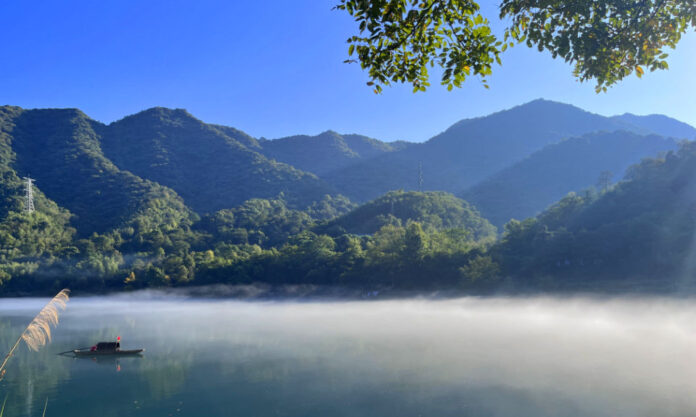
Dongjiang Lake, dammed in 1958 and first fully flooded in 1992, covers some 160 square kilometres and holds water clean enough, locals say, to drink straight from the surface; from May to October, mist rises off its Misty Small Dongjiang stretch at dawn and dusk, thick enough to blur the boundary between water and sky.
东江湖始建于一九五八年,一九九二年才首次全面蓄水,湖面面积约一百六十平方公里;当地人说,湖水清澈到可以直接掬水饮用。每年五月至十月的清晨与黄昏,小东江段上会升起浓雾,厚重到几乎分不清水面与天空的界限。
According to Hunan’s provincial statistics bureau, Chenzhou’s permanent population stood at 4.5778 million at the end of 2024, with GDP reaching ¥332.78 billion, up 5.6 percent on the previous year; per capita output came to ¥72,514.
据湖南省统计局公布的数据显示,截至二零二四年底,郴州市常住人口为四百五十七点七八万人,GDP达三千三百二十七点八亿元,同比增长百分之五点六;人均产值为七万二千五百一十四元。
Getting to Chenzhou means passing through one of China’s busiest north-south corridors; both the Beijing-Guangzhou railway and its high-speed counterpart run directly through the city, a position that has earned Chenzhou its long-standing nickname, the Southern Gateway of Hunan, on account of its border with Guangdong province just to the south.
前往郴州,通常要经过中国最繁忙的南北交通走廊之一;京广铁路及其高速铁路均直接穿城而过,这一区位优势,也为郴州赢得了”湖南南大门”的长期美誉,皆因其南邻广东。
Pharmacy signboards a thousand kilometres from Chenzhou still carry the four characters Su Dan’s mother earned brewing orange leaves in well water, long after anyone remembers her name.
远在千里之外的药铺招牌上,至今仍挂着苏耽之母当年以井水煎煮橘叶所换来的四个字,尽管早已无人记得她的名字。