



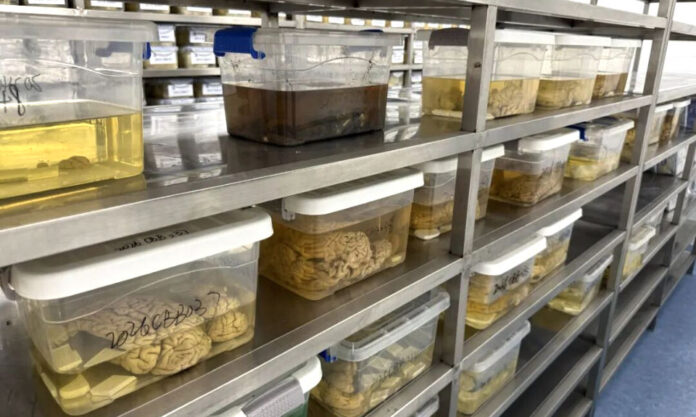



China’s human brain banks are still struggling to attract donors more than a decade after the first facilities opened, according to neuroscientist Duan Shumin. The shortage is becoming more urgent as researchers find that dementia is often more complicated than a single diagnosis.
中国最早的人脑库建立十多年后,仍然面临捐献者不足的问题。神经生物学家段树民表示,随着研究人员发现,认知障碍往往并非由单一疾病造成,脑组织样本不足的问题也变得更加紧迫。
Duan, an academician of the Chinese Academy of Sciences, helped establish the Zhejiang University Medical School Chinese Human Brain Bank in 2012. His comments were published by Southern Weekly on 13 October, in an interview examining the development of China’s brain-tissue research network and the difficulties surrounding donation.
中国科学院院士段树民于2012年牵头建立了浙江大学医学院中国人脑库。10月13日,《南方周末》刊发了对他的采访,讨论中国脑组织研究网络的发展,以及脑组织捐献面临的现实困难。
The Zhejiang facility is now formally known as the National Health and Disease Human Brain Tissue Resource Bank. It is one of two national-level brain banks in China; the other is the National Development and Function Human Brain Tissue Resource Bank associated with Peking Union Medical College. Together, the wider collaboration includes more than 20 member institutions.
浙江大学的这一机构如今正式称为国家健康和疾病人脑组织资源库,是中国两个国家级脑库之一。另一个是与北京协和医学院相关的国家发育和功能人脑组织资源库。两家机构牵头的中国人脑组织库协作联盟,目前已有20多个成员单位。
The Diagnosis That Comes After Death
生命终点之后的诊断
For many brain disorders, doctors must make difficult judgements while a patient is alive. Scans and clinical symptoms can point towards Alzheimer’s disease, Parkinson’s disease or another form of dementia, but they cannot always distinguish between conditions with similar effects.
对于许多脑部疾病来说,医生必须在患者生前作出困难的判断。影像学检查和临床症状可以指向阿尔茨海默病、帕金森病或其他类型的认知障碍,但它们并不总能区分症状相似的不同疾病。
Examination of the brain after death can provide the final evidence. A patient diagnosed with Alzheimer’s may also have Parkinson’s-related pathology, vascular damage or another neurodegenerative condition. In some cases, the tissue may show that the original diagnosis was incomplete or incorrect.
去世后的脑组织检测可以提供最终证据。一名被诊断为阿尔茨海默病的患者,也可能同时存在帕金森病相关病变、脑血管损伤或其他神经退行性疾病。在一些情况下,病理组织甚至会显示,原来的诊断并不完整,或并不准确。
That is why the National Brain Bank’s 2024 investigation attracted attention. The study examined 1,142 donated brains collected through six brain banks. It found cerebrovascular pathology in 63 percent of the samples and Alzheimer’s-related pathology in 48 percent. Among the samples from northern China, cerebrovascular pathology was found in 77 percent, compared with 50 percent in samples from the south, according to Health News and the National Brain Bank. These figures describe the donated sample, not the prevalence of disease across the entire population.
这也是国家脑库2024年调查受到关注的原因。研究人员分析了由6家脑库收集的1,142份捐献大脑样本,发现其中百分之六十三存在脑血管病变,百分之四十八存在阿尔茨海默病相关病理。根据《健康时报》和国家脑库的报道,北方样本中的脑血管病变比例为百分之七十七,南方样本为百分之五十。需要强调的是,这些数字描述的是捐献样本,并不等同于整个中国人口中的疾病患病率。
The different types of pathology are not mutually exclusive; a single brain may show evidence of both cerebrovascular damage and Alzheimer’s-related changes. Overlapping pathology can make diagnosis more difficult and complicate the search for effective treatment.
不同类型的病理变化并不互相排斥;同一份大脑样本可能同时存在脑血管损伤和阿尔茨海默病相关病变。多种病理变化重叠,可能使临床诊断更加困难,也增加寻找有效治疗方法的难度。
A Donation Made to Break a Family’s Curse
为了打破家族“诅咒”的捐献
The first brain-tissue donation to the Zhejiang facility came from a person with Huntington’s disease, a rare inherited neurological condition. According to Southern Weekly, the donor learned that their children were affected by the same illness and decided to donate their brain in the hope that researchers might better understand the disease and develop treatments that could spare future generations some of its suffering.
浙江大学脑库接收的第一份脑组织捐献,来自一名患有亨廷顿舞蹈病的人。这是一种罕见的遗传性神经系统疾病。据《南方周末》报道,捐献者得知自己的子女也受到同一种疾病影响后,决定捐出大脑,希望研究人员能够更深入地了解这种疾病,并开发出更有效的治疗方法,减轻后代可能承受的痛苦。
The story gives an otherwise technical subject a human centre. A brain bank is not simply a freezer containing anonymous material. Each sample belonged to a person with a family, a diagnosis and a reason for making the decision. Researchers inherit not only tissue, but also the expectations attached to it.
这个故事让一个原本技术性很强的话题有了人的核心。脑库并不只是存放匿名样本的冰柜。每一份样本都曾属于一个有家庭、有诊断结果并有捐献理由的人。研究人员接收的不只是组织,也包括捐献者和家属寄托在样本上的期待。
The shortage is partly practical. Brain tissue begins to deteriorate rapidly after death, and the interview says collection generally needs to be arranged within about 12 hours. This can clash with other forms of donation, including organ, eye tissue or body donation, which have their own medical and administrative deadlines.
样本不足部分源于现实限制。脑组织在人去世后会迅速发生变化,采访中提到,取材通常需要在大约12小时内完成。这可能与器官、眼组织或遗体捐献发生时间上的冲突,因为这些捐献同样有各自的医学和行政时限。
Legal and administrative arrangements also vary between provinces. Zhejiang has moved towards listing brain tissue alongside body and eye tissue in its donation system. Elsewhere, volunteers may need to contact a brain bank separately and sign an additional agreement. Families who want to make several forms of donation are advised to discuss the practical arrangements in advance.
各省的法律和行政安排也并不完全一致。浙江已经逐步把脑组织与遗体、眼组织等捐献项目一同纳入登记体系。在其他地区,志愿者可能需要另行联系脑库,并签署额外的同意书。希望同时进行多种捐献的家庭,最好提前了解并沟通具体安排。
The ethical question is just as significant as the logistics. Brain tissue cannot currently be used to save another person’s life through transplantation. Its purpose is research. That makes the benefit distant and collective, rather than immediate and visible in a hospital ward.
伦理问题与实际操作同样重要。脑组织目前不能通过移植直接挽救另一个人的生命,它的用途是科学研究。这意味着捐献带来的回报往往遥远而且属于整个社会,不像器官移植那样能在医院里立即看见结果。
Duan has suggested that donating the brain can be understood as leaving a scientific inheritance. The idea may not appeal to every family, especially where traditional beliefs attach importance to bodily completeness. Yet the decision also offers a different way of thinking about death; something from one life may remain useful to people facing the same disease decades later.
段树民认为,捐献大脑可以被理解为留下科学遗产。这种观念未必能被每个家庭接受,尤其是在重视遗体完整性的传统观念仍然存在的地方。然而,它也提供了另一种看待死亡的方式;一个生命留下的部分,也许可以在几十年后继续帮助那些面对同一种疾病的人。
For scientists, the value of a donated brain lies not in preserving the person who once lived, but in preserving evidence of disease that may help future patients receive earlier diagnoses and better treatment. China’s brain banks still need more donors, clearer procedures and wider public understanding. Their work begins only after life ends, but the questions it addresses belong to everyone still living.
对研究人员来说,捐献大脑的价值并不在于保存曾经生活过的那个人,而在于保存疾病留下的证据,帮助未来患者获得更早的诊断和更好的治疗。中国的脑库仍然需要更多捐献者、更清晰的流程以及更广泛的公众理解。它们的工作始于生命结束之后,但所要回答的问题,属于每一个仍然活着的人。
Sources
Southern Weekly interview with Duan Shumin
Health News report on the 1,142-brain study