



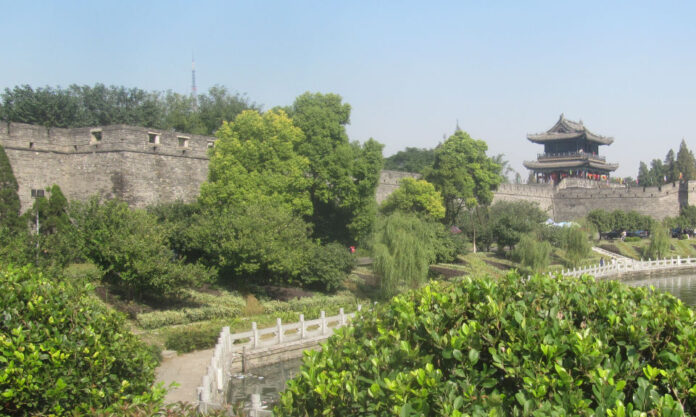



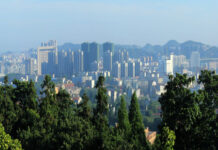
Jingzhou sits in the heart of the Jianghan Plain in central Hubei, straddling the middle Yangtze at the point where the river’s ancient shipping lanes meet some of China’s oldest continuously settled ground.
荆州地处湖北中部江汉平原腹地,横跨长江中游,境内古老的航运水道与中国最早持续有人定居的土地在此交汇。
Administratively, the city covers 14,100 square kilometres across two urban districts, two counties and four county-level cities, with a registered population of 6.12 million and a resident population of 5.12 million.
荆州全市面积1.41万平方公里,下辖2个市辖区、2个县,代管4个县级市,户籍人口612.29万,常住人口512.35万。
In 2024, Jingzhou’s GDP reached ¥350.599 billion, up 6.3 percent on the year, with per capita output of ¥68,350. The city holds several national titles, including Historic and Cultural City, Garden City and Forest City.
2024年,荆州市地区生产总值达到3505.99亿元,同比增长6.3%,人均地区生产总值68350元。荆州先后获评国家历史文化名城、国家园林城市、国家森林城市等称号。
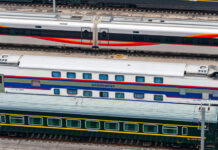
For over a decade, Jingzhou’s only rail link was the Hanyi line, opened in 2012 and marketed as high-speed despite trains that topped out at 200km/h, well below what the designation usually implies. That changed in December 2024, when the Jingmen–Jingzhou line, built to a 350km/h design speed, finally gave Jingzhou genuine high-speed rail and completed Hubei’s goal of connecting every city in the province to the network.
十余年来,荆州唯一的铁路线是2012年通车的汉宜铁路,虽号称高铁,实际运营时速却始终只能跑到200公里,远低于这一称号通常所指的水准。直到2024年12月,设计时速350公里的荆荆高铁通车,荆州才真正用上高铁,湖北也借此实现了”市市通高铁”的目标。
Jingzhou Shashi Airport, opened in January 2021, was the first new civil airport commissioned anywhere in China during the 14th Five-Year Plan period. Its route network had grown to 21 cities by April 2024, and a ¥385 million expansion is now underway to add taxiways, cargo facilities and additional aircraft stands.
2021年1月通航的荆州沙市机场,是”十四五”期间全国第一个建成投运的民用运输机场。截至2024年4月,其通航城市已增至21个,目前正在推进一项总投资3.85亿元的改扩建工程,将新增滑行道、货运设施和机位。
The Chu Capital and the Man Who Never Decayed
楚国故都与两千年不腐之身

Five kilometres north of the present city, the ruins of Jinan Cheng mark where the state of Chu built its capital during the Warring States period. Enclosed by a 15.5km wall of rammed earth up to 7.5 metres high, the site covers 15.75 square kilometres, larger than the historic city that stands there today, and has been a national key heritage site since 1961.
在今荆州城以北5公里处,纪南城遗址标记着战国时期楚国都城的所在地。城垣为夯土筑成,周长15.5公里,最高处达7.5米,遗址总面积15.75平方公里,比今天的荆州古城还要大,1961年即被列为全国重点文物保护单位。
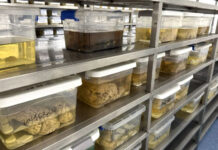
At Fenghuangshan, on the same site’s southeastern edge, archaeologists in 1975 excavated a Western Han tomb containing the remains of a man named Sui, buried in 167 BCE at around 60 years old. His body, found with elastic skin, movable joints and intact internal organs after more than two thousand years, remains one of the best-preserved wet corpses ever recovered in China.
在同一遗址东南隅的凤凰山,考古工作者于1975年发掘出一座西汉墓葬,墓主名”遂”,约60岁,下葬于公元前167年。历经两千余年,其遗体皮肤仍有弹性,关节可活动,内脏器官保存完整,是中国迄今发现保存最好的湿尸之一。
Jingzhou Museum, built around the find, holds some 170,000 relics and is the only museum in China to exhibit a wet corpse and a dry corpse, a Ming-Qing era woman found separately in the city’s Lujiashan district, side by side.
以此为核心建立的荆州博物馆,藏品约17万件,是中国唯一同时展出一具湿尸与一具干尸的博物馆,后者是在本市鲁家山另行发现的一具明清时期女性遗骸。
Three Kingdoms, a Wall and a Fallen Giant
三国、城墙与一尊被拆的巨像
Jingzhou is central enough to the Three Kingdoms period that 72 of the 120 chapters in the classic novel Romance of the Three Kingdoms mention it by name, giving rise to a set of idioms still in everyday use; Cao Cao seized Jingzhou, Liu Bei borrowed it, Sun Quan attacked it, and Guan Yu, tasked with holding it, eventually lost both the city and his life defending it.
荆州在三国故事中的分量之重,以至于《三国演义》全书120回中有72回都写到了它,由此衍生出至今仍在使用的成语典故:曹操”夺荆州”、刘备”借荆州”、孙权”讨荆州”,而奉命镇守荆州的关羽,最终连城带命一并丢在了这里。
The city’s brick wall, 11.28 kilometres in circumference and up to 9 metres high, traces its origin to an earthen fortification Guan Yu himself built while holding the city for Liu Bei. The brick wall standing today was rebuilt in 1646 on Ming-dynasty foundations, and is counted among the four best-preserved ancient city walls in China, alongside those of Xi’an, Pingyao and Xingcheng in Liaoning, and the best-preserved south of the Yangtze; it was listed as a national key heritage site in 1996.
如今的荆州砖城墙周长11.28公里,最高处9米,其源头可追溯至关羽为刘备镇守荆州时所筑的土城。现存砖墙为清顺治三年(1646年)在明代旧基上重修而成,与西安、平遥和辽宁兴城的城墙并称中国现存最完整的四座古城墙,也是长江以南保存最好的一座,1996年列入全国重点文物保护单位。
Guan Yu’s more recent monument fared worse. A 57.3-metre bronze statue of the general, unveiled in 2016 at a cost of ¥172.9 million, was found to violate the historic district’s 24-metre height limit, began cracking and sinking into the riverside silt beneath it, and was ordered dismantled by China’s Ministry of Housing and Urban-Rural Development in 2020 as an unauthorised “vanity image project”. It was relocated 8km in 2021 at a further cost of ¥155 million, after four years in which the park around it had earned less than ¥13 million in revenue.
关羽的另一座近代纪念物则命运多舛。这尊高57.3米的青铜关公像于2016年落成,造价1.729亿元,后被认定违反了古城历史城区24米的限高规定,并因建在江边淤泥地基上而出现开裂下沉。住房和城乡建设部于2020年将其认定为未经批准的”形象工程”,责令整改,2021年该雕像被迁移8公里,又耗资1.55亿元,而此前四年间,雕像所在的公园总营收还不到1300万元。
The city’s economy today draws heavily on aquaculture; Jingzhou produced 584,300 tonnes of crayfish in 2024, up 12.3 percent on the year, out of a total aquatic product output of 1.33 million tonnes.
如今荆州的经济也高度依赖水产养殖:2024年全市小龙虾产量达58.43万吨,同比增长12.3%,占全市水产品总产量133.03万吨的相当一部分。