



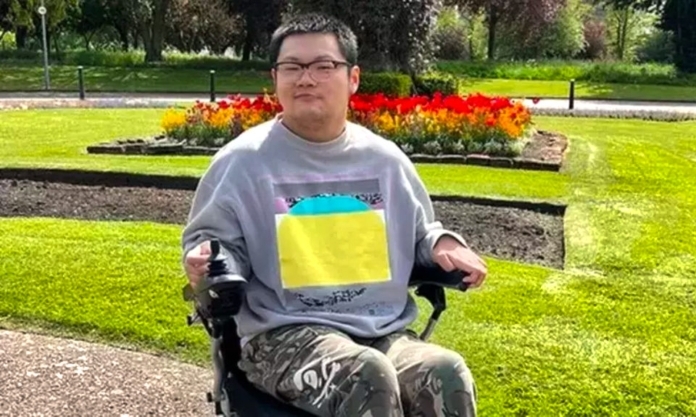



A Nanjinger who suffers from cerebral palsy has recently been awarded his doctorate from a university abroad, whilst at the same time developing AI-assisted, remote-diagnosis software which can detect COVID with an accuracy of 97 percent.
一名患有脑瘫的南京人最近获得了国外大学的博士学位,同时开发了人工智能辅助的远程诊断软件,该软件可以检测新冠病毒,准确率高达97%。
Earlier this month, 31-year-old Lu Siyuan completed the defence of his doctoral thesis at the University of Leicester in the UK. He was finally ready to return home to Nanjing. Lu’s specialty? Machine learning, artificial intelligence and computer-aided diagnosis technology.
本月初,31岁的卢思源在英国莱斯特大学完成了博士论文答辩。他终于准备好返回南京的家了。卢的专长?机器学习、人工智能和计算机辅助诊断技术。
Lu was born a child with severe cerebral palsy in Yancheng City of our very own Jiangsu Province. As the BBC reported on Tuesday, Lu recalled his younger years by saying, “My father told me from childhood that I was different from others. If I wanted to live, I had to study hard. I had no other choice. Learning was the only way out”.
卢出生在我们江苏省盐城市,是一个患有严重脑瘫的孩子。据英国广播公司周二报道,卢回忆起自己的年轻时光,他说:“我父亲从小就告诉我,我和别人不一样。如果我想活下去,我就必须努力学习。我别无选择。学习是唯一的出路”。
Luckily for him, Lu was one of the 20 percent of cerebral palsy sufferers who experience a normal intellectual development. Physically though, as a child, Lu experienced muscle spasms in his limbs, deformities in his legs, a bent spine, was unable to walk or open his hands, and had difficulty in raising his head.
幸运的是,卢是百分之二十智力发育正常的脑瘫患者之一。但在身体方面,卢先生小时候四肢肌肉痉挛,腿部畸形,脊柱弯曲,无法行走,无法张开双手,抬起头也有困难。
He had two operations on his legs. But after the anesthetic wore off, Lu refused painkillers, wary of any possible side effects on his brain and mindful that his intellect was the only way to survive. Lu is convinced the following 3 days and nights were the “most painful memory” of his life.
他的双腿接受了两次手术。但麻醉药效过后,卢拒绝服用止痛药,因为他担心对大脑可能产生的任何副作用,并意识到他的智力是生存的唯一途径。卢坚信接下来的三天三夜是他一生中“最痛苦的记忆”。
With his goal to do scientific research, Lu needed to pass the “gaokao” (University Entrance Examination). Failing on the first attempt, on account of his slow writing speed, but with a supreme score in English, Lu was given the opportunity to resit. Subsequently, he was admitted to Nanjing Normal University to study computing.
为了从事科学研究,卢需要通过“高考”。由于写作速度慢,第一次尝试失败了,但由于英语成绩优异,卢获得了重考的机会。随后,他考入南京师范大学计算机专业。
During his 2-year master’s degree, Lu achieved outstanding results and published six papers, in the process becoming known as the academic “bully” of the class.
硕士两年期间,陆老师取得了优异的成绩,发表了六篇论文,被誉为班里的学术“霸王”。
Later, he was convinced by his professor to continue his doctoral studies at the University of Leicester. But Lu was extremely afraid that he would not survive in Britain; in his 28 years he had never lived alone, with his parents always around.
后来,他被教授说服去莱斯特大学继续攻读博士学位。但卢非常担心自己在英国无法生存; 28年来,他从未独自生活过,父母一直在身边。
But he persevered, and his results are potentially world changing. Together with his mentor, Zhang Yudong, Lu has developed artificial-intelligence software to diagnose COVID. Suitable for remote diagnosis, it is believed the quick-delivery test has an accuracy of over 97 percent.
但他坚持了下来,他的成果可能会改变世界。卢与他的导师张育东一起开发了用于诊断新冠病毒的人工智能软件。适合远程诊断,快速送检准确率高达97%以上。
The two of them discussed whether to apply for a patent. But Zhang said, “He [Lu] felt that such a tool should be free for everyone to use and that it could help more people”.
两人商量是否申请专利。但张说,“他(鲁)觉得这样一个工具应该免费给大家使用,可以帮助更多的人”。