

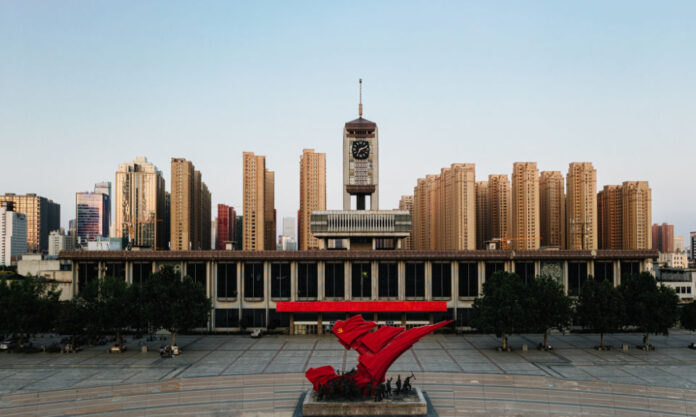

Three wartime banks, the North China Bank, the Beihai Bank and the Northwest Farmers Bank, merged in Shijiazhuang on 1 December 1948 to form the People’s Bank of China, which issued the first notes of what would become the renminbi that same day.
一九四八年十二月一日,华北银行、北海银行与西北农民银行三家战时银行在石家庄合并,组建中国人民银行;同日,这家银行发行了后来被称为人民币的第一套钞票。
The North China Bank itself was only months old. Its two predecessor banks had moved into a modest grey building on Zhonghuabei Street in April 1948 and formally merged there that July; the new People’s Bank of China simply took over the same address, a three-storey building that still stands today, preserved as a museum.
华北银行本身也只成立了数月。它的两家前身银行于一九四八年四月迁入中华北大街一座不起眼的灰色小楼联合办公,并于当年七月正式合并为华北银行;新成立的中国人民银行随后直接沿用了这同一处办公地点,这座三层小楼至今依然矗立,如今已辟为博物馆对外开放。
That first series of renminbi remained legal tender until 10 May 1955; the People’s Bank of China itself moved its headquarters from Shijiazhuang to Beiping, the city now called Beijing, on 12 February 1949, barely two months after it was founded.
第一套人民币一直作为法定货币流通至一九五五年五月十日;而中国人民银行本身,在成立仅两个月后,即一九四九年二月十二日,便将总行从石家庄迁往了当时称为北平的北京。
A Modern City with a Medieval Name
一座现代城市,一个中世纪的名字
Communist forces captured Shijiazhuang on 12 November 1947, the first major city they had taken through a full-scale urban assault during the Civil War; its subsequent administration became an important early experiment in governing a large city.
一九四七年十一月十二日,中共军队攻克石家庄,这是内战期间他们首次通过大规模攻城作战夺取的大城市;此后对该城的治理,也成为中共治理大城市的一次重要早期实践。
The name Shijiazhuang may be considerably older than the modern city. A Yuan-dynasty stone dated 1300 at Longquan Temple appears to list Shijiazhuang among more than 90 donor villages; the city’s official place-name history, however, cites a 1535 renovation inscription at Pilu Temple as the earliest established record of the village name.
“石家庄”这一地名,或许比这座现代城市本身要古老得多。龙泉寺一方元代大德四年(一三〇〇年)的石碑,碑文中九十余个施主村落名录里,似乎便列有石家庄;而该市官方地名史料,则将毗卢寺一五三五年(嘉靖十四年)的一方重修碑记,列为该村名有据可查的最早记录。
A popular story holds that the village’s name originally meant village of ten families, but city archivist Qiao Na, who searched the surviving records, found no trace of any settlement written with those characters; an 1898 Qing household register instead recorded 93 households and 532 people there, leading her to conclude that the story was likely folk exaggeration rather than fact.
一种流传甚广的说法称,这座村庄原名”十家庄”,意即十户人家的村落;但市档案馆馆员乔娜遍查现存史料,却未能找到任何写作这几个字的村落记载。一八九八年(光绪二十四年)的一份清代户口清册显示,当地实有九十三户、五百三十二人,她因此认为,这一说法很可能只是民间的夸张之辞,而非真实村名。
A Village the Railway Made, Twice
一座被铁路成就了两次的村庄
Other explanations have linked the name to an early resident surnamed Shi, though the village’s dominant surnames on record were Yin, Yu, Lu and Yao, or to local stonemasons, or to houses once built of stone; none has been conclusively established.
另有说法将地名溯源于一户石姓人家,但史料记载的当地大姓实为殷、于、卢、姚四姓;也有说法称因当地曾聚居石匠,或因早年房屋多以石砌而得名;这些说法均无定论。
The Beijing–Hankou railway reached the area in 1902, but the station was named after the larger town of Zhentou, seven li away, because Shijiazhuang itself was then considered too small and obscure to lend its name to the station.
一九〇二年,京汉铁路修至此地,但车站却以七里外更大的振头镇命名,因为当时的石家庄村规模太小、名气太低,不足以作为车站名称。
Construction of the Zhengtai railway, linking Zhengding to Taiyuan, began in 1904; to save the cost of bridging the Hutuo River, engineers moved its planned junction with the Beijing–Hankou line south to Shijiazhuang’s Zhentou station, and the line opened in 1907, making the village the meeting point of two railways. Railway workers later raised money for a bridge over the tracks, giving rise to the names Qiaodong and Qiaoxi, east of the bridge and west of the bridge, that became fixtures of the city’s geography.
一九〇四年,连接正定与太原的正太铁路动工;为节省跨越滹沱河建桥的费用,工程人员将其与京汉铁路的交会点南移至石家庄的振头站,铁路于一九〇七年通车,石家庄由此成为两条铁路的交汇之地。铁路员工此后集资修建了一座跨越铁道的大桥,由此得名”桥东””桥西”,这两个名字此后也成为这座城市地理格局中的固定称谓。
An attempt to establish a municipality in 1925 first produced the name Shijia City and then Shimen, combining characters from Shijiazhuang and neighbouring Xiumen; the name Shimen was formally used for the city from 1937 until Communist authorities restored the name Shijiazhuang in December 1947. The city became the capital of Hebei province in 1968, a role previously held by Baoding.
一九二五年一次设市尝试中,先后出现了”石家市”与”石门市”两个名称,后者取”石家庄”与邻近”休门”两村各一字组合而成;”石门”这一市名自一九三七年起正式使用,直至一九四七年十二月,中共政权将其改回”石家庄”。一九六八年,这座城市取代此前的保定,成为河北省省会。
Shijiazhuang’s economic output reached ¥865.17 billion in 2025, up 6.0 percent on the year, with a resident population of 11.2469 million.
二零二五年,石家庄地区生产总值达八千六百五十一点七亿元,同比增长百分之六点零,常住人口一千一百二十四点六九万人。
The city remains a major rail junction today, sitting on the Beijing–Guangzhou line and its high-speed successor, with direct high-speed trains reaching Beijing in well under two hours.
如今,石家庄依然是重要的铁路枢纽,京广铁路及其高铁线路均经过此地,乘高铁前往北京,所需时间远不到两小时。