






Jiangmen’s government banned pet dogs from public places across its three urban districts in August 2011, after rabies had killed 42 people in the preceding three years; officials set aside a 13 acre site where rural residents could adopt the roughly 30,000 dogs expected to be handed in.
二零一一年八月,江门市政府宣布禁止在市区蓬江、江海、新会三区的公共场所饲养宠物犬,此前三年,狂犬病已在当地夺去四十二人的生命;官员划出一块约十三英亩的场地,供农村居民领养预计将被上交的约三万只犬只。
The notice gave owners of unlicensed dogs until 10 August to make arrangements for their animals, with an enforcement campaign to follow; dogs remaining in the three urban districts after 26 August faced confiscation or destruction.
通告要求未获许可的养犬人在八月十日前对犬只作出妥善安排,此后将展开执法行动;八月二十六日后仍留在三区内的犬只,将面临收缴或捕杀。
According to the city’s animal disease control centre, dog bites injured more than 12,000 people across the three districts in 2010, and rabies killed 42 people between 2008 and 2010. Facing public criticism, officials softened the policy within days, dropping the threat of confiscation in favour of simply telling violators to leave public places.
据江门市动物疫病控制中心统计,二零一零年,三区因犬只伤人受伤者逾一万二千人,二零零八年至二零一零年间,狂犬病共导致四十二人死亡。面对舆论批评,官员在数日内软化了这项政策,取消了收缴威胁,改为仅要求违规者离开公共场所。

Two Retreats, Two Years Apart
两次退让,相隔两年
In July 2013 the China National Nuclear Corporation and China General Nuclear Power Group proposed building a nuclear fuel plant worth ¥37 billion in Zhishan township, part of Heshan, a county-level city under Jiangmen’s administration; Heshan had beaten more than 40 rival local governments to win the project, which was intended as southeast China’s first nuclear fuel processing facility, supplying enriched uranium and fuel assemblies to reactors including Daya Bay and Taishan.
二零一三年七月,中国核工业集团公司与中国广核集团提出,拟在江门下辖县级市鹤山的址山镇兴建一座投资三百七十亿元的核燃料加工厂;鹤山在与四十多个地方政府的角逐中胜出,该项目意在建成中国东南沿海第一座核燃料加工厂,为大亚湾、台山等核电站供应浓缩铀及核燃料组件。
Thousands of residents gathered outside the Jiangmen municipal government building on 12 July to protest against the plant. Officials responded by extending the public comment period on the project’s social stability risk assessment by ten days and promising not to proceed until broad public consensus had been reached.
七月十二日,数千名居民聚集在江门市政府大楼前抗议这一项目。官员随即回应,将项目社会稳定风险评估的公示期延长十天,并承诺在社会未达成广泛共识之前,绝不推进项目。
The retreat came even faster. On the morning of 13 July, Heshan announced that it would no longer seek approval for the project. When protesters returned the following day demanding written proof, Jiangmen issued a formal notice confirming its cancellation, saying it had fully heard and respected the wishes of the public.
事态的转折比预期更快。七月十三日上午,鹤山宣布不再申请该项目立项。次日,抗议者再度聚集,要求书面确认,江门随后正式发文,确认取消该项目,称已充分听取并尊重民众的诉求。
Towers Built by the People Who Left
由离乡者建起的一座座碉楼
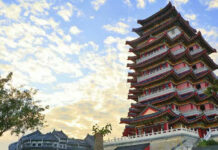
Two hours from the site of the abandoned nuclear plant, in Kaiping, overseas Chinese families once built more than 3,000 fortified diaolou. Construction peaked in the 1920s and 1930s, financed largely with money earned overseas; 1,833 still stand across 15 townships, blending Chinese village architecture with balconies, columns and domes borrowed from the West.
从放弃建厂的鹤山出发,往开平驱车约两小时,当地华侨家族曾建起三千多座碉楼。碉楼的兴建在二十世纪二三十年代达到高峰,资金主要来自华侨在海外赚取的财富;如今仍有一千八百三十三座分布在十五个镇(街),融合了中国传统乡土建筑与西式阳台、柱式和穹顶。
UNESCO listed Kaiping Diaolou and Villages as a World Heritage Site in 2007, recognising both their fusion of Chinese and Western architecture and the role of emigrant Kaiping communities in their creation. The tallest, Ruishi Lou, was built between 1923 and 1925 by Huang Bixiu, a Hong Kong pharmacist and money changer who put HK$30,000 into the project; villagers still call it Kaiping’s number one tower.
联合国教科文组织于二零零七年将”开平碉楼与村落”列入《世界遗产名录》,认可其中西合璧的建筑风格,以及海外开平侨民群体在其兴建过程中所发挥的作用。其中最高的瑞石楼,由在香港经营药材铺与钱庄的黄壁秀出资三万港元,于一九二三年至一九二五年间建成,村民至今仍称其为”开平第一楼”。
Jiangmen calls itself China’s leading hometown of overseas Chinese, with more than 4 million overseas Chinese and residents of Hong Kong and Macau tracing their ancestry to the city, spread across 107 countries and regions; the reformist scholar Liang Qichao, born in Jiangmen’s Xinhui district in 1873, is among its best known sons.
江门自称”中国第一侨乡”,祖籍江门的华侨及港澳同胞逾四百万人,遍布全球一百零七个国家和地区;一八七三年出生于江门新会的维新派学者梁启超,是其中最广为人知的乡贤之一。
Jiangmen station opened for passenger services in 2020 as a major rail hub for the western Pearl River Delta. Since October 2023, direct high-speed trains have linked it with Hong Kong West Kowloon.
江门站于二零二零年开通客运服务,成为珠江西岸的重要铁路枢纽。自二零二三年十月起,更有高铁列车直达香港西九龙。