



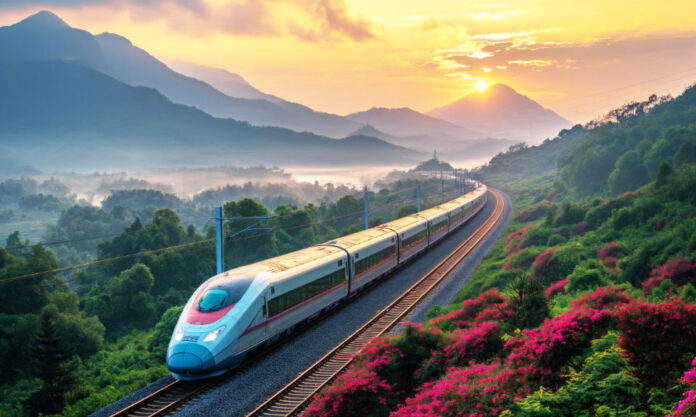



From the start of Wednesday 25 November, China’s familiar T and K passenger trains begin running under new N and V numbers, part of a change that shall affect more than 4,700 passenger and freight services nationwide.
从11月25日(周三)零时起,中国人熟悉的T字头和K字头旅客列车将改用新的N字头和V字头车次,此次调整涉及4700多列客货列车。
Most routes and departure times remain unchanged, but passengers should check their tickets.
多数列车的运行区段和发车时刻不变,但旅客仍应核对车票。
Bullet-train numbers stay put for now. They change in late December, when a new X prefix arrives for future services above 350 km/h.
动车组车次暂时不变,将于12月下旬调整,届时将新增X字头,用于未来时速350公里以上的列车。
Old Letters, New Jobs
旧字母,新岗位
As China State Railway Group announced through Xinhua on 5 November, passenger and tourist trains setting off from the start of Wednesday 25 November will carry the new numbers, and freight trains setting off from 6pm the day before. Tickets for the new numbers have been on sale since 11 November.
据国铁集团11月5日通过新华社发布的消息,11月25日(周三)零时起始发的普速旅客列车和旅游列车,以及前一天18时起始发的货物列车,将启用新车次。新车次的车票已于11月11日起陆续发售。
The practical catch is that tickets are sold 15 days ahead, so during the changeover the same train may appear under two numbers on different dates. The railway advises passengers to check the travel date, train number, stations and times on 12306 or 95306. N, V and Z are also read as English letters, with no Chinese character to hear, which The Paper has said may confuse passengers who rely on station announcements.
实际的麻烦在于,车票提前15天发售,因此在新旧车次交替期间,同一列车在不同日期可能对应两个车次。铁路部门提醒旅客,通过12306或95306核对乘车日期、车次、车站和时刻。N、V和Z今后也按英文字母读音,没有汉字可听,澎湃新闻曾指出,这可能让依赖站内广播的乘客感到困惑。
For passengers, the rules are short. T (tè, 特) trains become N, for fast trains at up to 140 km/h, numbered N1 to N1998. K (kuài, 快) trains and unprefixed ordinary passenger services become V, for trains at up to 120 km/h; V1 to V5998 are fast trains, V6001 to V6998 ordinary fast trains and V7001 to V7998 ordinary slow ones. Z stays at up to 160 km/h and Y stays for tourist trains.
对旅客来说,规则很简短。T字头(tè,特)改为N字头,代表时速最高140公里的快速旅客列车,车次为N1至N1998;K字头(kuài,快)及原先不带字母的普速旅客列车改为V字头,代表时速最高120公里的普速旅客列车,其中V1至V5998为快速旅客列车,V6001至V6998为普通旅客快车,V7001至V7998为普通旅客慢车。Z字头仍为时速160公里的快速列车,Y字头仍用于旅游列车。
Freight changes too. Freight shuttles drop the letter X for B, and a new DH prefix is created for EMU express freight. The letter X, until now stamped on freight, is being handed to the fastest passenger trains in the country.
货运也有调整。货运班列的字头由X全部改为B,动车组快运列车则新设DH字头。X这个字母原本印在货运列车上,如今将交给全国最快的客运列车。
The New Speed Ladder
新的速度阶梯
The bullet-train ladder, due in December, is ranked by top speed. X (xīn, 新, “new”) is for Fuxing trains above 350 km/h and G (gāo, 高) for Fuxing at 350. T (tè, 特) is for EMUs at 300 km/h and K (kuài, 快) for EMUs at 200 to 250. D (dòng, 动) is for power-concentrated EMUs at 200 or below, C (chéng, 城) for intercity EMUs within one railway bureau and S (shìjiāo, 市郊) for suburban trains at up to 160.
12月将实施的动车组体系按最高时速分级。X(xīn,新)用于时速350公里以上的复兴号,G(gāo,高)用于350公里的复兴号;T(tè,特)用于时速300公里的动车组,K(kuài,快)用于200至250公里的动车组;D(dòng,动)用于时速200公里及以下的动力集中动车组,C(chéng,城)用于铁路局管内的城际动车组,S(shìjiāo,市郊)用于最高时速160公里及以下的市郊列车。
The reason is crowding. On peak days such as the May Day and National Day holidays, G trains take up more than 90 percent of usable numbers. The fleet of 300 to 350 km/h standard sets grew from 1,018 in 2014 to 3,149 in 2025, a rise of 209 percent. Bullet-train prefixes rise from four to seven, which adds nearly 40 percent more numbers.
原因是车次拥挤。在五一和国庆等高峰期,G字头列车占用了超过90%的可用车次号段。时速300至350公里的标准动车组从2014年的1018组增至2025年的3149组,增幅达209%。动车组字头由4个增至7个,可编排车次增加近40%。
The twist is that T and K began on slower trains and are moving up to bullet trains. Letters long tied to conventional services will soon sit on faster ones.
转折在于,T和K原本用于较慢的列车,如今将升级给动车组。长期与普速列车相连的字母,很快将落在更快的列车身上。
As for X, no route has been named. The CR450, China’s 400 km/h train, has reached 453 km/h in trials but must still complete 600,000 km of assessment before it carries passengers. According to Beijing News, industry watchers expect the first X trains on the Chengdu–Chongqing Middle Line, due to open in 2027.
至于X字头,目前没有公布任何线路。时速400公里的CR450试验速度已达453公里,但仍需完成60万公里的运用考核才能载客运营。据新京报报道,业内普遍预计首批X字头列车将出现在预计2027年开通的成渝中线。
The second batch in late December will bring the new numbering system to China’s high-speed and other EMU services. But the first trains to wear the new letters are the slow ones; the T that has meant express becomes, from the start of Wednesday 25 November, an N limited to 140 km/h.
12月下旬的第二批调整,将把新的编号体系推广到中国的高速及其他动车组列车。但最先换上新字母的是慢车;一直代表特快的T字头,将从11月25日(周三)零时起,变成时速最高140公里的N字头。