






China’s best-known early human, Peking Man, vanished in December 1941 while his fossils from Zhoukoudian, now part of Beijing, were being shipped abroad for safekeeping on the eve of the Pacific War; the original skullcaps have never been seen since.
中国最著名的早期人类——北京人——于一九四一年十二月失踪:当时,出自今属北京的周口店的”北京人”化石正被运往国外暂存,太平洋战争一触即发;其头盖骨原件此后再也没人见过。
Pei Wenzhong unearthed the first complete skullcap at Zhoukoudian on 2 December 1929. The fossils were last recorded at Peking Union Medical College in early December 1941, when they were packed into two wooden crates and entrusted to US Marines for transport by rail to Qinhuangdao, where they were to meet the liner President Harrison for shipment to the United States. Japan attacked Pearl Harbor days later; the fossils disappeared during the ensuing chaos.
裴文中于一九二九年十二月二日在周口店发掘出第一个完整的头盖骨。这批化石最后一次有明确记录是在一九四一年十二月初的北平协和医学院,当时它们被装入两只木箱,交由美国海军陆战队经铁路运往秦皇岛,原计划在那里装上”哈里逊总统号”轮船运往美国。数日后,日军偷袭珍珠港;此后的战乱中,这批化石就此失踪。
According to Xinhua, the Zhoukoudian museum displays replica crates and a list of the missing fossils, which records one box holding seven cases of specimens, four of them skullcaps. UNESCO inscribed the site on its World Heritage List in 1987.
据新华社报道,周口店北京人遗址博物馆里陈列着两只仿制木箱和一份遗失化石清单,清单记载,一只木箱里装有七盒标本,其中四盒是”北京人”头盖骨化石。联合国教科文组织于一九八七年将周口店遗址列入《世界遗产名录》。
A Wall that Became a Subway Line and a Ring Road
一道城墙,变成了地铁与环路
Beijing’s Ming and Qing Inner City was enclosed by a wall about 24 kilometres long. Demolition began in the 1950s, but the decisive final phase came with subway construction from 1965, when most of what remained was pulled down and the railway was largely routed along the old wall’s foundations. Only three stretches of the Inner City wall survive.
北京明清内城原有一圈长约二十四公里的城墙。拆除工作始于二十世纪五十年代,但决定性的最后阶段是一九六五年起的地铁施工:剩余城墙的大部分被拆除,地铁线路也大多沿着老城墙的基址铺设。如今内城城墙仅残存三段。
In 1950 the architects Liang Sicheng and Chen Zhanxiang proposed building a new administrative centre west of the old city so that it could be kept intact, a plan that was rejected. The Second Ring Road, shaped like the Chinese character tu, roughly follows the old wall’s outline.
一九五零年,建筑学家梁思成与陈占祥提议在旧城以西另建新的行政中心,以保全旧城,这一方案被否决。今天呈”凸”字形的二环路,大致沿着当年老城墙的轮廓而建。
An Axis 7.8 Kilometres Long
一条长七点八公里的中轴线
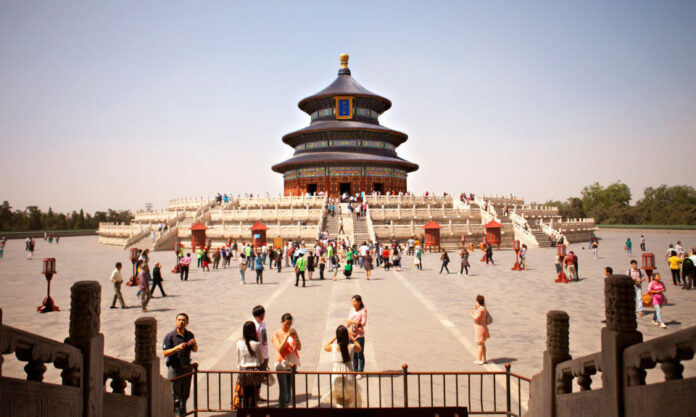
In July 2024 UNESCO inscribed the Beijing Central Axis, which Beijing’s cultural heritage bureau describes as the world’s longest urban axis at 7.8 kilometres, running from the Bell and Drum Towers in the north to Yongdingmen in the south. It has 15 components, including the Forbidden City, the Temple of Heaven and Jingshan, and a heritage area of 589 hectares.
二零二四年七月,联合国教科文组织将北京中轴线列入《世界遗产名录》;据北京市文物局介绍,中轴线全长七点八公里,是世界上最长的城市轴线,北起钟鼓楼,南至永定门,共有十五处遗产构成要素,包括故宫、天坛、景山等,遗产区面积五百八十九公顷。
The axis began in the 13th century and took its present form in the 16th, and the application took 12 years; the Bell and Drum Towers, at its northern end, were the tallest buildings on it for more than 500 years, according to Beijing’s government portal.
中轴线始建于十三世纪,形成于十六世纪,申遗历时十二年;据首都之窗介绍,位于北端的钟鼓楼,在五百多年间一直是中轴线上最高的建筑。
The Only City to Host Both Games
唯一一座举办过夏冬两季奥运会的城市
Beijing, which hosted the Summer Games in 2008 and the Winter Games in 2022, is the only city to have done both, and, according to Olympics.com, the Bird’s Nest became the first stadium to stage the opening and closing ceremonies of both.
北京于二零零八年举办夏季奥运会,二零二二年举办冬季奥运会,是唯一一座两者都举办过的城市;据奥林匹克官网介绍,鸟巢成为首座同时举办过夏、冬两届奥运会开闭幕式的体育场。
Apart from the National Speed Skating Oval and the big air jump built on the former Shougang steelworks site, every competition venue in Beijing’s zone in 2022 was a reused 2008 venue, according to the China Journalists Association. The Water Cube was converted for curling, and, according to Beijing Daily, the Winter Games’ first event, mixed doubles curling, was played there.
据中国记协网介绍,除国家速滑馆和建在原首钢厂区的滑雪大跳台外,二零二二年北京赛区的全部竞赛场馆都沿用了二零零八年的场馆;”水立方”被改造为冰壶场馆,据《北京日报》报道,冬奥会的第一场比赛——冰壶混双——就在这里举行。
A Service Economy under Bluer Skies
服务业主导的经济,与更蓝的天空
According to Beijing’s 2025 statistical communiqué, GDP reached ¥5.20734 trillion, up 5.4 percent, with services at 86.0 percent of output and per capita GDP of ¥239,000, which the city says is the highest of any provincial-level region. The permanent population was 21.8 million, down 32,000, with 5.55 births and 6.28 deaths per thousand.
据北京市二零二五年统计公报显示,全市GDP达五万二千零七十三点四亿元,同比增长百分之五点四,服务业占比百分之八十六点零,人均GDP二十三点九万元,北京称这是全国省级地区中的最高水平;年末常住人口二千一百八十万人,比上年减少三点二万人,出生率千分之五点五五,死亡率千分之六点二八。
Annual average PM2.5 fell to 27.0 micrograms per cubic metre in 2025, down 11.5 percent, and Beijing recorded 311 days of good or excellent air quality, 21 more than the year before.
二零二五年北京PM2.5年均浓度降至每立方米二十七点零微克,同比下降百分之十一点五,全年空气质量优良天数为三百一十一天,比上年增加二十一天。
By the end of 2025 Beijing’s metro network had reached 909 kilometres on 30 lines and carried 3.57 billion passengers during the year, according to the municipal communiqué. The city’s two airports handled 124 million passengers in 2025, 70.76 million at Capital and 53.61 million at Daxing, and the Beijing–Tianjin intercity train takes about 30 minutes, according to the Beijing government.
据市统计公报显示,到二零二五年底,北京地铁网络已达三十条线路、九百零九公里,全年客运量三十五点七亿人次。北京两座机场二零二五年共完成旅客吞吐量一点二四亿人次,其中首都机场七千零七十六万人次,大兴机场五千三百六十一万人次;据北京市政府介绍,京津城际列车约三十分钟即可抵达天津。
The place where Pei Wenzhong found the first skullcap is marked at the Zhoukoudian museum, in Beijing’s Fangshan district, according to Xinhua.
据新华社报道,位于北京房山区的周口店北京人遗址博物馆里,标示着裴文中发现第一颗头盖骨化石的地点。