





Shiseido has sued Aldi China, the product’s manufacturer and an Aldi Shanghai store operator over unfair competition, arguing that a ¥24.9 primer copies the packaging of its own ¥540 product; the case is due in a Shanghai court on 5 November 2026.
资生堂已就不正当竞争起诉奥乐齐中国、涉案产品的生产商以及奥乐齐上海的一家门店运营主体,指控一款售价24.9元的隔离霜抄袭了其旗下一款售价540元产品的包装;此案将于2026年11月5日在上海开庭。
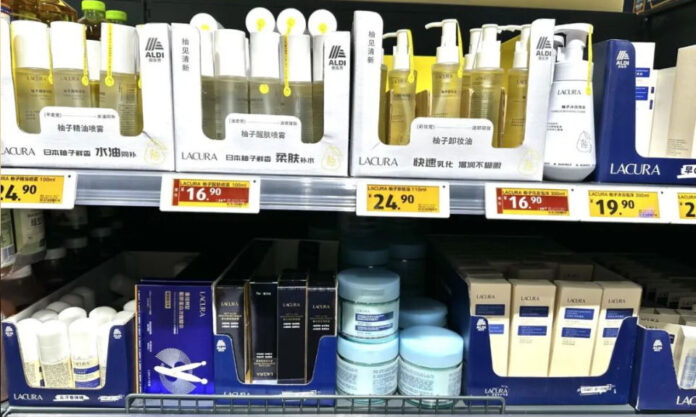
The case will be heard at the Shanghai Pudong New Area People’s Court. The product at issue is a primer sold under Aldi’s own brand, LACURA, priced at ¥24.9, whose packaging closely resembles Shiseido’s high-end CPB primer, priced at ¥540, a difference of more than twentyfold.
案件将由上海市浦东新区人民法院审理。涉案产品是奥乐齐自有品牌LACURA旗下一款售价24.9元的隔离霜,其外包装与资生堂高端品牌CPB售价540元的隔离霜高度相似,两者售价相差超过二十倍。
Southern People Weekly argues that what is at stake extends beyond one packaging design, reflecting a shift in control over the supermarket shelf from brands towards the retailers that stock them.
《南方人物周刊》认为,这起纠纷所涉及的远不止一款包装设计,它折射出超市货架的控制权正从品牌方转移向摆放这些商品的零售商。
Aldi was founded in Essen, Germany, in 1913, and is credited as the originator of the hard discount model; it now runs more than 13,000 stores worldwide. It entered China in 2019 with boutique supermarkets in Shanghai, and did not settle on its hard discount community supermarket format until 2023.
奥乐齐于1913年创立于德国埃森,被视为全球硬折扣模式的鼻祖,如今在全球拥有超过13000家门店。它于2019年以精品超市的形式进入中国,落地上海,直到2023年才正式确立硬折扣社区超市的定位。
According to rankings published by the China Chain Store & Franchise Association, its China revenue reached roughly ¥4 billion in 2025, more than five times its ¥750 million figure in 2022. By March 2026 it had passed 100 stores; CEO Chen Jia has said more than 50 new stores will open this year, at an annual growth rate of 40 percent.
据中国连锁经营协会发布的历年排名数据显示,奥乐齐中国区销售额从2022年的7.5亿元增长至2025年的约40亿元,达到三年前的五倍以上。截至2026年3月,其门店数已突破100家;奥乐齐中国CEO陈佳表示,今年新增门店将超过50家,年增长率达40%。
This is not Aldi’s first such case. In Islestarr Holdings Ltd v Aldi Stores Ltd, a UK court ruled in 2019 that Aldi’s LACURA contouring palette, priced at £6.99, infringed the copyright in the design of Charlotte Tilbury’s £49 Filmstar Bronze and Glow palette, and Aldi lost.
这并非奥乐齐第一次遭遇此类诉讼。在Islestarr Holdings Ltd诉Aldi Stores Ltd一案中,英国法院于2019年判定奥乐齐一款售价6.99英镑的LACURA修容盘侵犯了Charlotte Tilbury售价49英镑的Filmstar Bronze and Glow修容盘的外观设计版权,奥乐齐败诉。
Renting the Shelf
货架的租金
Traditional supermarkets earn in two ways, described in the trade as front counter and back counter. Front counter profit comes from selling goods; back counter income comes from suppliers, and trade publications describe slotting fees that can reach as much as 40 percent of a product’s retail price.
传统商超的盈利方式行话称作前台和后台。前台利润来自卖货本身,后台收入则来自供应商,据行业媒体报道,进场费最高可达商品零售价的40%。
One former buying director at a regional supermarket chain, quoted by Retail Finance, described his own company’s numbers — annual revenue of ¥1.5 billion, with ¥130 million budgeted from this kind of non-operating income, generated by a buying department that reportedly outperformed every sales department in the firm.
据《新零售财经》报道,一位区域连锁超市的前采购总监透露了他所在公司的具体数字——年营收15亿元,其中此类非经营性收入预算高达1.3亿元,这笔收入由采购部门创造,据称贡献甚至超过公司内所有销售部门。
Aldi relies far less on that model. More than 90 percent of what it sells is its own brand, greatly reducing its reliance on renting shelf space to outside brands. Contrast that with the “soft discount” model, represented by the chain Hitoo, which shrank from nearly 500 stores at its peak in 2024 to just 39 by July 2026, having built its original model around discounted brand overstock and near-expiry goods rather than the private-label supply chains central to hard discounting.
奥乐齐对这套模式的依赖要低得多。其自有品牌占比超过90%,因此对向外部品牌出租货架获取收入的依赖也大幅降低。与之形成对比的是以嗨特购为代表的“软折扣”模式,该企业从2024年巅峰期近500家门店,萎缩至2026年7月的仅剩39家;其最初的模式建立在品牌尾货和临期商品之上,而非硬折扣核心的自有品牌供应链。
Who Is Buying It
谁在买单
The savings come from the supply chain. Aldi buys directly from factories, and limits its entire store to under 2,000 stock-keeping units, against the 20,000 to 30,000 carried by a conventional supermarket; concentrating purchases this way gives it stronger bargaining power, while enlarged barcodes speed up checkout and plain white packaging keeps costs down.
省下的成本来自供应链本身。奥乐齐直接向工厂采购,全店SKU控制在2000个以内,远低于传统商超2万至3万的规模;集中采购提升了议价能力,放大的条形码加快了收银速度,统一的白色包装则进一步压低了成本。
Its Chinese expansion has not primarily targeted poorer, lower-tier markets despite the online nickname “poor person’s supermarket”. Aldi has concentrated on relatively affluent markets in Jiangsu, Zhejiang and Shanghai, positioning low prices as an attraction to value-conscious consumers rather than simply low-income ones. When its Wuxi store opened in April 2025, it took in more than ¥1 million on its first day; when a store opened in Kunshan the following month, it drew over 100,000 visitors and ¥1.1 million in sales in a single day.
尽管在网络上被戏称为“穷鬼超市”,奥乐齐在中国的扩张并未主要瞄准较贫穷的下沉市场。其门店集中布局于江浙沪一带相对富裕的市场,将低价定位为吸引精打细算的消费者,而非单纯针对低收入人群。2025年4月,其无锡门店开业当日营业额超过100万元;次月,昆山门店开业当日客流突破10万人次,单日销售额达110万元。
Rapid expansion has also coincided with quality-control problems. In April 2026 national regulators reported Listeria monocytogenes in a classic Caesar salad sold at one of its Shanghai stores. Competitors have piled in regardless, with Meituan’s hard discount chain reaching 68 stores by 25 August 2026, with 22 more preparing to open, and Hema’s Chaohesuan NB chain reported at more than 500 stores nationwide by the same month.
快速扩张也伴随着品控问题。2026年4月,国家市场监管总局通报其上海一家门店销售的凯撒沙拉检出单核细胞增生李斯特菌。竞争对手依旧蜂拥而入,截至2026年8月25日,美团旗下硬折扣品牌快乐猴门店已达68家,另有22家正在筹备;同期,盒马旗下超盒算NB门店据报已超过500家。
Retail analyst Zhuang Shuai, founder of Bailian Consulting, describes the shift as moving from a model where the channel was king and brands set prices, to one where the supply chain is sovereign and private labels do. With hard discount penetration in China still at just 8 percent, against 42 percent in Germany, the fight over who controls the supermarket shelf has considerably further to run.
零售电商行业专家、百联咨询创始人庄帅将这一转变形容为从“渠道为王、品牌定价”转向“供应链主权、自有品牌定价”。目前中国硬折扣渗透率仅为8%,远低于德国的42%,这场围绕超市货架控制权的争夺,还远未到终局。