



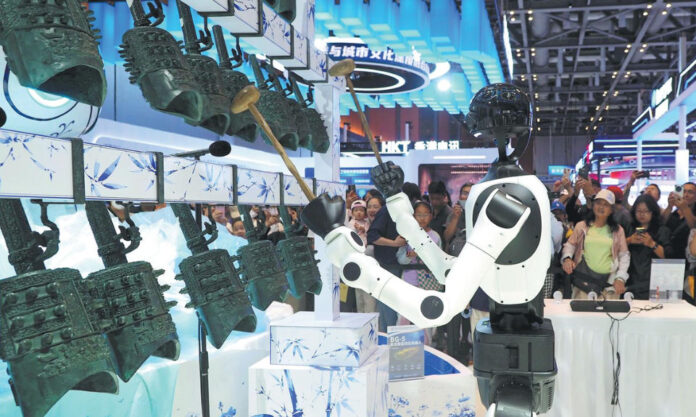



Chinese robots are moving out of viral clips and onto real shop floors, but first they graduate from an unglamorous kind of school. Near Beijing’s Shougang Park, nearly 270 machines spend their days on chores nobody would normally film for social media.
中国的机器人正在走出爆红短视频,走上真正的生产线,但在此之前,它们得先”毕业”于一所毫不光鲜的学校。在北京首钢园附近,近270台机器人每天忙着做那些没人会拍成短视频的琐碎工作。
They iron trousers, practice caregiving drills, and place circuit boards on assembly lines, generating close to 20 million data entries a year. That grind is a world away from the calligraphy robot nearby, dipping a brush in ink to write fu, the character for good fortune, to a delighted crowd.
它们熨烫裤子、练习照护动作、往生产线上摆放电路板,一年下来能产生近2000万条数据。这种苦活,与不远处那台写”福”字的书法机器人形成鲜明对比——后者蘸墨挥毫,逗得围观人群阵阵惊叹。
Such tricks made Chinese robots internet-famous over the past year. At the China International Fair for Trade in Services (CIFTIS), which closed September 13 in Beijing, robots demonstrated they can do more than entertain.
这类”绝活”是过去一年中国机器人走红网络的原因。而在9月13日闭幕的北京中国国际服务贸易交易会(服贸会)上,机器人展示了它们不止会取悦观众。
Galbot G1, the machine that went viral folding laundry during this year’s Spring Festival Gala, staffed an unmanned convenience pod. Elsewhere, a robot stamped postcards and fetched blind-box toys at an “unstaffed post office,” while others flipped pancakes and poured latte art.
曾在今年春晚因叠衣服片段走红的银河通用机器人Galbot G1,在会场里守起了无人便利舱。另一处,一台机器人在”无人邮局”为明信片盖章、取出盲盒玩具,还有机器人现场煎饼、拉花咖啡。
Visitors were impressed. Olga, a Belarusian professor at Beijing Foreign Studies University, said her own campus has a coffee-making robot, but described these as noticeably more advanced.
参观者对此印象深刻。北京外国语大学的白俄罗斯籍教授奥尔加说,她所在的校园里也有咖啡机器人,但这些明显更先进。
She noted that the latte art humans struggle to master seemed effortless for the machines.
她特别提到,人类很难练成的拉花,机器人却做得轻松自如。
The Data Bottleneck
数据缺口
Zhu Kai, general manager of the Beijing Shijingshan Humanoid Robot Data Training Center, said the showmanship masks a harder problem. China shipped 23,000 humanoid robots domestically in the first half of the year, he noted, yet fewer than 5 percent work reliably on actual production lines.
北京石景山人形机器人数据训采中心总经理朱凯认为,光鲜的展示背后藏着更棘手的难题。他说,今年上半年中国人形机器人国内出货量达到2.3万台,但能在实际生产线上稳定作业的不到5%。
The bottleneck isn’t hardware — it’s data. High-quality multimodal training data covers less than one percent of industrial demand, Zhu said, calling the shortage the central obstacle between robots that perform and robots that actually work.
瓶颈不在硬件,而在数据。高质量的多模态训练数据,还不到产业实际需求的1%,朱凯说。他认为,这一缺口正是机器人从”能表演”迈向”真干活”路上的核心障碍。
That’s where the vocational school comes in. Rows of robots there practice fetching boxes and ironing clothes, each shadowing a human mentor’s movements.
这正是”职业技校”存在的意义。训练中心里,一排排机器人反复练习取放箱子、熨烫衣物,每个动作都跟着人类教练示范学习。
Those human trainers now have an official job title. China formally recognized “embodied-intelligence robot application technicians” as a new occupation on September 9, with robot data collectors and robot trainers as two specialized trades within it.
这些人类教练如今也有了正式的职业身份。9月9日,中国正式新增”具身智能机器人应用技术员”职业,下设机器人数据采集员、机器人训练师两个新工种。
The tools for teaching robots are evolving too. Data collectors once worked from fixed lab consoles; now, wearable rigs let them capture real-world movement directly.
采集数据的方式也在升级。过去,数据采集员只能坐在固定的实验室工位前操作;如今,可穿戴设备让他们能够直接进入真实场景采集动作数据。
At one CIFTIS booth, VR company Nolo showed off EgoCapture, a head-mounted device recording a full 360 degrees of human motion — useful for teaching a robot to judge a turn on a long trail run.
在服贸会的一个展位上,VR公司诺亦腾展示了其头戴式设备EgoCapture,可360度记录人体动作——比如用来教会机器人在长距离越野跑中判断转弯时机。
Other exhibitors showed tactile sensors recording the force of a human grip, and dexterous robotic hands built with an internal “brain” model for autonomous action.
其他展台上,有企业展示能记录人手抓握力度的触觉传感器,以及内置”大脑”模型、能自主行动的灵巧机械手。
Going Global
出海征程
The economics are starting to follow. CIFTIS launched what organizers call China’s first industry-level platform for exporting embodied-intelligence data services internationally, built by a Beijing Shijingshan government-backed group with China Telecom’s Beijing branch.
相关产业链也开始成形。本届服贸会上,由北京石景山国资背景企业联合中国电信北京分公司打造的具身智能数据国际化服务平台正式发布,据介绍是国内首个行业级平台。
Shijingshan district has registered the country’s first 3D dataset for large-model training and opened four data service stations, part of a citywide push toward 100 high-quality industrial datasets by 2028.
石景山区已登记全国首个面向大模型训练的三维高质量数据集,并开设了四个数据服务站,全市计划到2028年建成100个高质量产业数据集。
The robots themselves are already heading overseas. Beijing startup Anyverse Dynamics signed a 500-million-yuan ($74.6 million) deal with green-tech firm Envision.
机器人本身也已经”出海”。北京企业它石智航与绿色科技集团远景能源签下5亿元人民币(约合7460万美元)的合同。
The first batch of its K15 semi-humanoid robots arrived this month at Envision’s battery gigafactory in France, to handle autonomous loading and unloading.
首批K15半人形机器人本月已运抵远景位于法国的电池超级工厂,执行自主装卸作业。
Back at the calligraphy booth, the fu character is meant as a blessing for the crowd. Increasingly, though, the fortune behind it is being written by machines that had first to spend countless hours learning how to hold the brush.
回到写”福”字的展位前,这个”福”字本意是为围观者祈福。但如今,这份”福气”的背后,越来越多是由机器人的手写就的,而它们首先得花上无数时间学会怎么拿笔。