



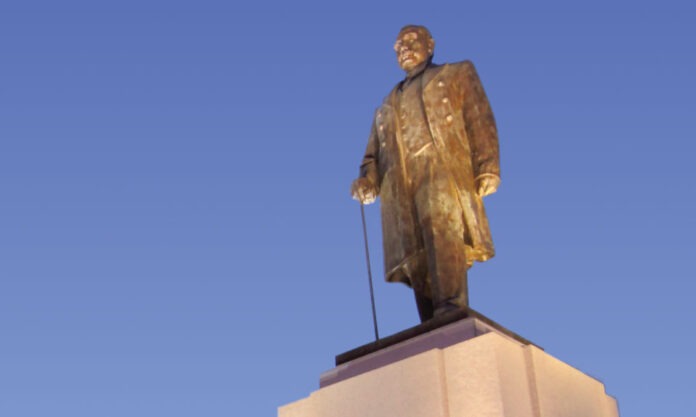


Just as compasses do in China, the statue of Sun Yat-sen in Nanjing’s Xinjiekou that marks the very centre of our City, faces south. Perhaps out of respect for the accepted way of doing things, but more pragmatically so that he may face his hometown of Zhongshan in Guangdong Province.
就像中国的指南针一样,南京新街口的孙中山雕像朝南,标志着我们城市的中心。 也許是出於對公認的做事方式的尊重,但更務實,以便他能面對他的家鄉廣東省中山。
But the statue we cannot miss today, sited in Xinjiekou most recently in 1996 on the 130th anniversary of Sun’s birth, has a predecessor, several in fact. And fascinatingly, their links lie across the East China Sea, in Japan.
但我们今天不能错过的雕像,最近于1996年太阳诞生130周年之际,位于新街口,有一个前身,事实上有几个。 令人着迷的是,它们的联系横跨日本的东海。
Umeya Shokichi was a renowned Japanese film promoter and producer. A 2-decade long financial supporter of Sun, Umeya was a guest of honour at Sun’s state funeral, where he was the only non-family member to accompany Sun’s casket. Umeya also read an elegy to Sun before going on to sell property in order to pay for the original bronze statue in March of 1929, some 4 years after Sun’s death.
Umeya Shokichi是一位著名的日本电影推广者和制片人。 Umeya是孙中山二十年来的经济支持者,是孙中山国葬的贵宾,他是孙中山棺材的唯一非家庭成员。 1929年3月,在孙去世约4年后,乌梅亚还向孙读了一份谵漓歌,然后继续出售房产,以支付原始青铜雕像的费用。
As per the then “Japan Spotlight” bimonthly magazine in 2006, “Chinese newspapers praised Umeya as the ‘benefactor of China’, at a time when the Chinese view of Japan was worsening with each passing day”.
根据2006年《日本聚焦》双月刊杂志,“中国报纸称赞梅耶是’中国的恩人’,当时中国人对日本的看法一天比一天糟糕”。
When complete, the statue, 2.9 metres high, weighing over a tonne and posturing Sun giving a public speech, was transported from Japan to China.
这座雕像建成后,高2.9米,重达一吨以上,并装出太阳发表公开演讲的姿势,从日本运往中国。
The statue would provide the mould for the others to be cast, to be then sited in the Huangpu Military Academy in Guangzhou, Sun Yat-sen University in Guangzhou and the National Father Memorial Hall in Macau. In Nanjing, it was originally sited in the KMT Central Military Academy.
该雕像将为其他雕像的铸造提供模具,然后放置在广州的黄浦军校、广州的中山大学和澳门的国家父亲纪念馆。 在南京,它最初位于国民党中央军校。

Making its first appearance in Xinjiekou in November of 1942, on the eve of the 76th anniversary of Sun’s birth, the tumultuous second half of the 1960s prompted Premier Zhou Enlai to issue instructions to protect the statue. Hence, the Nanjing Municipal Party Committee removed the bronze statue from Xinjiekou Square and transported it to the Sun Yat-sen Mausoleum.
1942年11月,在孙中山诞辰76周年前夕,它首次出现在新街口,20世纪60年代后半叶动荡不安,促使周恩来总理发布保护雕像的指示。 因此,南京市市委将青铜雕像从新街口广场移走,并运往中山陵墓。
Moved from here to there over the years, the statue found its final resting place on 12 March, 1985, being the 60th anniversary of the death of Sun, when the Sutra Library of the Sun Yat-sen Mausoleum became the Sun Yat-sen Memorial Hall. The statue sits on the stone steps in front of the building to this day.
多年来,这座雕像从这里移动到那里,于1985年3月12日找到了最后的安息之地,这是孙中山陵墓的佛经图书馆成为孙中山纪念馆。 这座雕像坐立在大楼前面的石阶上,时至今。
It would then take until 1996 for its successor to be revealed, when Chinese sculptor Dai Guangwen cast another bronze statue of Sun, this time holding a cane in his right hand and wearing a suit jacket, waistcoat and tie. Weighing 6.2 tonnes and 5.37 metres tall, the new statue was in that same year erected back in Nanjing’s Xinjiekou Square. Dai had taken the initiative for this to be his responsibility without receiving a penny.
直到1996年,中国雕塑家戴光文铸造了另一尊孙的青铜雕像,这次右手拿着手杖,穿着西装外套、马甲和领带。 这座新雕像重6.2吨,高5.37米,同年在南京新街口广场竖立。 Dai主动将此作为他的责任,而没有收到一分钱。
The modern world was then to come calling, and with it construction of the Nanjing Metro.
那时,现代世界将召唤南京地铁的建设。
In 2001, Xinjiekou Square was temporarily demolished and Dai’s version of the statue was moved to a military warehouse at Xinmenkou in the north of the city. Half a year later, it was decamped once again, to a facility in Laoshan of Pukou District.
2001年,新街口广场被暂时拆除,戴的雕像被移到该市北部新门口的一个军事仓库。 半年後,它再次被分到浦口區崂山的一個設施。
As Xinjiekou Metro Station was completed almost a decade later, the founder of modern China received his final send off. The statue came to stand once again in the centre of Xinjiekou Square, revealed to the public the morning of 13 May. Sun may not have been a communist, but he was rightfully afforded the wearing of red silk for the occasion.
随着新街口地铁站建成近十年后,现代中国的创始人收到了最后的送走。 这座雕像再次矗立在新街口广场的中心,于5月13日上午向公众展示。 Sun可能不是共產主義者,但他理所當然地被賦予了戴紅絲的衣服。