







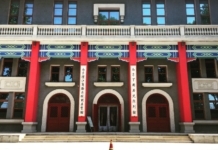
Foreigners in Nanjing will most likely be familiar with this building. It sits at 155 Baixia Lu almost next to the visa office, across Taiping Nan Lu. Many might have wondered at its architectural beauty while waiting for their visa appointment and why the Bank of Communications is therein.
南京的外国人很可能熟悉这座建筑。 它位于太平南路对面的百夏路155号,几乎毗邻签证办公室。 许多人在等待签证预约时可能想知道它的建筑之美,以及为什么交通银行会在那里。
During the First World War and for a period thereafter, foreign banks in China collapsed one after another due to the impact of the war and the Chinese anti-imperialist movement. The credibility of the surviving foreign banks had also been badly shaken.
在第一次世界大战期间和之后的一段时间里,由于战争和中国反帝国主义运动的影响,中国的外国银行接二战倒闭。 幸存的外国银行的信誉也受到了严重冲击。
Partly as a response to this, the China & South Sea Bank was established in 1919 by overseas Chinese during the country’s Republican era, with its head office located in Shanghai.
部分作为对此的回应,中国和南海银行于1919年由海外华人在该国共和国时期成立,总部位于上海。
In July 1922, the Bank opened its first branch in Tianjin. Branches and sub branches followed in Beijing, Chongqing, Guangzhou, Hangzhou, Hankou, Hong Kong, Nanjing, Suzhou, Wuxi, Xiamen and other cities. Mainly engaged in the deposit business, the Bank absorbed savings and provided loans to the business community. Later, its trust department was established to keep valuables and buy and sell securities on behalf of customers.
1922年7月,该银行在天津开设了第一家分行。 分行和分分行随后在北京、重庆、广州、杭州、汉口、香港、南京、苏州、无锡、厦门等城市。 银行主要从事存款业务,吸收储蓄,向商业界提供贷款。 后来,其信托部门成立,以保管贵重物品并代表客户买卖证券。


Shortly after opening, the China & South Sea Bank won the right to issue banknotes. In fear of runs on the bank due to indiscriminate bank-note issuance, it was decided to do it as a group; with the Salt Bank, the Jincheng Bank and the China Continental Bank, together otherwise known as the “four northern banks”.
开业后不久,中国和南海银行赢得了发行纸币的权利。 由于担心银行因不分青红皂白地发行而导致银行挤兑,因此决定作为一个集团进行;盐银行、金城银行和中国大陆银行,也被称为“北方四家银行”。
Banks notes issued by the group remained the de facto legal tender until November of 1935, when the Nanjing National Government unified the national currency system.
该集团发行的银行纸币一直是事实上的法定货币,直到1935年11月,南京政府统一了国家货币体系。
As a building, the former China & South Sea Bank Nanjing Branch (中南银行南京分行) that we appreciate today was the result of a continuous expansion in the Bank’s business. The new building, in its then-quite-revolutionary, modern architectural style, appeared in 1936.
作为一座建筑,我们今天欣赏的前中南银行南京分行是银行业务持续扩张的结果。 这座新建筑建于1936年,当时具有革命性的现代建筑风格。
Let’s face it; the appearance of most banks is rather drab and was especially so back then. But the China & South Sea Bank Nanjing Branch has a two-tone exterior, giving it a crisp sharpness. Both European and American decorative styles are evident.
让我们面对现实吧;大多数银行的外表都相当单调,那时尤其如此。 但中国和南海银行南京分行的外观是双色调的,给人一种清脆的锐利。 欧美的装饰风格都很明显。
Centre to the show is of course the bell tower, which sits four floors above the Bank’s entrance hall. From here, the wings of the building extend northward and westward over a total floor area of 1,986 square metres.
展会的中心当然是钟楼,它位于银行入口大厅上方四层。 从这里开始,建筑物的翼楼向北和向西延伸,总面积为1,986平方米。
With World War II raging, the Bank moved to Chongqing, and the building became the Ministry of Industry and latterly the Ministry of Grain. In the 1950s it became the Chaoyang Hotel. Today’s branch of the Bank of Communications was located here in February, 1987.
随着第二次世界大战的肆虐,银行搬到了重庆,该建筑成为工业部,后来又成为谷物部。 在20世纪50年代,它变成了朝阳酒店。 1987年2月,今天的交通银行分行就位于这里。