



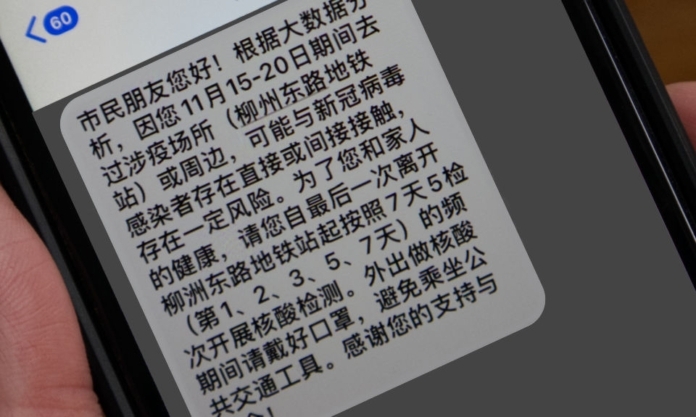



Hundreds, if not thousands, of Nanjingers have in the past few days been receiving an SMS alerting them that their travels may have crossed the path of a COVID-positive case. City authorities are keen to pass the message on; these messages are not spam.
With the numbers of COVID cases locally once again creeping up as they are in many parts, so vigilance is back on the agenda. More tests, more mask wearing and now, more messages.
随着当地新冠病例数量再次像许多地方一样攀升,因此保持警惕又回到了议程上。更多测试,更多戴口罩,现在还有更多信息。
The SMS in question relates specifically to the period from 15-20 November, and (theoretically) will only be sent to those who have been in the vicinity of two key areas in Nanjing.
该短信具体涉及11月15日至20日期间,并且(理论上)只会发送给去过南京两个重点区域附近的人。
Firstly, that would be those who have used Metro Line 3, and specifically to or from Liuzhou Dong Lu Metro station in Jiangbei New Area. The other is downtown; the Panda Valley Financial Technology Centre (熊猫万谷金融科技中心) near the junction of Zhongshan Dong Lu and Longpan Lu.
首先是乘坐地铁3号线的人,特别是往返于江北新区柳州东路地铁站的人。另一个是市中心;熊猫万谷金融科技中心位于中山东路与龙蟠路交汇处。
To paraphrase the Chinese-only message, its contents state that according to big-data analysis, the recipient may have had direct or indirect contact with a COVID-infected person. The recipient should conduct a series of five COVID tests beginning immediately, and on the following 2nd, 3rd, 5th and 7th days. The recipient should also wear a mask and avoid taking public transport.
套用这条只有中文的信息,其内容是,根据大数据分析,收件人可能与新冠病毒感染者有过直接或间接接触。接受者应立即开始并在接下来的第 2、3、5 和 7 天进行一系列五次新冠病毒检测。收件人还应佩戴口罩并避免乘坐公共交通工具。
For readers of The Nanjinger who have received such a message and have indeed been to one of the two aforementioned places within the specified time period, the advice from our city’s Epidemic Prevention & Control Headquarters is as follows.
对于收到该消息且确实在规定时间内去过上述两个地点之一的《南京人》读者,我市疫情防控指挥部建议如下。
Try to avoid going out, do not participate in gathering activities. If going out is absolutely necessary, wear a mask and socially distance by more than 1 metre, reduce chatting and perform timely disinfection of hands.
尽量避免外出,不参加聚集性活动。如确需外出,应佩戴口罩,保持1米以上社交距离,减少聊天,及时消毒双手。
For anyone who does develop a fever, sore throat, dry cough and other symptoms, they should go to the nearest fever clinic and avoid taking public transport on the way.
出现发热、咽痛、干咳等症状的,应到就近的发热门诊就诊,途中避免乘坐公共交通工具。
For those who were not in either of the locales during the specified period, but have received the message anyway, don’t panic and remember that mistakes do happen. Even China’s anti-COVID efforts are not infallible.
对于那些在指定时间段内不在任何一个区域但仍收到消息的人,请不要惊慌,并记住错误确实会发生。即使中国的抗疫努力也并非万无一失。
Therefore, the instructions therein can probably be safely ignored, other than in the case that one’s health code subsequently turns yellow.
因此,除了健康码随后变成黄色的情况之外,可以安全地忽略其中的说明。
For non-Chinese readers, the message is easy to spot. Just look for “1、2、3、5、7”, while the full contents of the message can be viewed in this article by Nanjing Daily.
对于非中文读者来说,这个信息很容易发现。查找“1、2、3、5、7”即可,完整内容可参见《南京日报》这篇文章。
But things change fast in the world of Dynamic-Zero-Covid China. Now, with the bulk of the Nanjing populace once again undergoing COVID tests every day, the issue of the instructions in the SMS becomes really rather moot.
但在充满活力的零新冠疫情中国,情况变化很快。现在,随着大部分南京民众每天再次接受新冠病毒检测,短信中的指示问题变得毫无意义。