



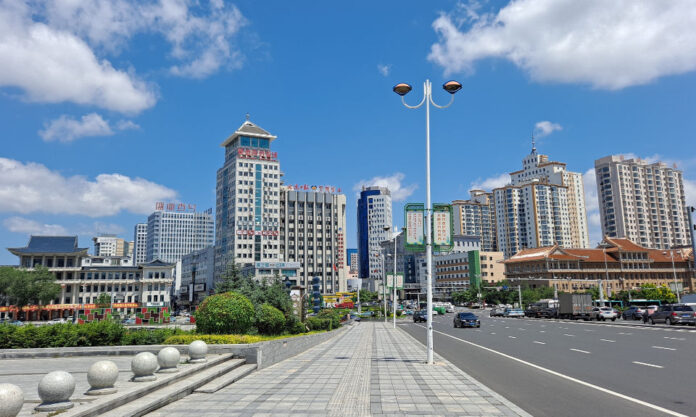



Shop signs, road signs and official seals across Yanbian, in China’s north-east, must carry both Korean and Chinese, and local rules say that when the two are set side by side the Korean comes first, or on top.
在中国东北的延边,店铺招牌、路牌与公章都必须同时使用朝鲜文和汉文;当地规定,两种文字并排书写时,朝鲜文排在前面或上方。
Yanbian Korean Autonomous Prefecture was founded on 3 September 1952 as an autonomous region and became a prefecture in December 1955; it is China’s only Korean autonomous prefecture and its largest Korean community, which English-language reports have sometimes called the Third Korea. It covers about 42,700 square kilometres of eastern Jilin, with six county-level cities and two counties, and Yanji as its seat.
延边朝鲜族自治州于一九五二年九月三日以自治区形式成立,一九五五年十二月改为自治州;它是全国唯一的朝鲜族自治州,也是中国最大的朝鲜族聚居地,英文媒体有时称之为”第三个朝鲜”。全州位于吉林东部,面积约四点二七万平方公里,下辖六个县级市和两个县,州府设在延吉市。
According to the prefectural government’s 2005 implementing rules for its Korean-language regulations, the two scripts must be of equal size, and on a circular display the Korean takes the outer ring.
据延边州人民政府办公室二零零五年印发的朝鲜语言文字工作条例实施细则,朝汉两种文字须字号相等;环形排列时,朝鲜文位于外环。
Two Peoples Who Crossed into a Closed Frontier
越过封禁边疆的两批移民
The Qing court had long kept the Northeast closed to settlement, but after 1860, alarmed by Russian expansion, it allowed peasants from Shandong and Hebei to move in and farm, according to The Beijing News.
清廷长期对东北实行封禁;据《新京报》报道,一八六零年之后,出于对沙俄扩张的担忧,清廷允许山东、河北等地的农民进入东北开垦。
Koreans were already crossing the Tumen and Yalu rivers by then, and after a famine in northern Korea around 1869 they came in larger numbers. By 1881 more than 10,000 Koreans lived in Yanbian, and in 1885 the Qing designated a strip along the Tumen’s north bank, about 700 li long and 50 li wide, as a farming zone reserved for them, according to People’s Daily.
那时,朝鲜人已陆续越过图们江和鸭绿江来到中国;一八六九年前后朝鲜北部遭遇饥荒之后,迁入者更多。据《人民日报》报道,一八八一年延边地区的朝鲜族已达一万多人;一八八五年,清政府将图们江北岸长约七百里、宽约五十里的地带划为朝鲜族农民专垦区。
By 1918 more than 360,000 Koreans lived in the Northeast, and by 1945 the number in China had reached 2.165 million; many returned to the peninsula after Japan’s surrender, and the 1953 census counted 1.111 million Koreans nationwide, according to People’s Daily and the Heilongjiang government.
据《人民日报》和黑龙江省人民政府介绍,到一九一八年,东北的朝鲜人已达三十六万多人;到一九四五年,在华朝鲜人达二百一十六点五万人;日本投降后,不少人返回朝鲜半岛,一九五三年第一次全国人口普查时,朝鲜族人口为一百一十一点一万人。
A First Governor Sent to a Hubei Farm
被下放到湖北农场的首任州长
Yanbian University opened in April 1949, after a 1948 meeting backed a proposal for a Korean university with the support of Zhu Dehai, who later became the prefecture’s first Party secretary and governor, according to Yanbian University and Longjing’s public library.
据延边大学和龙井市图书馆介绍,一九四八年的一次座谈会通过了创办朝鲜族大学的提案,朱德海对此大力支持,延边大学于一九四九年四月成立;他后来出任自治州首任书记和首任州长。
Born in the Russian Far East in 1911, Zhu was persecuted during the Cultural Revolution and sent in 1969 to work on a farm in Hubei, where he died of lung cancer in Wuhan on 3 July 1972, aged 61, according to Longjing’s public library; he was later rehabilitated.
朱德海一九一一年生于俄罗斯远东地区;据龙井市图书馆介绍,”文化大革命”期间他遭到迫害,一九六九年被下放到湖北农场劳动,一九七二年七月三日因肺癌在武汉逝世,终年六十一岁;他后来得到平反。
A Korean Population in Decline
正在减少的朝鲜族人口
At the 2000 census, 801,210 Koreans lived in Yanbian, 36.26 percent of the population; in 2020 the census counted 597,426, or 30.77 percent. Compared with 2010, the Korean population had fallen by 137,759, or 18.74 percent, according to the prefecture’s census bulletin, while the total population fell 12.66 percent over the same decade to 1,941,700.
二零零零年人口普查时,延边有朝鲜族八十万零一千二百一十人,占总人口的百分之三十六点二六;二零二零年普查时为五十九万七千四百二十六人,占百分之三十点七七。据延边州普查公报显示,与二零一零年相比,朝鲜族人口减少十三万七千七百五十九人,下降百分之十八点七四;同期全州总人口下降百分之十二点六六,降至一百九十四万一千七百人。
Registration figures show a larger community than the census does. At the end of 2020, 730,300 Koreans were registered in Yanbian, 132,874 more than the census found living there, and in Tumen city the census counted 37,724 Koreans, down 46.96 percent in the decade.
户籍数据显示的朝鲜族规模大于人口普查。二零二零年末,延边登记在册的朝鲜族为七十三万零三百人,比普查时实际居住在此的人数多出十三万二千八百七十四人;图们市普查登记的朝鲜族为三万七千七百二十四人,十年间下降百分之四十六点九六。
Football is Yanbian’s other great local passion. A Jilin team drawn mainly from its Korean players won the national league in 1965, and in 2015 its Yanbian successor won China League One after 21 unbeaten rounds, with crowds near 30,000 a match at Yanji’s stadium, according to The Paper. The club was dissolved in February 2019 over unpaid taxes, according to China Jilin Network.
足球是延边的另一大地方热情。以朝鲜族球员为主力的吉林队于一九六五年夺得全国足球甲级联赛冠军;据澎湃新闻报道,二零一五年延边队在连续二十一轮不败之后夺得中甲冠军,延吉市人民体育场每场上座人数接近三万。据中国吉林网报道,该俱乐部于二零一九年二月因欠税问题解散。
A Border Village 15 Kilometres from the Sea
距大海十五公里的边境村庄
In Hunchun, the village of Fangchuan lies where China, Russia and North Korea meet, about 15 kilometres from the Sea of Japan; the road to it runs along an 888-metre embankment only 8 metres wide. According to the Jilin Daily, border negotiations led by the Qing envoy Wu Dacheng in 1886 recovered disputed territory and secured the right of Chinese vessels to navigate through the Tumen River mouth to the sea.
珲春的防川村位于中、俄、朝三国交界处,距日本海约十五公里;通往村子的道路沿着一条长八百八十八米、宽仅八米的大堤延伸。据《吉林日报》报道,一八八六年清朝钦差大臣吴大澂主持勘界谈判,收回了争议领土,并争得中国船只经图们江口通航入海的权利。
According to Yanbian’s 2025 statistical communiqué, GDP reached ¥106.408 billion, up 5.8 percent, with per capita output of ¥56,606; the permanent population was 1.8733 million, down 12,900, while the prefecture received 78.1303 million visitors, up 85.8 percent, and earned ¥90.152 billion from tourism.
据延边州二零二五年统计公报显示,全年GDP达一千零六十四点零八亿元,同比增长百分之五点八,人均产值五万六千六百零六元;年末常住人口一百八十七点三三万人,比上年末减少一点二九万人;全年接待国内外游客七千八百一十三点零三万人次,增长百分之八十五点八,旅游总收入九百零一点五二亿元。
Getting to Yanbian means a high-speed train from Changchun to Yanji West that takes as little as 2 hours 5 minutes, against about seven hours before the Changchun–Hunchun intercity line opened in full in September 2015, according to Sohu.
前往延边,可从长春乘坐高铁前往延吉西站,最快仅需两小时零五分钟;据搜狐报道,二零一五年九月长珲城际铁路全线贯通之前,长春至延吉耗时约七小时。
At Fangchuan, the boundary stone set in 1886 carries the Chinese words Tu Zi Pai on its Chinese face and a single Russian T on the other, according to Tencent News.
据腾讯新闻报道,防川一八八六年竖立的”土字牌”界碑,中方一面刻着”土字牌”三个大字,俄方一面只刻着一个”Т”字。