



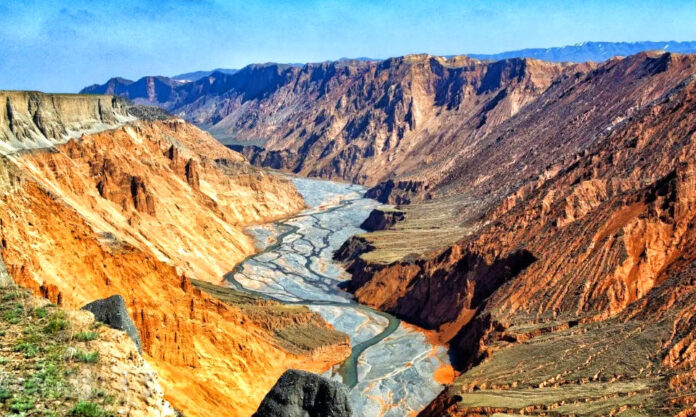



Water makes Bayannur. The Yellow River’s diverted flow irrigates more than 10 million mu of desert-edge farmland, the runoff feeds a lake of 293 square kilometres, and the city plants about half of China’s edible sunflower area.
水造就了巴彦淖尔。黄河引来的水灌溉着一千多万亩沙漠边缘的农田,退水汇入一片二百九十三平方公里的湖,全市的葵花种植面积约占全国食用葵花的一半。
Bayannur is Mongolian for “rich lake”, and the State Council created the city on 1 December 2003, according to Baidu Baike and a regional place-name site.
据百度百科和区划地名网介绍,巴彦淖尔在蒙古语里是”富饶的湖泊”,国务院二零零三年十二月一日批准设市。
Channels and Sunflowers
渠道与葵花
The Yellow River runs 345 kilometres through Bayannur, according to Sichuan Online, yet the plain gets less than 200 millimetres of rain a year against more than 2,100 millimetres of evaporation, so there is no farming without irrigation, according to the Ministry of Water Resources’ conservation site. The Sanshenggong barrage, 309 metres long, was closed on 13 May 1961 and is known as the first gate on the Yellow River, according to NetEase. Irrigated land grew from about 3 million mu before 1949 to 10.2 million mu at the time of the 2019 heritage listing, according to the conservation site and Xinhua. The district draws about 5 billion cubic metres of river water a year, according to the Chinese science paper Kepu Shibao.
据四川在线介绍,黄河流经巴彦淖尔三百四十五公里,但据节水网介绍,这片平原年降水量不足二百毫米,蒸发量超过二千一百毫米,无灌溉便无农业。据网易介绍,长三百零九米的三盛公拦河闸一九六一年五月十三日截流成功,被称作万里黄河第一闸。据节水网和新华社介绍,灌溉面积由一九四九年前的约三百万亩扩大到二零一九年入选遗产名录时的一千零二十万亩。据《科普时报》介绍,灌区每年引黄河水约五十亿立方米。
In 2019 the Hetao Irrigation District was added to the World Heritage Irrigation Structures register, maintained by the International Commission on Irrigation and Drainage rather than UNESCO, according to Xinhua.
据新华社介绍,二零一九年河套灌区被列入世界灌溉工程遗产名录,该名录由国际灌排委员会而非联合国教科文组织维护。
Sunflowers are the crop that made the plain famous. The city plants more than 4 million mu a year, about half of China’s edible sunflower area, and Xinhua says about four of every ten sunflower seeds nationwide come from the Hetao. American edible hybrids were introduced in 2000, and seeds and kernels are exported to more than 40 countries, according to Xinhua.
葵花是让这片平原出名的作物。据新华网介绍,全市年种植葵花四百多万亩,约占全国食葵种植面积的一半,并称全国每十粒葵花籽中约有四粒产自河套。据新华网介绍,二零零零年美国食葵杂交种子开始在这里推广,葵花籽和籽仁远销四十多个国家和地区。
Agriculture remains unusually important to the economy. GDP reached ¥127.76 billion in 2025, up 4.5 percent, and the primary sector made up 27.3 percent of it, according to the 2025 communiqué. But the city had 1.47 million residents, 19,000 fewer than a year earlier, and about 6,000 births against 16,000 deaths, according to the same source.
农业在巴彦淖尔经济中的分量仍然格外突出。据二零二五年统计公报,二零二五年全市地区生产总值一千二百七十七点六亿元,增长百分之四点五,第一产业占百分之二十七点三。同一来源介绍,全市常住人口一百四十七万人,比上年末减少一点九万人,全年出生约六千人,死亡一万六千人。
The Lake and the Rock Gallery
湖与岩画长廊
Modern Wuliangsuhai owes much of its size to irrigation drainage. Wuliangsuhai means “poplar lake” in Mongolian. It developed from a low-lying poplar grove and a small oxbow of an old river channel, according to 114city. Flood water and drainage from the Hetao fields subsequently enlarged the lake, according to People’s Daily. It now takes more than 500 million cubic metres of runoff a year, according to the same source, and its area has held at 293 square kilometres since 2018, according to Baidu Baike. Pollution was at its worst in 2008, with a large algal bloom, and the water has since improved from worse than Class V to Class V overall, according to the National People’s Congress.
如今乌梁素海的湖面规模,很大程度上与河套灌区的退水有关。据114城市网介绍,”乌梁素海”在蒙古语里是”杨树湖”,它由一片长着杨树的洼地和古河道遗留的小型牛轭湖发展而来。据人民网介绍,山洪和河套农田的退水后来不断汇入,使湖面扩大。同一来源介绍,它每年接纳五亿多立方米退水;据百度百科介绍,从二零一八年起湖面稳定在二百九十三平方公里。据中国人大网介绍,二零零八年污染最为严重,爆发大面积黄藻,此后水质由劣Ⅴ类提高到整体Ⅴ类。
About 6 million birds migrate through or breed there each year, according to Bao Wei, deputy director of the lake’s ecological protection centre, quoted by Xinhua. The lake has more than 260 bird species, according to the National Forestry and Grassland Administration.
据新华社引述乌梁素海生态保护中心副主任包巍介绍,每年约有六百万只鸟类迁徙经过或在此繁殖。据国家林业和草原局介绍,湖区现有鸟类二百六十多种。
Farther north, on the walls of the Yin Mountains, the same plain keeps a far older record. More than 50,000 rock carvings in 156 groups lie across Urad Front, Middle and Rear Banners and Dengkou, according to People’s Daily, in ten phases from the late Palaeolithic to the Ming and Qing, according to Xinhua. Li Daoyuan mentioned them in the fifth century CE, and the carvings were placed on China’s tentative World Heritage list in November 2012, according to People’s Daily and Xinhua. The densest site, a gully in Urad Middle Banner, holds more than 2,000, according to the news site Newsduan.
再往北,阴山的崖壁上,这片平原保存着更古老的记录。据人民网介绍,乌拉特前旗、中旗、后旗和磴口县共有五万多幅岩画,分布在一百五十六个分布群;据新华社介绍,它们跨越旧石器时代晚期到明清十个阶段。据人民网和新华社介绍,公元五世纪郦道元已有记载,阴山岩刻二零一二年十一月列入中国世界文化遗产预备名单。据新闻媒体网介绍,最密集的乌拉特中旗一条沟壑里有两千多幅。
Getting There
前往巴彦淖尔
The first high-speed train, D4667, reached Bayannur station at 11.10 am on 23 December 2025 on the Baotou–Yinchuan line, which passes Urad Front Banner, Wuyuan, Linhe and Dengkou, according to the city government. The fastest trains take 2 hours 7 minutes to Hohhot and 1 hour 33 minutes to Yinchuan, according to the same source. As per China News Service, direct trains to Beijing began on 26 January 2026, bringing the city within 4 hours 20 minutes of the capital, 8 hours 31 minutes faster than conventional trains.
据市政府介绍,首列动车组D4667次二零二五年十二月二十三日十一点十分抵达巴彦淖尔站,所在的包银高铁途经乌拉特前旗、五原县、临河区和磴口县。同一来源介绍,最快到呼和浩特二小时七分,到银川一小时三十三分。据中国新闻网介绍,直达北京的动车组二零二六年一月二十六日开行,使这座城市进入首都四小时二十分钟的交通圈,比普速列车快八小时三十一分。