






Hohhot began in the 1570s as a Mongol khan’s copy of the lost Yuan capital, was named for submission by the Ming and for the colour blue by the Mongols, and is now a city where dairy giants share streets with two scripts.
呼和浩特始建于十六世纪七十年代,是一位蒙古汗王仿照已经失去的元大都建起的城,明朝以”归化”为它命名,蒙古人则按青色称它为”青城”,如今是乳业巨头与两种文字并存的城市。
It survived a plague that killed thousands in 1917, was joined to Beijing by rail in 1921, and has a metro whose stations announce in Mongolian.
它挺过了一九一七年夺去数千人性命的鼠疫,一九二一年有铁路通到北京,如今的地铁用蒙古语报站。
The Blue City
青色的城
Altan Khan, lord of the Tümed Mongols, moved into the Fengzhou area in 1572, and in the same year the chronicle of his life records him ordering a city built in imitation of Dadu, the Yuan capital that the Mongols had lost, according to Zhihu quoting the chronicle. The walls were of blue brick by 1581, and the Ming court gave the city the name Guihua, according to the Hohhot government’s place-name record. Mongols called it Köke Qota, “blue city”, according to the same record.
据知乎援引《阿勒坦汗传》的记载,土默特蒙古首领阿勒坦汗一五七二年来到丰州一带驻牧,同年下令仿照已经失去的元大都建城。据呼和浩特的地名记载,一五八一年城墙用青砖砌成,明朝赐名”归化”。据同一记载,蒙古人称它”库库和屯”,意为青色的城。
Altan Khan died soon after, and his wife Sanniangzi ran the city and kept the peace with the Ming for some thirty years, so that people along the Great Wall called it Sanniangzi’s City, according to the historical-cities series. The city was burned in the early Qing, and in 1694 an outer wall was added, with a garrison city, Suiyuan, built 2.5 kilometres to the north-east, according to the Hohhot government’s place-name record. Guihua housed the townspeople and Suiyuan the soldiers, and they were merged late in the Qing as Guisui, according to the same record.
据历史文化名城系列介绍,阿勒坦汗不久去世,夫人三娘子主持城事,与明朝和睦相处约三十年,长城沿线的人们因此称这座城为”三娘子城”。据呼和浩特的地名记载,清初城被焚毁,一六九四年增筑外城,又在东北二点五公里处另建驻防城绥远城。据同一记载,归化城住着居民,绥远城驻着军队,清末合并为归绥。
Guisui became capital of Suiyuan province in 1928, the Japanese occupiers renamed it Houhe, and the province was peacefully handed over to the Communists on 19 September 1949, according to Baidu Baike. In 1954 Suiyuan was folded into the Inner Mongolia Autonomous Region, Guisui took back a transliteration of its Mongolian name as Hohhot, and the regional capital moved here from Ulanhot, according to the same source.
据百度百科介绍,归绥一九二八年成为绥远省会,日本占领者将它改称厚和,一九四九年九月十九日绥远和平解放。据同一来源介绍,一九五四年绥远并入内蒙古自治区,归绥恢复蒙古语名称的音译,改名呼和浩特,自治区首府也从乌兰浩特迁来。
A Plague and a Railway
鼠疫与铁路
The worst crisis came in 1917. Pneumonic plague broke out in August at a church in Bazibulong in what is now Urad Front Banner, killing some 70 people, and in late September a cart convoy carrying furs took it to Baotou, according to The Paper. It reached Hohhot in mid-October and spread to 27 counties, eventually reaching Shanxi and areas farther south, according to the same source and a study of Dagong Bao reporting. In Guihua, contemporaries wrote, the dead lay pillowed on one another, according to Ifeng.
最严重的危机发生在一九一七年。据澎湃新闻介绍,肺鼠疫八月在今乌拉特前旗的扒子补隆一座教堂爆发,死了约七十人,九月下旬一支运皮毛的马车队把它带到包头。据同一来源和一项依据《大公报》报道所做的研究介绍,十月中旬疫情传到呼和浩特,波及二十七个旗县,最终传到山西及更南的地区。据凤凰网介绍,当时人记载,归化城里死者枕藉。
Wu Lien-teh, who had fought the Manchurian plague of 1910, was sent in January 1918, and Beijing set three lines of defence at Suiyuan, Fengzhen and Datong and stopped the trains, according to The Paper. The epidemic ended in May 1918 after about ten months and 14,600 deaths, according to the Dagong Bao study, while Wu himself counted more than 16,000 over seven months, according to Peking University’s news site. The Suiyuan commander at first refused to admit that there was any plague, according to Guancha.
据澎湃新闻介绍,曾领导一九一零年东北鼠疫防治的伍连德一九一八年一月被派往,北京政府在绥远、丰镇、大同设三道防线,并停开火车。据《大公报》研究介绍,疫情一九一八年五月扑灭,历时约十个月,死亡一万四千六百人;据北京大学新闻网引述,伍连德自己的统计是七个月里死了一万六千多人。据观察者网介绍,绥远都统起初不承认有疫情。
The railway followed. The Beijing–Suiyuan line reached Guisui on 1 May 1921, opened formally on 1 September and was extended to Baotou on 1 January 1923, making 886 kilometres and 67 stations, according to Inner Mongolia News. After it opened, Beijing, Tianjin and Shanxi merchants poured out beyond the Great Wall, and young Inner Mongolians such as Ulanhu rode it to Beijing to study, according to Sohu.
随后是铁路。据内蒙古新闻网介绍,京绥铁路一九二一年五月一日修到归绥,九月一日正式通车,一九二三年一月一日延到包头,全长八百八十六公里,设六十七个车站。据搜狐介绍,通车后,京津晋商沿铁轨涌向塞外,乌兰夫等内蒙古青年也坐这条铁路去北平求学。
A City in Two Scripts
两种文字的城
Hohhot is a Han city with a Mongol identity. At the 2020 census it had 3,446,100 residents, of whom 85.42 percent were Han and 11.57 percent Mongol, or 398,688 people, according to the Hohhot census bulletin. Even so, under measures passed by the city’s congress on 29 June 2001 and approved by the regional congress on 22 September, Mongolian and Chinese must be used together on banners, unit names and plaques, airport and station names, traffic signs, street names and road signs, shop signs, house numbers, public-facility names, official notices and business licences, according to Baidu Baike.
呼和浩特是一座汉人为主、却有蒙古族身份认同的城市。据呼和浩特市第七次人口普查公报,二零二零年全市常住人口三百四十四万六千一百人,其中汉族占百分之八十五点四二,蒙古族占百分之十一点五七,共三十九万八千六百八十八人。据百度百科介绍,尽管如此,按二零零一年六月二十九日市人大常委会通过、九月二十二日自治区人大常委会批准的办法,会标、单位名称和牌匾、机场车站名称、交通标志、街道名称和路标、店牌、门牌、公共设施名称、布告和营业执照,都必须蒙汉两种文字并用。
The metro announces in Mandarin, Mongolian and English, according to a Zhihu discussion of the city’s announcements. The new buildings follow the same line. The Inner Mongolia Ethnic Minorities Sports Centre, the main venue of the region’s 70th-anniversary celebrations, takes “Mongol-Yuan cultural symbols” as the base of its façade, with a roof shaped like a yurt and motifs of saddles, epaulettes and ceremonial scarves, according to The Paper. The new Inner Mongolia Museum, opened in 2025, has a circular dome for the sky, 34 vermilion columns for the 34 peoples long resident in Inner Mongolia, and a 360-metre arc of façade facing the Daqing Mountains, according to the architecture magazine Archina.
据知乎上对该市报站语言的讨论介绍,地铁用普通话、蒙古语和英语报站。新建筑也是同一思路。据澎湃新闻介绍,作为自治区成立七十周年庆典主会场的内蒙古少数民族群众文化体育运动中心,以”蒙元文化符号”为立面设计主调,屋面形如蒙古包,并融入马鞍、肩章、哈达等元素。据建筑杂志《建筑中国》介绍,二零二五年落成的新内蒙古博物院,圆形穹顶象征苍穹,三十四根朱红立柱象征内蒙古三十四个世居民族,三百六十米的弧形主立面面向大青山。
Temples, Mosques and Milk
召庙、清真寺与牛奶
The old city is the older Hohhot. Dazhao, built in 1579 by Altan Khan to receive the Third Dalai Lama, was the first Yellow Hat temple in Mongol lands, and it houses a silver Buddha 2.5 metres high, according to People’s Daily. Its Mongolian name, Ikh Zuu, means “great temple”, and people in the city still talk of “seven large zhao, eight small and seventy-two unnamed ones”, according to the Tibet culture site Tibetcul.
旧城是更老的呼和浩特。据《人民日报》介绍,大召由阿勒坦汗为迎接三世达赖喇嘛于一五七九年修建,是蒙古地区第一座黄教召庙,寺内供奉一尊高二点五米的银佛。据西藏文化网介绍,它的蒙古语名叫”伊克召”,意为大庙,城里至今流传”七大召八小召,七十二个免名儿召”的说法。
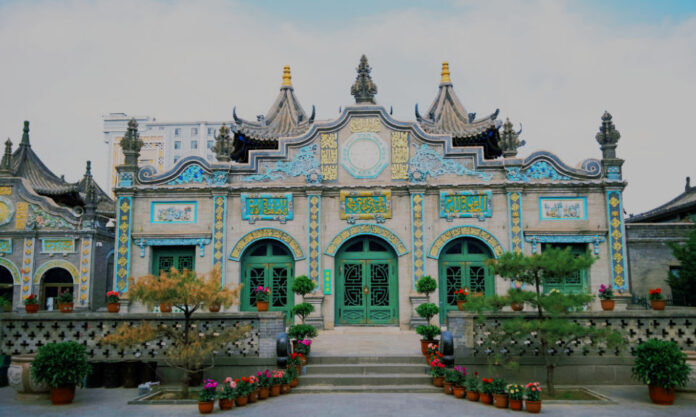
Just to the north is a Muslim quarter. The Great Mosque, the oldest and largest in the city, is recorded on a stele of 1694 as already standing, was enlarged in 1789 and 1923, and gained a moon-viewing tower in 1939, with a hall of about 4,000 square metres that faces west towards Mecca, according to Jiaxiangwang and Sina. According to Sina, Hui families moved here from Xinjiang in the Qianlong period. The Hui District gazetteer lists five religions there in 2005, with 24 places of worship, 132 clergy, 33,000 believers, eight mosques and one Catholic cathedral, according to the gazetteer via Sohu.
往北是穆斯林聚居的街区。据家乡网和新浪介绍,清真大寺是城里最古老、最大的清真寺,一六九四年的石碑已记载其存在,一七八九年和一九二三年扩建,一九三九年增建望月楼,礼拜大殿约四千平方米,朝向西方的麦加。据新浪介绍,清乾隆年间回民从新疆迁来。据《回民区志》经搜狐转载介绍,二零零五年回民区有五种宗教,二十四处活动场所、一百三十二名教职人员、三万三千名信教群众,八座清真寺和一座天主教总堂。
The mosques also show how things were rebuilt. The East Mosque, a Muslim school in the early nineteenth century, was shut during the Cultural Revolution and reopened in 1981, and the North Mosque was rebuilt in 1986 to 1988 and opened in October 1989, according to the gazetteer.
清真寺也显示了重建的过程。据《回民区志》介绍,清真东寺本是十九世纪初的一所经学小学,”文化大革命”期间被封闭,一九八一年重新开放;清真北寺一九八六至一九八八年重建,一九八九年十月开放。
The newest local business grew from the same district. In 1956 seven dairy farmers in Hui District formed a cattle-raising group that became Yili, according to the Economic Observer. China’s dairy industry association named Hohhot “China’s dairy capital” on 28 August 2005, according to the same source. Yili’s Modern Smart Health Valley now processes 6,500 tonnes of raw milk a day, and the city’s 13 mid-size and large plants handle 14,500 tonnes a day, the most of any big or mid-size Chinese city, according to Inner Mongolia News. Mengniu’s headquarters stand in the Shengle Economic Park in Horinger, according to Baidu Baike.
最新的本地产业也是从同一个区长出来的。据《经济观察报》介绍,一九五六年回民区七户奶农组成养牛合作小组,后来发展成伊利。据同一来源介绍,二零零五年八月二十八日中国乳制品工业协会把”中国乳都”的牌匾授予呼和浩特。据内蒙古新闻网介绍,伊利现代智慧健康谷如今每天处理鲜奶六千五百吨,全市十三座中大型乳品厂日处理鲜奶一万四千五百吨,居全国大中城市首位。据百度百科介绍,蒙牛总部设在和林格尔的盛乐经济园区。
In 2025 GDP reached ¥427.83 billion, up 5.2 percent, with the primary, secondary and tertiary sectors at 4.2, 30.1 and 65.6 percent, and the city made 2.68 million tonnes of dairy products, up 8.7 percent, according to the 2025 communiqué. The resident population was 3.661 million, but with 20,000 births and 24,000 deaths its natural growth rate was minus 1.1 per thousand, according to the same source.
据二零二五年统计公报,二零二五年全市地区生产总值四千二百七十八点三亿元,增长百分之五点二,三次产业占比为百分之四点二、三十点一和六十五点六,乳制品产量二百六十八万吨,增长百分之八点七。据同一来源介绍,年末常住人口三百六十六点一万人,但全年出生两万人、死亡两万四千人,人口自然增长率为千分之负一点一。
Getting There
前往呼和浩特
The railway that arrived in 1921 now carries high-speed trains. The Zhangjiakou–Hohhot and Beijing–Zhangjiakou lines opened together on 30 December 2019, cutting the fastest trip from 9 hours 15 minutes to 2 hours 9 minutes, according to the State Council and People’s Daily. The fastest of the daily trains from Beijing North to Hohhot East cover the 459 kilometres in 2 hours 9 minutes, with a second-class fare of ¥215, according to Ctrip and gaotie.com.cn. The first, G2410, left Hohhot East at 10.35 am that day, according to Inner Mongolia News.
一九二一年通到的铁路,如今跑着高铁。据国务院和人民网介绍,张呼高铁和京张高铁二零一九年十二月三十日同日开通,最快用时由九小时十五分缩短到两小时九分钟。据携程和高铁旅行网介绍,每天从北京北站开往呼和浩特东站的列车,最快的两小时九分钟跑完四百五十九公里,二等座票价二百一十五元。据内蒙古新闻网介绍,当天第一趟进京高铁G2410次十点三十五分从呼和浩特东站开出。
The overnight train still runs. The K89/K90 between Beijing and Ordos through Hohhot has operated since 1975, according to Baidu Baike. As of June 2026 the K90 leaves Hohhot at 21.35 and Hohhot East at 21.58 and reaches Beijing Fengtai at 07.11, and the K89 leaves Fengtai at 20.31 and reaches Hohhot at 06.03, according to the same source. The service was suspended on 31 July 2023 after flood damage on the Fengsha railway and restarted on 10 December 2024 with Fengtai as its Beijing terminal, according to Baidu Baike.
夜车仍在运行。据百度百科介绍,经呼和浩特往返北京与鄂尔多斯的K89/90次列车一九七五年开行。据同一来源介绍,截至二零二六年六月,K90次二十一点三十五分离开呼和浩特站,二十一点五十八分离开呼和浩特东站,次日七点十一分到达北京丰台;K89次二十点三十一分从丰台出发,六点零三分到达呼和浩特。据百度百科介绍,二零二三年七月三十一日丰沙铁路遭水害后停运,二零二四年十二月十日恢复,北京端改为丰台站。
Inside the city, the metro’s first line, the first in Inner Mongolia, opened on 29 December 2019, running 21.7 kilometres along Xinhua Avenue from Hohhot East station to the airport, according to Guangming Daily. According to The Paper, a perforated wall in the People’s Hall station is carved with Mongolian and Chinese text on the spirit of the Mongolian horse.
在市区内,据《光明日报》介绍,内蒙古第一条地铁一号线二零一九年十二月二十九日开通,沿新华大街从呼和浩特东站到机场,全长二十一点七公里。据澎湃新闻介绍,人民会堂站的一面冲孔板墙上,刻着蒙汉双语的文字,讲的是蒙古马精神。