



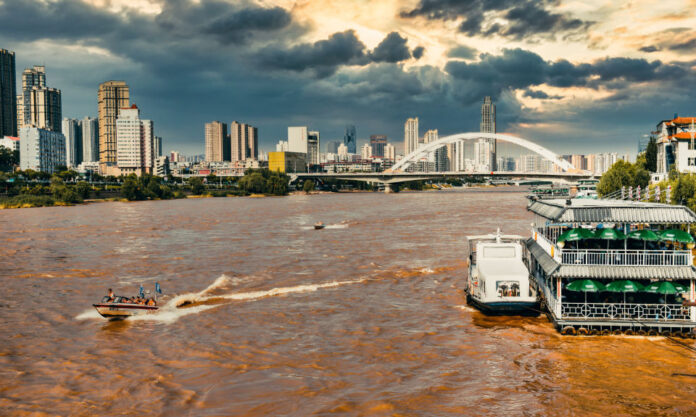



Smog once shrouded Lanzhou so thickly that it was described as invisible from satellites. Its air has since improved dramatically, while many of the noodle shops carrying the city’s name across China are actually run by entrepreneurs from neighbouring Qinghai.
兰州曾被浓重的烟雾笼罩,被形容为一座在卫星上看不见的城市。如今,其空气质量已显著改善,而全国各地许多挂着兰州招牌的面馆,其实是来自邻省青海的创业者开的。
One story played out in the skies above Lanzhou. The other has unfolded on shopfronts across China.
一个故事发生在兰州的天空之上,另一个则写在全国各地的面馆招牌上。
Lanzhou is the capital of Gansu and the only provincial capital the Yellow River runs straight through. It covers about 13,100 square kilometres and had 4.45 million residents at the end of 2025, 86 percent of them living in urban areas. The city promotes itself as the geometric centre of China’s land territory, although different methods of calculation produce different results; a monument marking one such calculation stands in neighbouring Dongxiang County.
兰州是甘肃省会,也是黄河唯一穿城而过的省会城市。全市面积约一万三千一百平方公里,二〇二五年末常住人口四百四十五万,城镇化率百分之八十六。兰州以“中国陆域版图几何中心”自称,不过不同的计算方法会得出不同结果;标示其中一种计算结果的纪念塔,位于邻近的东乡县。
The First Bridge on the Yellow River
黄河第一桥
The city grew out of the Han dynasty’s push west. Xinhua recounts that after Huo Qubing’s campaigns against the Xiongnu in 121 BCE, the general Li Xi was sent to the riverbank to choose a site and build a fortified town. The settlement would later become an important gateway to the Hexi Corridor and the Silk Road beyond. The Book of Han offers a plainer explanation for its old name, Jincheng, or “Golden City”: gold was found when the walls went up.
这座城市因汉朝向西开拓而兴起。据新华社介绍,公元前一二一年霍去病两度出击匈奴之后,关内侯李息奉命来到黄河岸边选址筑城。这座城后来成为通往河西走廊及丝绸之路的重要门户。至于“金城”这个古称,《汉书·地理志》给出的解释更直白:“初筑城得金,故曰金城。”
Crossing was the problem. The Paper notes that until the early 20th century, locals walked across winter ice bridges or took to inflated sheepskin rafts. In 1909 the Zhongshan Bridge opened, 233.5 metres long, designed by an American bridge company, built by the German firm Telge & Co and assembled by Chinese craftsmen. It was renamed in 1928 in honour of Sun Yat-sen and is known as the “first bridge under heaven on the Yellow River”.
过河曾是难题。据澎湃新闻介绍,直到二十世纪初,兰州人冬天还靠天然冰桥过河,平时则乘坐羊皮筏子。一九〇九年,中山桥建成通行,全长二百三十三点五米,由美国桥梁公司设计、德国泰来洋行承建、中国工匠施工;一九二八年为纪念孙中山改名“中山桥”,素有“天下黄河第一桥”之称。
On 8 October 2026, Charles Coltman, the great-nephew of the American engineer Robert Coltman, known in Chinese records as Man Baoben, walked across the bridge, Xinhua and China News Service reported. His family had known it for generations as “Rob’s bridge”.
据新华社和中新社报道,二〇二六年十月八日,当年参与建桥的美国工程师罗伯特·考特曼(中文名满宝本)的侄孙查尔斯·考特曼走上了中山桥。几代以来,这座桥在他们家族中一直被称为“罗布的桥”(Rob’s bridge)。
Water from the river also had to be lifted to irrigate the fields. The China Intangible Cultural Heritage Network credits Duan Xu with building Lanzhou’s first giant waterwheel in 1556, adapting a design he had seen in Yunnan. The largest wheels were more than 20 metres across, and a single wheel could irrigate some 50 hectares of farmland. In 1952 there were still 252 turning on the Lanzhou banks.
黄河水还需要被引上岸用于灌溉。据中国非物质文化遗产网介绍,公元一五五六年,段续借鉴云南的筒车灌溉技术,在兰州创制了黄河水车。大者直径二十多米,一架水车可灌溉约七百至八百亩农田。一九五二年,兰州黄河岸边仍有水车二百五十二架。
The rafts survive today as a tourist attraction. Xinhua reported in June 2026 that the raftsman Niu Qiang takes at least three months to make one, and keeps the skins supple with salt and linseed oil, a method handed down through generations.
羊皮筏子如今作为旅游项目保存了下来。据新华社二〇二六年六月报道,筏工牛强说,做好一个筏子至少需要三个月;在皮囊里灌入盐与胡麻油,是代代相传的保养方法。
The city’s most famous archaeological treasure was found elsewhere. Dating from the Eastern Han dynasty, the bronze Galloping Horse, known popularly as Ma Ta Fei Yan, or “horse treading on a flying swallow”, was unearthed in September 1969 by villagers in Wuwei who were digging an air-raid shelter, The Paper reports. Now in the Gansu Provincial Museum in Lanzhou, it balances on a single hoof resting on the back of a flying bird, with its other three hooves in the air. Xinhua notes that it became China’s tourism emblem in 1983 and was barred from overseas exhibition in 2002.
这座城市最负盛名的考古珍宝,却出土于别处。据澎湃新闻介绍,这件东汉铜奔马(俗称“马踏飞燕”)是一九六九年九月武威村民挖防空洞时发现的,如今藏于兰州的甘肃省博物馆。奔马三足腾空,一足踏在一只展翅飞鸟的背上。据新华社介绍,一九八三年铜奔马被确定为中国旅游标志,二〇〇二年被列入首批禁止出国展览的珍贵文物。
The City Satellites Could Not See
卫星上看不见的城市
Large-scale industrialisation accelerated with China’s first Five-Year Plan. Jiemian reports that a 1953 Soviet aid agreement provided for a refinery processing a million tonnes of crude a year, sited at Lanzhou because China’s largest oilfield was then at Yumen in Gansu. On 18 September 1958, China Energy News recorded, it produced its first batch of fuel, marking a milestone in China’s efforts to reduce its dependence on imported petroleum products.
兰州的大规模工业化进程随着第一个五年计划而加速。据界面新闻介绍,一九五三年中苏援建协定明确在中国建设一座年处理原油一百万吨的炼油厂,之所以选址兰州,是因为当时中国最大的油田就在甘肃玉门。据《中国能源报》记载,一九五八年九月十八日,兰州炼油厂炼出第一批成品油,成为中国减少对进口石油产品依赖的重要里程碑。
Hemmed into a narrow valley, the city trapped its own smoke. Locals told Dialogue Earth that in the 1970s a face mask worn in the morning would be black by noon. WHO air-quality reports published in 2011 and 2014 placed Lanzhou bottom among Chinese cities both times, Dialogue Earth notes, and the climate envoy Xie Zhenhua described it as “a city you cannot see from satellites”.
兰州夹在狭窄的河谷中,污染物难以扩散。当地人向“中外对话”回忆,上世纪七十年代,早上戴着口罩出门,中午回家口罩就变黑了。据“中外对话”介绍,世界卫生组织二〇一一年和二〇一四年发布的空气质量报告中,兰州两次在中国城市中垫底;中国气候变化事务特别代表解振华形容它是“在卫星上看不到的城市”。
Some of the cures were drastic. Xinhua reported that in 1998 the municipal government decided to flatten the 300-metre Daqing Mountain at the city’s eastern gate in the hope of letting fresh air into the city. The problem, as Xinhua later observed, was that beyond the mountain lay more mountains.
有的“治霾药方”十分大胆。据新华社报道,一九九八年,兰州市政府决定削平城市东大门三百多米高的大青山,希望借此引入新鲜空气。然而,正如新华社后来指出的,山外还是山。
What worked in the end was less dramatic. In less than two years, all 1,286 coal-fired heating boilers in the main urban area were either converted to natural gas or replaced by connections to combined heat and power networks, the Gansu Provincial People’s Congress reported. Xinhua recorded 252 days meeting national air quality standards in 2015. By 2025, the figure had risen to 312 days, or 85.5 percent of the year, according to Lanzhou’s environmental authorities. Dust storms, rather than industrial smoke alone, remain a challenge.
真正取得成效的,却是更为务实的治理措施。据甘肃人大网报道,不到两年时间,兰州主城区一千二百八十六台燃煤供热锅炉全部完成煤改气或热电联产并网改造。据新华社报道,二〇一五年兰州空气质量优良天数为二百五十二天;据兰州市生态环境部门公布的数据,到二〇二五年,这一数字已增至三百一十二天,占全年的百分之八十五点五。除工业排放外,沙尘天气仍是当地面临的一大挑战。
A Bowl and a Borrowed Name
一碗面与一个借来的名字
Locals call it beef noodles, not lamian. The Paper’s account of the dish’s heritage listing traces it to Ma Baozi, a Hui street vendor, and sets out its standard: “one clear, two white, three red, four green, five yellow”, meaning clear broth, white slices of radish, red chilli oil, green coriander and garlic shoots, and yellowish noodles. China News Service reports that Ma opened his first shop in 1919. A separate essay published by The Paper warns that the widely circulated Qing poems praising the dish are modern inventions.
兰州人管它叫“牛肉面”,而不是“拉面”。澎湃新闻介绍兰州牛肉面制作技艺这一非遗项目时,将其源头追溯到回族小贩马保子,并概括其标准为“一清二白三红四绿五黄”:汤清、萝卜白、辣子油红、蒜苗香菜绿、面条黄亮。据中新网报道,马保子于一九一九年开了第一家面馆。澎湃新闻刊发的另一篇文章则提醒,广为流传的赞美牛肉面的清代诗词,其实都是今人臆造的。
Many of the shops that popularised the name are run by Qinghai entrepreneurs. Jiemian reports that in 1988 Ma Guifu, a farmer from Hualong in neighbouring Qinghai, raised ¥5,000 and opened a noodle shop in Xiamen under the “Lanzhou lamian” sign. Many followed. Qinghai’s noodle industry now runs more than 30,000 shops and employs some 203,000 people, though not all of those shops carry Lanzhou’s name. In 2010 Lanzhou registered “Lanzhou beef lamian” as a geographical-indication trademark. Since 2024, Qinghai has been helping shops switch to “Qinghai lamian” signs, and about 1,000 had done so, the head of the Qinghai noodle association told Jiemian.
把这个名字带遍全国的面馆,许多是青海人开的。据界面新闻报道,一九八八年,邻省青海化隆农民马贵福筹措五千元,在厦门挂出“兰州拉面”招牌开了一家面馆,此后效仿者众多。如今青海拉面门店超过三万家,从业人员约二十万三千人,但并非每家都挂着兰州的名字。二〇一〇年,兰州注册了“兰州牛肉拉面”地理标志证明商标。青海省拉面协会会长马丽萍向界面新闻介绍,青海自二〇二四年起推动门店换上“青海拉面”招牌,全国已有约一千家门店完成更换。
The menu goes well beyond noodles. China Railway’s guide to the city lists hand-eaten lamb, known locally as shouzhua, alongside braised lamb and chilli-roasted meat, and recommends an afternoon of the local sanpaotai tea, taken in deckchairs on the riverbank.
兰州美食远不止一碗牛肉面。中国铁路官方账号的城市介绍里,还有手抓羊肉、黄焖羊肉和辣子烤肉;下午则推荐在黄河边的躺椅上,细品一杯“三泡台”。
Crossroads of the North-West
西北交通枢纽
The geographical advantages that drew the Han to Lanzhou still serve the city today. China Railway lists the conventional lines that converge here: the Longhai, Lanzhou–Xinjiang, Lanzhou–Qinghai, Baotou–Lanzhou and Lanzhou–Chongqing railways. It also lists four high-speed lines, linking the city with Xinjiang, Baoji, Yinchuan and Zhangye. Trains bound for Tibet continue from Xining.
两千多年前汉朝看中的地理优势,如今依然发挥着作用。据中国铁路官方介绍,陇海、兰新、兰青、包兰、兰渝等普速铁路,以及兰新、宝兰、银兰、兰张等高速铁路在此交会。前往西藏的列车,则经西宁继续西行。
According to the city’s statistics bulletin, GDP reached ¥390.36 billion in 2025, up 5.5 percent, with services accounting for 65.6 percent.
据兰州市统计公报,二〇二五年全市地区生产总值三千九百零三点六一亿元,增长百分之五点五,第三产业占比百分之六十五点六。
Lanzhou Zhongchuan International Airport opened its T3 terminal on 20 March 2025, four times the size of its two older terminals combined and designed for 38 million passengers a year, Xinhua and China News Service reported. A railway station beneath the terminal provides direct access to the departures hall. According to the Lanzhou New Area government, the airport handled a record 17.74 million passengers in 2025, up 4.32 percent on the previous year.
据新华社和中新社报道,二〇二五年三月二十日,兰州中川国际机场T3航站楼启用,面积是原有T1、T2航站楼总和的四倍,可满足年旅客吞吐量三千八百万人次的需求;航站楼地下的中川机场东站让旅客乘电梯即可直达候机大厅。据兰州新区官方网站发布的数据,二〇二五年,中川机场旅客吞吐量达一千七百七十三点五万人次,同比增长百分之四点三二,再创历史新高。
Below the century-old Zhongshan Bridge, sheepskin rafts still drift down the Yellow River. Above them hangs a sky considerably clearer than the one Lanzhou’s residents remember.
百年中山桥下,羊皮筏子依旧顺着黄河漂流。头顶的天空,比兰州人记忆中的那片天空清朗了许多。