



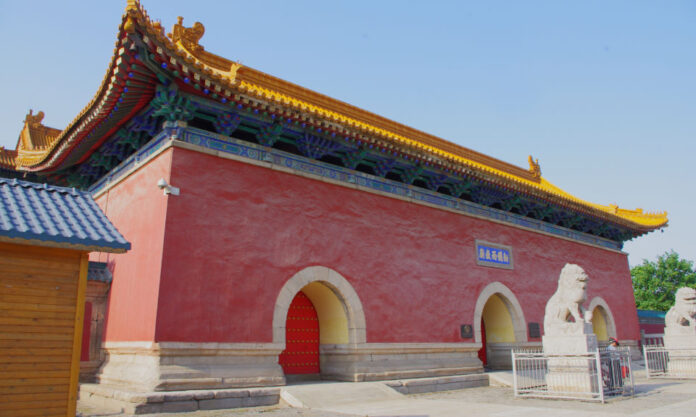



Weinan holds the world’s grimmest record. Around midnight on 23 January 1556, an earthquake centred on Hua County is estimated to have claimed more than 830,000 lives, more than any other earthquake in history.
渭南保持着一项世界上最惨痛的纪录。一五五六年一月二十三日午夜前后,以华县为中心的一场地震,估计夺去了八十三万多人的生命,是有史以来死亡人数最多的地震。
The same ground now carries trains at 350 kilometres an hour.
如今,同一片土地上跑着时速三百五十公里的列车。
Estimates of the quake’s magnitude run from about 7.5 to 8. A plaque put up three years later described the earth cracking, water gushing out, and city walls and houses sinking into the ground.
对这场地震震级的估计,在七点五级到八级之间。三年后立起的一块碑记载,大地开裂,地下水涌出,城墙和房屋陷入地中。
The Night the Ground Opened
大地裂开的那一夜
The Ming court annals recorded more than 830,000 identifiable deaths, with countless others unaccounted for, according to a 2017 study by the geophysicist Jean-Paul Poirier. The Hua County gazetteer gives the annals’ wording: officials, soldiers and commoners “crushed to death, reported by name, more than 830,000”.
据地球物理学家让-保罗·普瓦里耶(Jean-Paul Poirier)二〇一七年的研究,明代官修史书记载,有名可查的死者超过八十三万,此外无从查考者不计其数。《华县志》引述了史书原文:“压死官吏军民奏报有名者八十三万有奇。”
Not all of them died in the shaking. A 2020 geophysical study suggests that famine and disease in the aftermath may account for a substantial share of the toll. The disaster area covered some 900,000 square kilometres across 185 counties, Fatima Wu writes for EBSCO, and most people were asleep when it struck.
并非所有人都死于震动本身。二〇二〇年的一项地球物理研究认为,震后的饥荒和疫病可能造成了相当一部分死亡。Fatima Wu在EBSCO撰文称,受灾面积约九十万平方公里,涉及一百八十五个县;地震发生时,大多数人正在睡觉。
One survivor left advice that anticipates some modern earthquake-safety guidance. Qin Keda, a young scholar near Xi’an, was thrown to the floor, escaped through a gap in the wall and found his family outside, the historian James Carter writes in The China Project. Qin recorded that 70 percent of people died in Tongguan and Puban, and he told readers caught indoors to stay put, crouch, cover their heads and get under furniture if they could.
一位幸存者留下的建议,与今天的一些防震常识不谋而合。历史学家柯杰(James Carter)在The China Project撰文称,西安附近的年轻学子秦可大被震倒在地,从墙缝里逃出,在屋外找到了家人。秦可大记下潼关、蒲坂一带死者十之七,并告诫后人:若身在屋内,不要急于往外跑,应就地蹲下,护住头部,能躲到家具下面最好。
Water Backing Up the Wei
倒灌渭河的水
Four centuries later the ground gave way to water. Building the Sanmenxia Dam on the Yellow River displaced 403,700 people from the wider reservoir area, a 1982 study found, and 196,400 of the early resettlers came from Shaanxi, according to Li Chen’s 1991 review in People’s Yellow River.
四百年后,土地让位给了水。据李晨一九九一年发表在《人民黄河》上的回顾文章,一九八二年的一项研究发现,黄河三门峡水库的修建使整个库区四十万三千七百人迁离家园,其中早期移民中有十九万六千四百人来自陕西。
Many were moved onto dry tableland north of the Wei River valley, where water had to be carried three or four kilometres. In 1957, 39,300 people from Shaanxi and Henan were sent to Ningxia and Gansu, and they were brought back in 1962. By the mid-1980s, Li writes, more than half the resettlers lived in relative poverty.
很多移民被安置到渭河谷地以北干旱的塬上,吃水要走三四公里去挑。一九五七年,陕西、河南的三万九千三百人被送往宁夏和甘肃,一九六二年又被接回库区。李晨写道,到二十世纪八十年代中期,半数以上的移民生活相对贫困。
Mount Hua, Sima Qian and the Railway
华山、司马迁和高铁
Mount Hua, one of China’s Five Great Mountains, is generally regarded as the most precipitous of them. Its Changkong plank walk clings to a cliff at 2,160 metres, and CCTV reported that visitors call it “Mount Hua’s number one danger”. In 2025 workers replaced its safety cable, more than 200 metres long, which had been strung in 2019 through 88 anchor points along the planks and ladders.
华山是五岳之一,一般认为也是其中最险峻的一座。据央视报道,长空栈道悬在海拔两千一百六十米的崖壁上,被游客称为“华山第一险”。二〇二五年,工人们更换了栈道上的安全钢缆;这条钢缆长两百多米,二〇一九年安装,沿木板和铁梯连着八十八个锚点。
The district’s other famous name is Sima Qian, author of the Shiji, from Hancheng. Every year tens of thousands of students in Hanfu recite his Letter to Ren An at the Sima Qian Temple there, Guangming Daily reported.
渭南另一张有名的名片是韩城人司马迁,《史记》的作者。《光明日报》报道,每年都有数万名学子身着汉服,在司马迁祠诵读他的《报任安书》。
Weinan’s economy reached ¥223.18 billion in 2025, up 5.6 percent, according to the municipal statistics bureau’s 2025 bulletin, which also gives a year-end population of 4.5338 million. For flights, travellers use Xi’an Xianyang International Airport.
据渭南市统计局二〇二五年统计公报,全市生产总值二千二百三十一亿七千六百万元,增长百分之五点六;年末常住人口四百五十三万三千八百人。坐飞机要去西安咸阳国际机场。
The trains came in 2010. The Zhengzhou–Xi’an high-speed railway opened on 6 February that year, People’s Daily Overseas Edition reported, as the world’s first 350 kilometre-an-hour line built on collapsible loess. In 1556 city walls sank into this ground; since 2010 they have held up the line.
列车是二〇一〇年来的。《人民日报海外版》报道,郑西高铁于当年二月六日开通,是世界上第一条建在湿陷性黄土地区、时速三百五十公里的高速铁路。一五五六年,城墙陷进了这片土地;二〇一〇年以来,它稳稳托起了这条铁路。