






Chifeng has given its name to eight prehistoric cultures, yielded some of the world’s earliest known cultivated millet, and is the only prefecture-level city officially called China’s hometown of nonferrous metals. It also gets 2,800 to 3,100 hours of sunshine a year in most places.
赤峰的地名被用来命名八种史前文化,这里出土了世界已知最早的一批人工栽培粟黍遗存,也是全国唯一被正式冠以”中国有色金属之乡”的地级市。大部分地区每年日照时数在二千八百至三千一百小时之间。
Eight Cultures and a Dragon
八种文化与一条龙
Eight prehistoric cultures are named after places in Chifeng, according to the city government. The oldest, Xiaohexi, is about 9,000 years old, Xinglongwa runs from 8,150 to 7,350 years ago, Zhaobaogou from 7,350 to 6,420 and Hongshan from 6,660 to 5,000, according to the same source. Four of them were first found in Aohan Banner alone, according to Sina. The Xinglongwa village is called the “first village of Huaxia”, and the oldest known Chinese jade dates to this period, according to the city government and China News Service.
据市政府介绍,赤峰境内有八种史前文化以当地地名命名。同一来源介绍,最早的小河西文化距今约九千年,兴隆洼文化距今八千一百五十至七千三百五十年,赵宝沟文化距今七千三百五十至六千四百二十年,红山文化距今六千六百六十至五千年。据新浪新闻介绍,其中四种仅在敖汉旗就被发现和命名。据市政府和中国新闻网介绍,兴隆洼聚落被誉为”华夏第一村”,中国已知最早的玉器也出自这一时期。
The most famous find is a C-shaped jade dragon from Sanxingtala in Wengniute Banner, called the first dragon of China, according to the city government. The Hongshan jade pig-dragons that followed shaped the coiled dragons of the Shang and Zhou, according to the archaeologist Liu Guoxiang, quoted by China News Service. The Liao dynasty later put two of its capitals here, Shangjing in Balin Left Banner and Zhongjing in Ningcheng, according to the city government.
最有名的发现是翁牛特旗三星他拉出土的C形玉龙,据市政府介绍,被誉为”中华第一龙”。据中国新闻网引述考古学家刘国祥介绍,随后出现的红山文化玉猪龙,影响了商周时期蜷体玉龙的造型。据市政府介绍,辽代把两座都城建在这里,即巴林左旗的上京和宁城县的中京。
Millet from the Ground
土里的小米
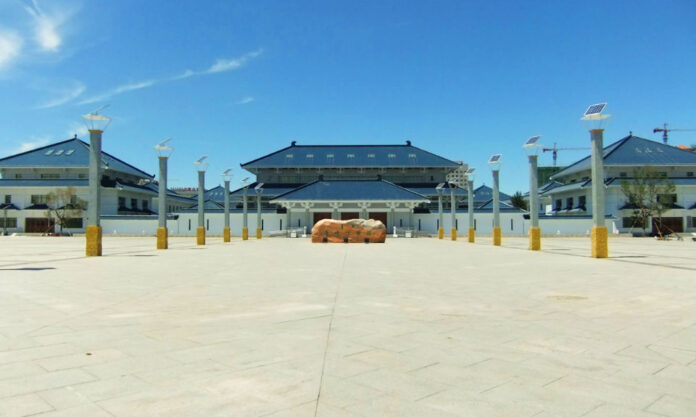
In 2001 to 2003 archaeologists digging at Xinglonggou in Aohan found more than 1,500 charred grains of cultivated millet, 90 percent broomcorn and 10 percent foxtail, which carbon-14 dating put at about 8,000 years old, according to Xinhua. At the time they were the earliest millet known, and 2,700 years older than any found in central Europe, according to China’s agriculture ministry. In 2012 the UN Food and Agriculture Organization listed Aohan’s dryland farming system as a Globally Important Agricultural Heritage System, according to Sina. Millet is still grown there, and a museum opened in 2018 shaped like a jade ring around three clay pots, according to Xinhua.
二零零一至二零零三年,考古人员在敖汉旗兴隆沟遗址发现一千五百多粒经过人工栽培的炭化粟黍,其中黍占百分之九十,粟占百分之十,据新华网介绍,经碳十四测定约为八千年前。据农业农村部介绍,它们在发现时是已知最早的粟黍遗存,比中欧地区发现的谷子早二千七百年。据新浪新闻介绍,二零一二年联合国粮农组织把敖汉旱作农业系统列为全球重要农业文化遗产。据新华网介绍,那里至今仍种着小米,二零一八年建成的小米博物馆形如一块玉玦,环绕着三个陶罐。
Sun, Metal and a Shrinking Population
阳光、金属与缩小的人口
Sunshine runs at 65 to 70 percent of the possible total in most areas, according to the China Weather Network. Chifeng’s own meteorological bureau rates its solar resource as abundant, with annual radiation above 5,050 megajoules a square metre in most areas.
据中国天气网介绍,大部分地区日照百分率在百分之六十五至七十之间。据赤峰市气象局介绍,当地太阳能资源丰富,大部地区年总辐射量在每平方米五千零五十兆焦以上。
Under the ground the city has found 86 minerals and more than 1,600 deposits, with a potential value above ¥5 trillion, according to Inner Mongolia Daily. It was named China’s hometown of nonferrous metals in 2010, the only prefecture-level city to be, according to the city government. The newspaper calls the Weilasituo lithium mine the world’s largest of the lepidolite type, the Shuangjianzishan silver mine the biggest in Asia, the Huanggang deposit the biggest iron and tin deposit north of the Yellow River, and the Bai Yinuoer mine the biggest lead and zinc mine north of the Yangtze. Chifeng’s remaining tin reserves are about 60 percent of China’s total, according to Inner Mongolia Practice in 2026. Gold, coal at about 3 billion tonnes, fluorite, limestone, marble, silica, perlite and bentonite complete the list, according to the city government and Baidu Baike.
在地下,据《内蒙古日报》介绍,全市已发现八十六种矿产、一千六百多处矿床,潜在经济价值超过五万亿元。据市政府介绍,二零一零年赤峰被命名为”中国有色金属之乡”,是全国唯一获此称号的地级市。这家报纸称维拉斯托锂矿是世界最大的锂云母型锂矿,双尖子山银矿是亚洲最大的银矿,黄岗是黄河以北最大的铁锡共存矿床,白音诺尔是长江以北最大的铅锌矿。据《内蒙古实践》二零二六年介绍,赤峰锡的保有储量约占全国的六成。据市政府和百度百科介绍,黄金、约三十亿吨煤炭,以及萤石、石灰石、大理石、硅石、珍珠岩和膨润土,也在清单上。
The metals mostly leave as concentrate or lightly smelted, and deep-processed copper, lead and tin products are still missing, according to Inner Mongolia Practice.
据《内蒙古实践》介绍,这些金属大多以精矿或初级冶炼品的形式运出,铜、铅、锡的深加工产品仍是空白。
The people are fewer each year. The 2020 census counted 4,035,967 residents, of whom 20.18 percent were Mongol and 75.88 percent Han, according to the city statistics bureau. At the end of 2025 there were 3.887 million, with 16,900 births against 34,900 deaths and 26.39 percent aged 60 or over, according to the 2025 communiqué. GDP was ¥240.71 billion, up 4.9 percent, according to the same source.
人口逐年减少。据市统计局介绍,二零二零年普查全市常住人口四百零三万五千九百六十七人,其中蒙古族占百分之二十点一八,汉族占百分之七十五点八八。据二零二五年统计公报,二零二五年末常住人口三百八十八点七万人,全年出生一点六九万人,死亡三点四九万人,六十岁及以上占百分之二十六点三九;地区生产总值二千四百零七点一亿元,增长百分之四点九。
Getting There
前往赤峰
Chifeng has direct high-speed trains to Beijing Chaoyang station, calling at Chengde South and Miyun or Shunyi West on the way, according to Ctrip. Most take 2 hours 30 minutes to 3 hours, and the overnight train from Chifeng South to Beijing Fengtai takes about 11 and a half hours, according to the same source.
据携程介绍,赤峰有直达北京朝阳站的高铁,沿途停靠承德南和密云或顺义西。同一来源介绍,多数车次用时二小时三十分至三小时,而夜间从赤峰南开往北京丰台的列车约需十一个半小时。
According to Ctrip, the fastest high-speed train takes 2 hours 16 minutes from Chifeng to Beijing Chaoyang.
据携程介绍,最快的高铁从赤峰到北京朝阳用时二小时十六分。