





The night hums in Nanjing like a half-remembered
melody; familiar, chaotic, irresistible.
夜晚在南京嗡嗡作響,就像半信半疑的旋律;熟悉、混乱、不可抗拒。
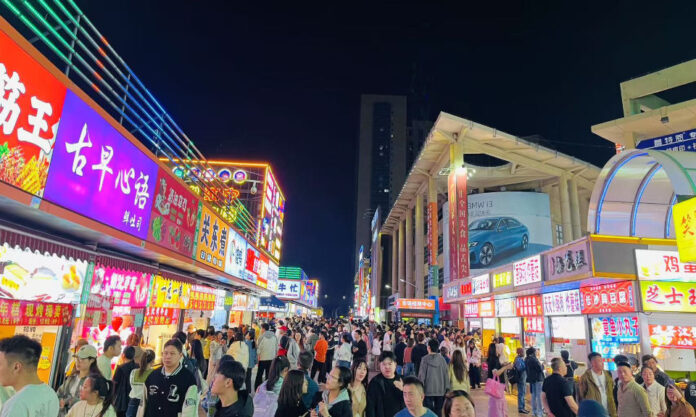
Skewers sizzle on open flames, sending curls of cumin- laced smoke into the air. The clang of frying woks punctuates the dusk like percussion, each metallic hit followed by the rhythmic chop-chop-chop of spring onions, garlic and coriander on worn wooden boards.
烤串在明火上发出嘶嘶作用,将卷曲的孜然烟雾吹向空中。 油炸锅的叮当声像打击乐器一样点缀着黄昏,每一次金属击球后,在破旧的木板上有节奏地切碎葱、大蒜和香菜。
Vendors shout out their specials with gusto of auctioneers; from stinky tofu to BBQ, with ice cream and milk tea thrown in for those with a sweet tooth. Their calls mingle with the low thrum of “外卖” (take out; delivery) scooters weaving through foot traffic. The neon signage just adds to the pulse of it all.
小贩们以拍卖师的热情大喊他们的特价商品;从臭豆腐到烧烤,还有冰淇淋和奶茶,供那些喜欢吃甜食的人使用。 他们的呼唤与“外卖”(外卖;送货)滑板车在人流中穿梭的低声混合在一起。 霓虹灯标牌只是增加了这一切的脉搏。
I’d argue that for any city in China, its true soundtrack is not found in concert halls or stadiums, but in the clatter of ladles and other cooking utensils and the chatter and bark of food names and prices called out over rickety food carts. Nanjing is no exception to speaking in sizzles and steam. Look down any late-night alley (or if you’re lucky on a random street corner when the sun sets) and you’re sure to find the steam rising from bamboo baskets or the smoky perfume of grilled meat skewers. Here, on the street, Nanjing feeds both body and soul.
我认为,对于中国的任何城市来说,其真正的配乐不是在音乐厅或体育场,而是在勺子和其他炊具的嚎嚎叫声,以及在摇摇欲苢的餐车上呼出的食物名称和价格的喋喋喋不休和吠叫中。 南京也不例外,在热气和蒸汽中说话。 向下看任何深夜的小巷(或者如果你幸运地在太阳落山时随机的街角),你一定会发现从竹篮里升起的蒸汽或烤肉串的烟熏香味。 在这里,在街上,南京滋养着身体和灵魂。
Look on the multitude of recommendations on Little Red Book and you’ll find a list of places downtown to satisfy your hunger.
看看《小红皮书》上的众多推荐,你会发现一份市中心满足你饥饿的地方列表。
Ke Xiang (科巷), Cha Nan Jie (茶南大街), Alley 378 (三七八巷), Laomendong (老东门) and Hongmiao Jie (红庙街) are all great places to wander down and eat a variety of Nanjing delicacies but for convenience’s sake (or at least where my e-bike could take me without being drained of battery) I explored and personally recommend (PR) three “美食街” in the south of the city. My top picks:
科巷、茶南大街、三七八巷、老东门和红庙街都是逛逛吃各种南京美食的好地方,但为了方便起见(或者至少为了我的电动自行车可以带我去而不耗尽电池的地方),我探索并亲自推荐(PR)城市南部的三条“美食街”。 我的首选:
Lele Jie (乐乐街; closest metro: Nanjing South Railway
Station, Exit 6). PR: Try the “烤苕皮”; a Chongqing street food delicacy; and “炸串”
乐乐街(最近的地铁:南京南站,6号出口)。 公关:试试“烤苕皮”;重庆街头美食;和“炸串”
Tuolejia (托乐嘉; see cover photo; closest metro: Cuiping Shan, Exit 3). PR: Try the “爆肚粉” or “肉夹馍”!
托乐嘉(托乐嘉;见封面照片;最近的地铁:翠平山,3号出口)。 公关:试试“爆肚粉”或“肉夹馍”!
Nanjing Yiwu (南京义乌; closest metro: Longmian Avenue, Exit 2). PR: There’s far too much choice at the Nanjing Yiwu Food Street! You can practically travel to all four corners of China along this food street (although street is definitely the wrong word to describe it, more like food maze!). Al-Jannat also opened their new restaurant here, so it’s worth the visit if you also fancy some Indian food.
南京义乌(南京义乌;最近的地铁:龙面大道,2号出口)。 公关:南京义乌美食街的选择太多了! 你实际上可以沿着这条美食街旅行到中国的四个角落(尽管街道绝对是一个错误的词来形容它,更像是美食迷宫!)。 Al-Jannat也在这里开了他们的新餐厅,所以如果你也喜欢印度菜,那就值得一去。
Street food in Nanjing isn’t just about convenience. To eat on the street in Nanjing is to become part of a shared, if fleeting, intimacy.
南京的街头小吃不仅仅是为了方便。 在南京的街头吃饭就是成为共享的,即使转瞬即逝的亲密关系的一部分。
The stranger beside you also queues for spicy duck neck or their “羊肉串”. If you’re tough enough to brave the cold, there’s something almost ethereal about the steam rising in the winter air, and for a moment, everything feels simpler.
你旁边的陌生人也在排队吃辣鸭颈或他们的“羊肉串”。 如果你足够坚强,可以冒着寒冷,冬天的空气中升起的蒸汽几乎有些空灵,有那么一瞬间,一切都感觉更简单了。
Some call it informal, even chaotic and dare I say even “unclean”. But others know; street food is where the city’s heart beats loudest.
有些人称它为非正式,甚至混乱,我甚至敢说“不干净”。 但其他人知道;街头小吃是城市心跳最响亮的地方。
In a world of apps and algorithms, where tastes are curated and meals can arrive without human interaction, Nanjing’s street food vendors offer something raw, immediate, and deeply human.
在一個由應用程式和算法組成的世界里,口味是精心策劃的,飯菜可以在沒有人際互動的情況下到達,南京的街頭食品供應商提供了一些原始、直接和深刻的人性的東西。