







Zhongshan Wharf is where, on 23 April, 1949, troops of the People’s Liberation Army landed to recapture Nanjing. It was the last time the city would be capital of China.
1949年4月23日,中国人民解放军部队登陆夺回南京的地方是中山码头。 这是这座城市最后一次成为中国的首都。
But the story of this, one of Nanjing’s most iconic buildings, goes back nearly another quarter of a century. Today’s Zhongshan wharf was built in 1925; on 8 August, 1928, the wharf was completed and named “Capital Wharf of the Jinpu Railway” (Tianjin-Pukou Railway).
但这个故事是南京最具标志性的建筑之一,可以追溯到近四分之一个世纪。 今天的中山码头建于1925年;1928年8月8日,码头建成,并命名为“金浦铁路首都码头”(天津-浦口铁路)。
History was then to unfold and the wharf would find itself bang in the middle of events regarded as among the 20th century’s most significant.
那时,历史将展开,码头将发现自己在被认为是20世纪最重要的事件之一的中间。
Sun Yat-sen (Sun Zhongshan) died in Beiping (now Beijing) in 1925. According to his last wish to be buried in Nanjing, on 28 May, 1929, his coffin was moved from Beijing to its final resting place in the Zhongshan Mausoleum on Purple Mountain. With the Wharf being the landing point in Nanjing for that coffin, it was felt fitting to rename the wharf in his memory.
1925年,孙中山在北平(今北京)去世。 根据他被埋葬在南京的最后愿望,1929年5月28日,他的棺材从北京搬到了紫山中山陵的最后安息之地。 由于码头是那个棺材在南京的着陆点,为了纪念他,重新命名码头是合适的。

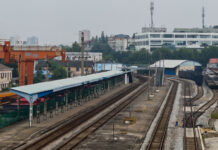

It is also important to note that this was in fact also a landing point for a train ferry. On the north side of the Yangtze River was the terminus of the Tianjin-Pukou railway at the now-beautifully restored Nanjing Pukou Railway Station. Before the train ferry, passengers would need alight and take to the ferry on foot, but its arrival meant they could stay on the train, while the carriages in which they sat were shunted on to the ferry.
同样重要的是要注意,这实际上也是火车渡轮的著陸点。 在长江的北侧,天津-浦口铁路的终点站是现已修复精美的南京浦口火车站。 在火车渡轮之前,乘客需要下车并步行前往渡轮,但渡轮的到来意味着他们可以留在火车上,而他们乘坐的车厢则被转移到渡轮上。
In 1933, Nanjing Railway Bureau rebuilt Zhongshan wharf and added a 100 metre-long barge, three steel trestles and a waiting room. The road from the Wharf to Yijiang Men was also later widened and a large car park built.
1933年,南京铁路局重建了中山码头,并增加了一条100米长的驳船、三个钢架和一个候车室。 从码头到宜江门的道路后来也拓宽了,并建造了一个大型停车场。
With two floors on both sides and three floors in the centre section, the wharf’s facade is the epitome of the Republic of China, while actual ferry embarking and disembarking takes place to the rear of the building. The second floor on the right is the ferry-ticket office and night-tour ticket office, while the middle part sits largely idle.
码头的立面两侧有两层,中间有三层,是中华民国的缩影,而实际的渡轮上船和下船则在建筑物的后面进行。 右边的二楼是渡轮售票处和夜游售票处,而中间部分大部分闲置。
In 1968, with the Nanjing Yangtze River Bridge complete and open to traffic, demand for ferry crossings of the River decreased sharply and passenger throughput at Zhongshan Wharf began to quickly ebb.
1968年,随着南京长江大桥建成并向交通开放,渡河需求急剧下降,中山码头的客运量开始迅速下降。
At its peak, the Wharf saw about 150 ferry crossings daily, moving more than 100,000 people across the River. Today, less than 10,000 cross the River in this way each day.
在高峰期,碼頭每天有大约150次渡口渡口,有10多万人穿越河流。 今天,每天只有不到10,000人以这种方式过河。
The 2.8-kilometre ferry ride takes around 15 minutes and a one-way fare is ¥2. Use the Nanjing “Jinlingtong” transportation card and get it half price.
乘坐2.8公里的渡轮大约需要15分钟,单程票价为2元。 使用南京“金陵通”交通卡,半价。
Meanwhile, that thought to be the Zhongshan Wharf Waiting Hall, located at 21 Jiangbian Lu, is an Important Modern Historical Site and Representative Building, as well as a District-Level Cultural Relics Protection Unit. With its hazy historical record, other theories abound as to the building’s true purpose at the time.
同时,位于江边路21号的中山码头候车厅是重要的现代历史遗迹和代表建筑,也是区级文物保护单位。 凭借其模糊的历史记录,关于该建筑当时的真正目的的其他理论比比皆是。