



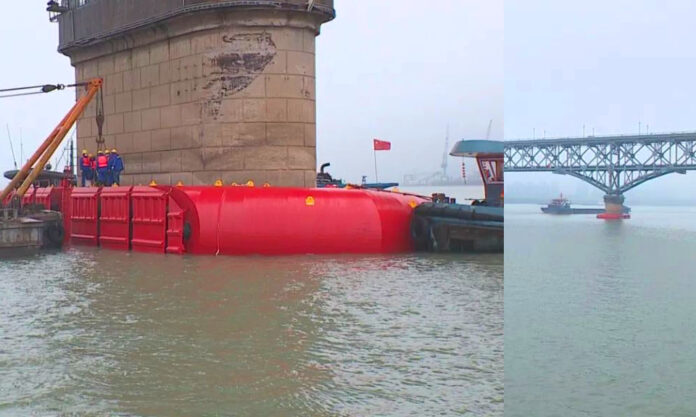



With the exception of not inconsiderable weathering, the physical appearance of our-beloved Nanjing Yangtze River Bridge has remained unchanged for its 55 year history. That’s now changing, with the installation of protective rings around its piers.
除了不小的风化外,我们敬爱的南京长江大桥的外观在其55年的历史中一直没有改变。现在,随着码头周围安装了保护环,情况正在发生变化。
To give them their proper name, flexible guided anti-collision devices (FGAD), are presently being fitted to what is arguably Nanjing’s most iconic structure, giving the Bridge its first splash of colour since a 2018 restoration.
柔性引导防撞装置(FGAD)目前正在被安装在可以说是南京最具标志性的建筑上,这给大桥带来了自 2018 年修复以来的第一抹色彩。
Installation of the FGAD around pier #6 of the Nanjing Yangtze River Bridge was completed on 12 February. Work is at present continuing to fit the devices around piers #2 thru #9.
南京长江大桥6号桥墩周围FGAD安装已于2月12日完成。目前,2 号至 9 号桥墩周围的设备安装工作仍在继续。
The FGADs are eye-catching red, and are comprised of steel composite, polymer, energy-absorption materials and other components, reports The Paper.
据澎湃新闻报道,FGAD呈抢眼的红色,由钢复合材料、聚合物、吸能材料等组成。
Extending to 1.5 metres below the water line and 2 metres above, the devices rise and fall with height of the Yangtze, to offer the Bridge, and indeed passing ships, protection in the event of a collision.
这些装置延伸至水线以下 1.5 米和水线以上 2 米,随着长江的高度升降,在发生碰撞时为桥梁和过往船舶提供保护。
While appearing to be little more than floats, there is considerable science behind the FGADs.
虽然 FGAD 看起来只不过是漂浮物,但其背后却蕴藏着大量的科学知识。
The devices work by prolonging the impact time between a ship and bridge’s pier. This gives the ship additional time and space in order to turn and avoid a full-on collision with the pier.
这些装置的工作原理是延长船舶和桥墩之间的撞击时间。这为船舶提供了额外的时间和空间,以便转弯并避免与码头发生全面碰撞。
The upcoming issue of Ocean Engineering has in fact an article on this very topic, saying, ”In this way, the ship can retain most of the kinetic energy, and the impact force on the pier can be greatly reduced. Both ship and pier can be protected by the FGAD”.
即将出版的《海洋工程》其实就有一篇文章专门讨论了这个话题,文章中写道:“这样,船舶可以保留大部分动能,并且可以大大减少对码头的冲击力。船舶和码头都可以受到FGAD的保护”。
Our Bridge is also not alone in receiving the high-tech floats. Further downstream on the Yangtze, installation of protective rings around the piers of the Shanghai-Suzhou-Nantong Yangtze River Bridge took place in 2020 around the time of its construction.
我们的大桥并不是唯一接收高科技浮标的桥梁。在长江下游,沪苏通长江大桥桥墩周围的防护圈于 2020 年施工期间安装。
The entire Nanjing project is expected to be completed by the end of April.
整个南京项目预计4月底完工。