






Zhaoqing’s new viceroy seized Matteo Ricci’s mission house in 1589 and expelled him from the city; Ricci relocated to Shaoguan, further up the North River, initially lodging at the Buddhist Guangxiao Temple before establishing a mission beside it.
一五八九年,肇庆新任总督没收了利玛窦的传教驻地,并将他逐出该城;利玛窦随即迁往北江上游的韶州,起初暂住于佛教光孝寺,随后在寺旁建立传教驻地。
The early years in Shaoguan were difficult. The mission was attacked in 1592, with Ricci himself slightly injured, and two of his fellow Jesuits died there within a few years of each other, Antonio de Almeida in 1591 and Francesco de Petris in 1593.
利玛窦在韶州的头几年十分艰难。一五九二年,传教驻地遭到袭击,利玛窦本人受了轻伤;此后数年间,他的两位耶稣会同伴先后在此去世,麦安东神父卒于一五九一年,石方西神父卒于一五九三年。
According to Chinese accounts of the mission, Ricci’s most important friendship in Shaoguan was with Qu Taisu, the son of a former president of the Ministry of Rites, who worked with him on the first Chinese translation of Book One of Euclid’s Elements.
据中方对这段传教史的记述,利玛窦在韶州结交的最重要的朋友,是一位前礼部尚书之子瞿太素,两人合作完成了《几何原本》第一卷的首个中文译本。
A Jesuit Traded His Robes for a Scholar’s Gown
一位耶稣会士,脱下僧袍换儒服
Qu Taisu told Ricci that Buddhist monks were held in low regard among China’s educated elite. With his superior’s approval, Ricci began growing out his hair and beard in 1594, preparing to abandon the Buddhist-style appearance the Jesuits had adopted; after leaving Shaoguan the following year, he began appearing publicly in the robes of a Chinese scholar.
瞿太素告诉利玛窦,在中国士大夫眼中,佛教僧侣地位不高。征得上级同意后,利玛窦于一五九四年开始蓄发留须,准备放弃此前采用的僧人装束;次年离开韶州后,他开始正式以中国士人的儒服公开示人。
While in Shaoguan, Ricci also completed what is regarded as the first Latin translation of the Confucian Four Books; the manuscript is now lost.
利玛窦在韶州期间,还完成了被认为是儒家经典《四书》的首个拉丁文译本;该译本手稿如今已佚失。
Shaoguan sat on the main north-south route linking Guangdong to the rest of China, and the city’s position brought Ricci into contact with travelling officials. In April 1595, a former vice minister of war passing through Shaoguan on his way back to the capital arranged travel permits that enabled Ricci to leave Guangdong and continue north into Jiangxi, beginning the expansion of his mission that would eventually take him to Nanchang, Nanjing and Beijing.
韶州地处贯通广东与内地的南北主干道上,这一位置让利玛窦得以结识往来的官员。一五九五年四月,一位途经韶州、奉召返京的前兵部侍郎,为利玛窦办妥了前往江西的通行证,使他得以离开广东,开启此后北上南昌、南京,最终抵达北京的传教事业扩展之路。
A Pagoda and a Dialect Nobody Can Place
一座塔,和一种无处归类的方言
Northern Guangdong preserves a group of unusual local varieties generally known as Yuebei Tuhua, or locally as Shina-hua, spoken across parts of Shaoguan and neighbouring counties by somewhere between 500,000 and a million people. Scholars remain divided on their origins, with some treating them as an extension of Guangxi’s Pinghua varieties and others tracing them to Song-dynasty Gan mixed with Hakka, Cantonese and Mandarin influences.
粤北地区保留着一组被统称为”粤北土话”的独特方言,当地人称之为”虱乸话”,分布于韶关及周边各县,使用人数约在五十万至一百万之间。学界对其源流至今未有定论,有学者认为它是广西平话的延伸,也有学者认为它可追溯至宋代赣语,并混合了客家话、粤语及官话的影响。
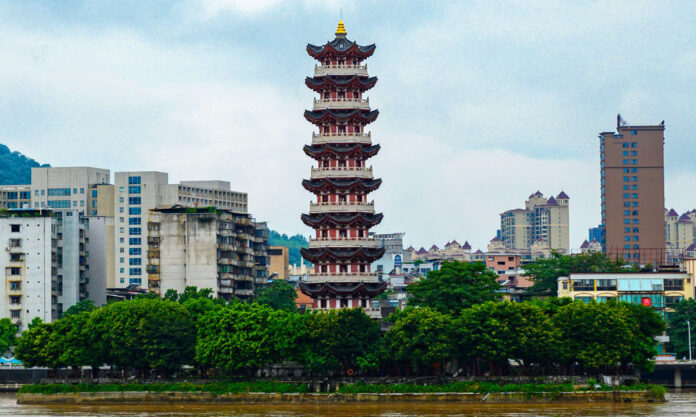
The Ming-dynasty prefect Chen Dalun built the Tongtian Pagoda in 1546 on a small island where the Zhen and Wu rivers meet to form the Bei River; it became one of the 24 celebrated scenes of old Qujiang.
明代知府陈大纶于一五四六年在浈江与武江交汇成北江的江心小岛上,修建了通天塔;此塔此后成为古曲江”二十四景”之一。
The pagoda was destroyed in 1854 during the Taiping Rebellion, after Taiping soldiers climbed it to observe the city’s defences and Qing forces opened fire on the tower.
一八五四年太平天国战乱期间,太平军士兵登上通天塔观察城内布防,守城清军发现后向塔开炮,通天塔遂毁于战火。
Archaeologists later uncovered the original foundations 4.1 metres below the surface, together with more than 160 pieces of brick and tile. A new Tongtian Pagoda, drawing on historical descriptions of the original, opened in September 2012 as a 39-metre, nine-storey octagonal tower in Song-dynasty style.
考古人员其后在地下四点一米处发现了通天塔的塔基遗址,并出土了逾一百六十件青砖瓦片。依据对原塔的历史记述,一座新的通天塔于二零一二年九月落成,为一座高三十九米的八角九层仿宋楼阁式塔。
Shaoguan’s economic output reached ¥170.51 billion in 2025, up 3.6 percent on the year.
二零二五年,韶关地区生产总值达一千七百零五点一亿元,同比增长百分之三点六。
Danxia Mountain, 45 kilometres from the city centre, gave its name to the geomorphological term danxia landform, used for the red-bed landscapes it exemplifies; in 2010, the mountain became one of six component sites inscribed together on UNESCO’s World Heritage List as China Danxia.
距市区四十五公里的丹霞山,为地貌学术语”丹霞地貌”提供了命名依据,用以指称其所代表的这类红层地貌;二零一零年,丹霞山作为”中国丹霞”系列遗产的六处组成地点之一,列入联合国教科文组织世界遗产名录。