


Siping was a village called Sipingjie until 1902. That year the railway between Changchun and the port of Dalian was completed. A station opened, traders arrived and within a generation the village had become a regional commercial centre.
1902年以前,四平还只是一个名叫”四平街”的村落。那一年,长春至大连港的铁路建成通车。车站设立,商人随之而来,不到一代人的时间,这个村落就发展成为区域性商业中心。
The railway also shaped who held power in the town. After 1907, the Japanese-controlled South Manchuria Railway Company came to dominate much of Siping’s railway-based economy. Breweries, oil presses and flour mills opened. More lines followed, running northwest to Baicheng in 1923 and southeast towards Tonghua and the Korean Peninsula in 1939.
铁路也影响着这座城镇的权力格局。1907年后,日本控制的南满洲铁道株式会社逐渐主导了四平依托铁路发展起来的大部分经济。酿酒厂、榨油厂和面粉厂相继开办。此后又有新线路陆续修建,1923年向西北通至白城,1939年向东南通往通化和朝鲜半岛。
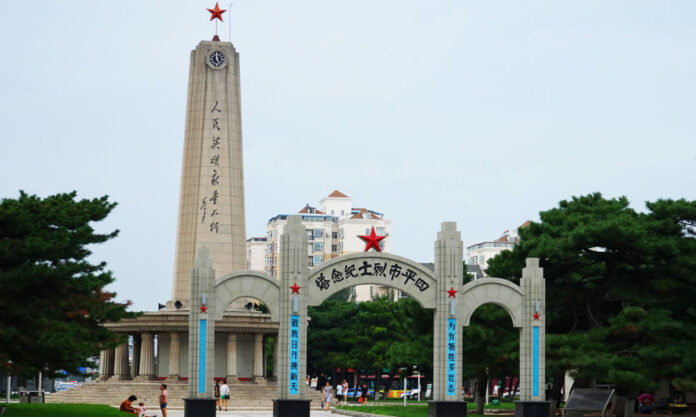
That junction is why Siping was fought over. During the Chinese Civil War, Communist and Nationalist forces fought four battles for the city between March 1946 and March 1948. Chinese historians call them the “four battles for Siping”.
正是这一铁路枢纽的地位,让四平成为兵家必争之地。解放战争期间,1946年3月至1948年3月,共产党与国民党军队在这里先后进行了四次大战,史称”四战四平”。
Four Battles in Two Years
两年四战
According to The Paper, the second battle in spring 1946 involved more than 200,000 troops on each side, along a front over 50 kilometres long. Communist forces held the city for about a month before withdrawing north. In June 1947 they attacked for 20 days and lost about 14,000 men. They finally captured Siping on 13 March 1948, months before the decisive Liaoshen Campaign.
据澎湃新闻报道,1946年春的第二次四平战役中,双方各投入20余万兵力,战线绵延百余里。东北民主联军坚守四平约一个月后撤往北满。1947年6月,民主联军攻城20天,伤亡约1.4万人。1948年3月13日,四平最终解放,数月后,具有决定意义的辽沈战役打响。
By the end of the war the city was virtually destroyed. The Siping Battle Memorial Hall, founded in 1958, now holds relics, documents and photographs from the fighting.
战争结束时,四平几乎被夷为平地。始建于1958年的四平战役纪念馆,如今收藏着这段战争的文物、史料和照片。
Older Than the Tracks
比铁路更古老
The land around the railway town has a much longer history. Southeast of the city lie the ruins of Yehe, stronghold of the Yehe tribe, one of the Jurchen groups that later formed the Manchus. Nurhaci destroyed it in 1619. The Yehe Nara clan went on to produce two Qing empresses dowager, Cixi and Longyu.
这座铁路城市周边的土地历史要久远得多。市区东南方坐落着叶赫古城遗址,这里曾是叶赫部的据点,叶赫部是后来形成满族的女真部落之一。1619年,努尔哈赤攻灭叶赫。此后,叶赫那拉氏出了慈禧和隆裕两位清末皇太后。
The plains are the other story. Siping sits on the black soil of the Songliao Plain, and its Lishu County is a major grain producer. In 2009 researchers from China Agricultural University, led by Li Baoguo, set up a test plot there. Farmers leave maize straw on the fields and plant without ploughing. The “Lishu model” is now promoted across northeast China.
平原则是四平的另一段故事。四平地处松辽平原黑土带,下辖的梨树县是产粮大县。2009年,以李保国为首的中国农业大学科研团队在这里建起了试验田。农民把玉米秸秆留在地里覆盖土壤,免耕播种。如今,”梨树模式”已在东北地区推广。
Winters are long, lasting from November to March. The Siberian anticyclone keeps them cold, windy and dry. Bare fields lose topsoil to that wind, and the straw cover is meant to stop it.
四平冬季漫长,从11月一直持续到次年3月。受西伯利亚高压影响,冬季寒冷、多风而干燥。裸露的农田表土容易被大风吹走,秸秆覆盖正是为了防止这一点。
According to the Jilin Provincial Bureau of Statistics, Siping’s GDP reached ¥58.06 billion in 2024, up 3.7 percent year on year. About 1.64 million people live in the city. Siping East station sits on the Harbin–Dalian high-speed railway, with trains to Changchun West in about half an hour and to Shenyang in about an hour. The nearest airport, Changchun Longjia International, is about 140 kilometres away.
据吉林省统计局数据,2024年四平地区生产总值达580.6亿元,同比增长3.7%,全市常住人口约164万。四平东站位于哈大高铁线上,乘高铁到长春西站约半小时,到沈阳约一小时。最近的机场是长春龙嘉国际机场,距离约140公里。
On a railway map of Jilin, the lines still meet at Siping. In 1902 the village was a stop on someone else’s line. Today it is the buckle that holds the province’s railways together.
翻开吉林的铁路地图,各条线路依然在四平交汇。1902年,这个村落不过是别人线路上的一个小站;如今,它已成为扣紧全省铁路网的那枚搭扣。