



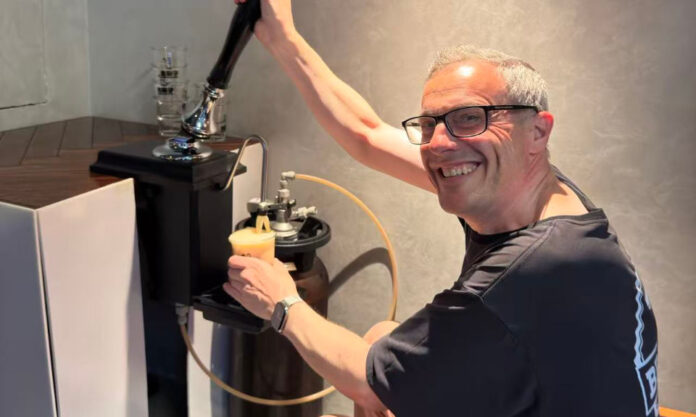



Serving beer from a hand pump (also known as a beer engine) is a curiously British thing. There are very few hand pumps outside the UK, but it seems there is an attempt to introduce some to China. But what are hand pumps? Hand pumps are typically (but not always) used to serve Real Ale in the UK which, unlike Craft Beer, has a specific definition.
Beer is brewed with malted barley, hops, water and yeast. Beer is either ale, which is top-fermented or lager, which is bottom fermented. Both can be “real” but Real Ale has become the generic term for all Real Beer because Real Lager is rare. From this point we will refer only to Real Ale.
What does the “Real” mean? The definition of a Real Ale is a beer that undergoes a secondary fermentation in the vessel from which it is served, typically a cask or a bottle. This gives a much more complex flavour profile. It has a slight natural sparkle due to the secondary fermentation process. It is a myth that Real Ale should be flat.
Real Ale is a living, premium product that needs looking after both before and during serving. In the UK in the 1960s the large breweries tried to kill it off in favour of “keg beer” which was easier to manage but vastly inferior in quality. Keg beer is not “living”. The yeast is “killed” and filtered off and the beer is pasteurised. The consequentially dead and lifeless beer needs to be pumped full of carbon dioxide at high pressure to give it artificial life. It is too fizzy to appreciate any subtle flavours and the acidity cause by the dissolved carbon dioxide only exacerbates the issue.
A group of drinkers lamenting the near loss of Real Ale set up CAMRA (The Campaign for Real Ale) in 1971. It was a hugely successful consumer movement. The revival of Real Ale in the UK was the precursor of the rise of Craft Beer around the world. Craft Beer is a vague term to describe a beer with character and flavour (though not guaranteed). The good examples are produced on a small scale with high quality ingredients as opposed to mass produced beer such as Tsingtao, Heineken and Stella Artois to name but a few.
Now we know what we are talking about, how is Real Ale served? There are two main methods used in the UK: gravity dispense and a beer engine (which is a hydraulic pump operated by hand). Gravity dispense is simply a tap in the cask which is an excellent way to serve Real Ale but necessitates walking to where the cask is kept, often a cellar beneath the bar. A beer engine pumps the beer from the cellar beneath up to the bar.
The advantage of these methods is that artificial carbon dioxide is not used (which is how most normal “gas taps” work). The means the Real Ale has “life” but not excessive fizz. This gives superior mouthfee, while more subtle flavours and character are apparent. The main disadvantage is that as the beer exits the cask air must enter, bringing in oxygen and bacteria. Beer is a perfect breeding ground for bacteria, so within two or three days the quality of the beer takes a nosedive and quickly becomes undrinkable.
Beer engines introduce another problem. The line between the cask and the pump and the capacity of the pump itself may one or two pints. Real Ale should be served at cellar temperature (about 12 °C), cold enough to be refreshing but not so cold that delicate flavours are lost. If the turnover is slow, you will likely get a pint at room temperature, hence another myth that Real Ale is supposed to be served warm. To serve good Real Ale the bar needs a high turnover so that the cask is consumed within a few days at the most.
So why are hand pumps starting to appear in China? Beer afficionados around the world recognise Real Ale as a premium product and the link between Real Ale in the UK and the global craft beer revolution. Real Ale does not actually need to be served by gravity or by hand-pump these days, but a hand pump on a bar is a visible link to that heritage and quality.
Some hand pumps can be found in countries like Australia, New Zealand, Japan, Singapore, Canada and the USA although in such countries it is still very rare indeed compared with the UK where virtually every pub has a row of hand pumps. Although there have for a while been two bars in Hong Kong with hand pumps (two in The Globe and one in Second Draft) to my knowledge there have never been hand pumps in Mainland China and nor did I ever expect to find any.
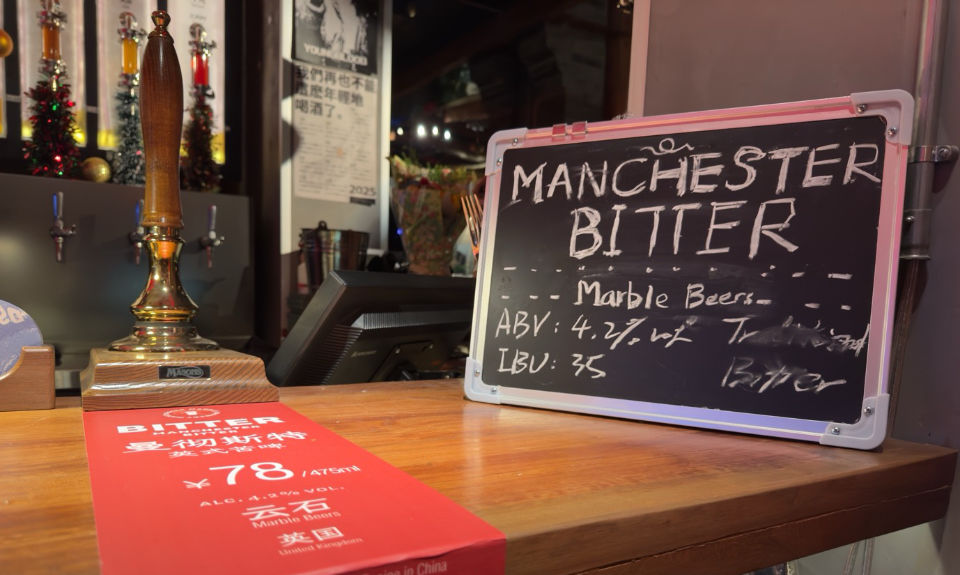
However, when I was in Beijing in April for Qingming I visited Xisi South Street which has five excellent craft beer bars within a kilometre. At Darkwave Brewing I chanced upon a hand pump that had been fitted only recently. It was serving Marble Brewery’s Manchester Bitter (from the UK), and very pleasant it was too. In another bar on this street a hand pump had also just been installed but was not yet in use. Further research the next day took me to The Factory on Gulou East Street which had a hand pump that I suspect was the first in Beijing. The bar is run by a Brit and serves imitations of some popular British beers brewed in China by Oak & Iron Brewery.
A month later in Nanjing (where I live) I visited a bar that I had not been to for some time: Ladder Bar (or Mutizi) on Sanmao Alley. In an extraordinary fluke of timing I arrived to find two gentlemen installing a hand pump. Not only that, they put a beer on immediately. Having shown an interest I was invited to pull and drink the first beer; very probably the first hand pumped beer consumed in Nanjing. A couple of days later I stumbled across yet another hand pump at Shanqiu Taproom off Suojie street. It also was brand new and had not yet been used. They attempted to put a beer on, but unfortunately there was a fault with the beer engine.
Nanjing is a very fine city in many ways but not even its biggest supporters would suggest it is among the top craft beer destinations in China. This makes me wonder how many other cities in China may now have a hand pump in some of their craft beer bars. I also wonder who is behind this apparent push. At the moment I have no answers to either question.
Wonderful, intriguing and exciting as this all is, I end with a few caveats. I suspect little or none of the beer served on these hand pumps will be Real Ale. Even in New Zealand for example I know of only one pub that serves genuine Real Ale on its hand pumps (the splendid Galbraith’s Bar in Auckland if you ever get the chance…) It is more likely to be “normal” beer that has not been artificially gassed. This means it will be totally flat and not have as much character as Real Ale. However, it is still a welcome change to very fizzy beer and I enjoyed what I had at Darkwave and Ladder Bar. It certainly made a welcome change to all of the fizz.
The bars will need to be careful as I assume air will enter the cask and the beer will start to go off. Temperature is also a concern. A warm, flat beer that is partially oxidised is not a pleasant experience and the emergence of hand pumps will come to an abrupt end if this is what consumers get more often than not. Cleaning the beer line thoroughly after each cask change is critical or bacteria builds up in the pipes and pump. Hopefully the bar staff are getting suitable training and hand pulled beer becomes popular in the best beer bars all over Mainland China.
Do let the Nanjinger know where you find hand pumps in China, and tell us how the beer was!