



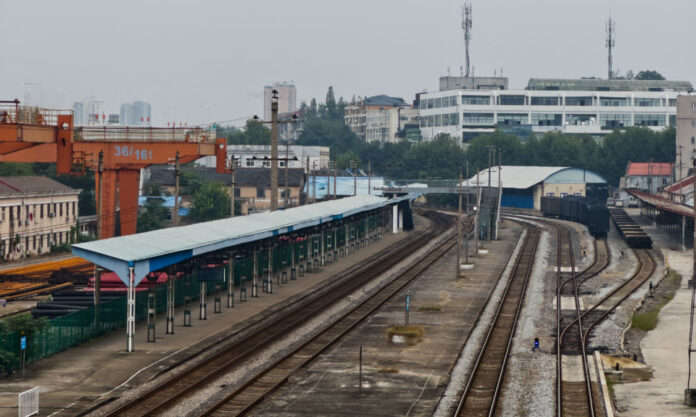



“Clang, clang”, goes the level crossing on Chenguang Lu as foot and vehicular traffic give way to an average of 90 enormous freight trains each day. They have just departed, will shortly arrive at, or completely ignore, Nanjing Zhonghua Men Railway Station.
“叮,叮”,在陈光路的平交道口,步行和车辆交通让位于平均每天有90列大型货运列车。 他们刚刚离开,很快就会到达,或者完全忽略南京中华门火车站。
But not for much longer. For this section of the Nanjing–Tongling Railway is soon to be moved. Local people are both looking forward to it and a little reluctant. After all, this railway line has been a core element of life among several generations of Nanjing people for almost a century; those trains’ sharp and piercing whistles in the middle of the night rousing many from their dreams.
但不会太久。 南京-同岭铁路的这一段即将搬迁。 当地人既期待它,又有点不情愿。 毕竟,近一个世纪以来,这条铁路线一直是几代南京人生活的核心要素;那些火车在半夜尖锐而刺耳的口哨声唤醒了许多人的梦境。
Nanjing Zhonghua Men Railway Station was built in 1935 and during its heyday saw more than 10,000 passengers every day as one of the three major stations in Nanjing, along with Nanjing West Station and Pukou Station. While the former sent trains to Shanghai and the latter to Tianjin, the focus for Zhonghua Men was the south. Renamed during this time in an attempt at continuity, the station became Nanjing South in March, 1998, with Pukou becoming Nanjing North.
南京中华门火车站建于1935年,在鼎盛时期,每天有超过10,000名乘客,与南京西站和浦口站一起成为南京三大车站之一。 前者派火车到上海,后者派火车到天津,而中华门的重点是南方。 在此期间,为了保持连续性,该车站更名为南京南,1998年3月,普口成为南京北。
Taking a train to or from Zhonghua Men to southern Anhui and Huang Shan is not only an experience shared by countless old Nanjingers, but also a collective memory of people across both Jiangsu and Anhui.
乘火车往返中华门到皖南和黄山,不仅是无数老南京人分享的经历,也是江苏和安徽人民的集体记忆。
And from further afield too. Deng Xiaoping himself once boarded a train at Zhonghua Men, to make an inspection tour of Ma’an Shan, Wuhu and Huang Shan.
也来自更远的地方。 邓小平本人曾经在中华门登上火车,考察马鞍山、芜湖和黄山。


The beginning of the end came in 2011, with the opening of the grand Nanjing South Railway Station. Zhonghua Men Station immediately got its old name back, while passenger services came to an end 3 years later with the K1325 train from Suzhou to Nanchang being the final train to make a stop at Zhonghua Men, on 14 October, 2014. The Station’s swansong comprised fewer than just 300 passengers boarding or alighting trains each day.
结束的开始是在2011年,随着宏伟的南京南站的开通。 中华门站立即恢复了旧名,而客运服务在3年后结束,2014年10月14日,从苏州到南昌的K1325列车是最后一列在中华门停靠的火车。 车站的天鹅松每天只有不到300名乘客上下火车。
But those long freight trains are still a common sight. Bulk materials such as iron ore, coal and steel are transported on this line all year round, essential for the operations of Ma Steel, Meishan Steel and other enterprises to the southwest of Nanjing.
但那些长长的货运列车仍然很常见。 铁矿石、煤炭和钢铁等散装物料常年在这条线上运输,这对南京西南的马钢、梅山钢等企业的运营至关重要。
As to the future, we can expect another of those historical and cultural spaces that have become the “à la mode” way for China to preserve its past.
至于未来,我们可以期待另一个历史和文化空间,这些空间已经成为中国保存其过去的“模式”方式。
But one emotive question remains in the minds of many Nanjingers; should the actual railway tracks be ripped up? At a 2023 planning meeting on the subject, Chen Yanping, Director of the Municipal Affairs Department of the Municipal Planning Bureau said, “Our suggestion is to try not to demolish them if possible”.
但许多南京人心中仍然有一个情绪化的问题;真正的铁轨是否应该被拆掉? 在2023年关于该主题的规划会议上,市政规划局市政事务司司长陈延平表示:“我们的建议是,如果可能的话,尽量不要拆除它们。”