



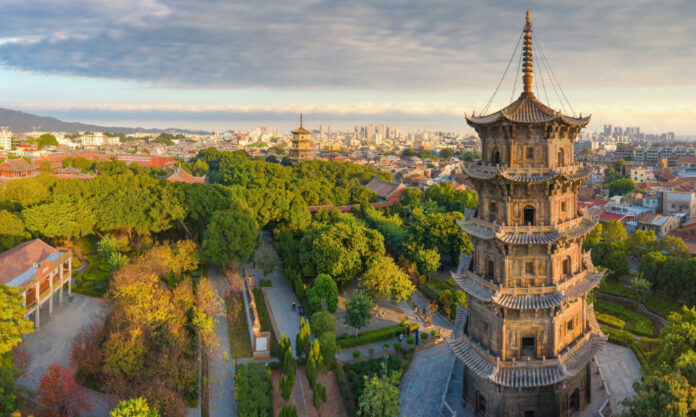



Southward on Fujian’s coast, Quanzhou still behaves like a port before it behaves like a heritage site. Ships no longer define the skyline, yet the city keeps its outward habit; in stone lanes, factory parks and temple courtyards, trade remains the default language.
福建南部的海岸线上,泉州至今仍更像一座港口,而不只是一个遗产城市。船只早已不再决定天际线,但这座城依然保留着外向的习惯;在石板路、工业园和庙宇天井之间,交易仍是这里最自然的语言。
The old name Citong still hovers over the city, and for good reason. Quanzhou grew as one of the great ports of Song and Yuan China; its streets, religious sites, bridges and dock remains were folded into UNESCO’s 2021 listing of “Quanzhou, Emporium of the World in Song-Yuan China”. That title sounds formal, but the city itself still feels busy and practical.
“刺桐”这个旧称至今仍笼着这座城,而且并非没有道理。泉州曾是宋元中国最重要的港口之一;街巷、宗教遗址、桥梁与码头遗存,一起被纳入联合国教科文组织于2021年列入名录的“泉州:宋元中国的世界海洋商贸中心”。这个名字听上去很正式,但这座城本身仍然忙碌而务实。
Quanzhou’s 2023 statistical bulletin put GDP at ¥1.217 trillion, up 4.8 percent, with secondary industry making up 53.2 percent of output. That matters because this is not a museum city pretending to be a workshop; it is a workshop that learned how to sell its memory.
泉州市2023年国民经济和社会发展统计公报显示,地区生产总值达到¥1.217万亿元,增长4.8 percent,其中第二产业占比53.2 percent。这个数字重要,因为它说明漳州式的“看景吃饭”并不是泉州的全部;泉州更像是一座懂得把记忆拿去变现的工厂城市。
The Port was First, Heritage Came Later
港口先于遗产成形,遗产是后来写进去的
The city’s old stones are spread across several neighbourhoods rather than locked into one showpiece. Kaiyuan Temple anchors West Street; the twin towers still stand with stubborn confidence; the Qingjing Mosque and other Islamic sites remind visitors that Quanzhou was shaped by merchants, sailors and faiths moving through the same commercial air.
这座城的老石头并没有被集中在一个景点里,而是散落在不同街区。开元寺撑着西街的气质;双塔依旧倔强地站着;清净寺和其他伊斯兰遗存则提醒人们,泉州从来不是单一人群塑造出来的,而是商人、水手与不同信仰在同一片商业空气里一起走出来的。
Walk the old quarters and Quanzhou becomes less like a textbook and more like a working district that happens to be beautiful. Tea shops, noodle stalls, incense smoke, repair counters and restored shopfronts sit under the same roofs. The city does not separate heritage from daily life very carefully; it lets the two share the rent.
走进老城区,泉州更像一片仍在运转的街区,而不是一本教科书。茶铺、面摊、香火、修补铺和修缮过的骑楼,共同挤在同一片屋檐下。泉州并不特别认真地把遗产和生活分开;它更愿意让两者一起分摊房租。
Shoes, Factories and the City’s Modern Muscle
鞋业、工厂与泉州的现代肌肉
The modern Quanzhou story is louder than its temple bells. Shoes, clothing, petrochemicals, machinery and household brands have given the city a broad industrial base, while private firms still drive much of the local economy. Anta, Xtep, Peak and Hengan are only the names people outside Fujian tend to recognise first; behind them sits a much wider web of suppliers, workshops and family companies.
泉州的现代故事,比寺庙里的钟声更响。鞋服、石化、机械和家居品牌,共同撑起了这座城宽厚的工业底盘,而民营企业仍是地方经济的主力。安踏、特步、匹克和恒安只是外地人最先认得出来的名字;它们背后,还有更庞大的供应链、工厂和家族企业网络。
The municipality has spent years building nine 100-billion-yuan industrial clusters, and that scale shows in the street life too. A factory district here is rarely far from a market, and a market is rarely far from a delivery van. Quanzhou has an old habit of turning production into everyday contact, which is why its economy feels lived in rather than remote.
泉州这些年一直在打造九大千亿级产业集群,这种体量也会反过来体现在街头生活里。这里的工业区离市场往往不远,市场离货车也不远。泉州有一种把生产转化成日常接触的老习惯,所以它的经济给人的感觉并不遥远,而是有温度、有烟火气。
It also helps that Quanzhou thinks in networks. The city’s overseas Chinese links, Minnan speech, Nanyin, puppet theatre and temple traditions have travelled much farther than the city limits. Many families here still speak about cousins abroad as if distance were only a temporary inconvenience; the city’s commercial instinct has always travelled with people.
泉州也擅长编织关系网。海外华侨联系、闽南话、南音、木偶戏和庙会传统,早已走得比城市边界更远。这里不少家庭谈起海外亲戚时,仍像在说一件只是暂时麻烦的事;泉州的商业本能,一直是跟着人一起走的。
That outward habit has a transport side now. Quanzhou is served by Jinjiang International Airport, while rail links through Quanzhou Railway Station, Quanzhou East and Jinjiang have pulled the city deeper into the Fujian coastal corridor. The Fuzhou-Xiamen high-speed railway has made the coast feel shorter and the city less self-contained.
这种向外走的习惯,如今也有了交通上的对应。泉州晋江国际机场在服务这座城市,泉州站、泉州东站和晋江站等铁路节点则把泉州更深地接进福建沿海走廊。福厦高铁让海岸线变短,也让泉州不再那么像一座自成体系的孤城。
Quanzhou works because it refuses to choose between shrine and workshop, street and port, memory and sales sheet. It has enough old stone to satisfy the eye and enough private enterprise to keep the lifts moving. That combination is not elegant in the brochure sense; it is better than that. It is durable.
泉州之所以成立,是因为它拒绝在寺庙与工厂、街巷与港口、记忆与销售报表之间做单选题。这里有足够多的老石头来满足眼睛,也有足够多的民营企业来让电梯继续上上下下。这样的组合未必适合放在宣传册上,但它比宣传册更好;它耐用。