



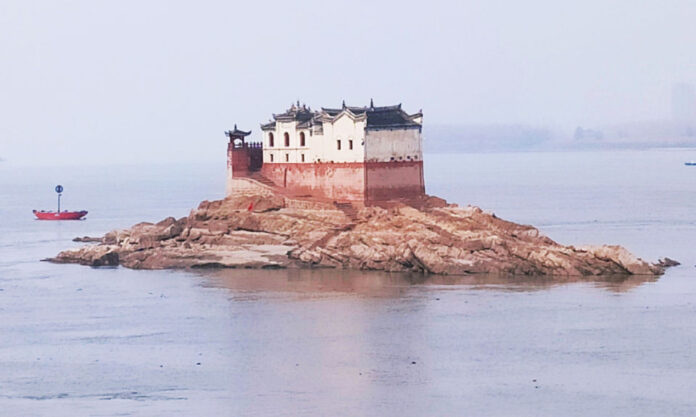


Sun Quan renamed this city Wuchang in 221 AD, founding the Kingdom of Wu here and later proclaiming himself emperor within its walls in 229, before moving his capital to Jianye, present-day Nanjing, that same year; the name Wuchang stayed attached to this city for the next seventeen centuries, until it was formally changed in 1915.
孙权于公元二二一年将此城更名为”武昌”,在此建立吴国,并于二二九年在城内称帝,同年即将都城迁往建业,也就是今天的南京;”武昌”这个名字此后在这座城市沿用了整整十七个世纪,直至一九一五年才正式更改。
That change came about because a district of the newly prominent city of Wuhan had, by then, also become known as Wuchang, and the resulting confusion between two places sharing one name eventually forced this older city to revert to an earlier name still, Ezhou.
改名的原因在于,当时逐渐崛起的武汉市下辖的一个区,恰好也被称作”武昌”,两地同名造成的混淆,最终迫使这座更为古老的城市,恢复了一个更早的名字——鄂州。
Wuchang remained the Wu kingdom’s secondary capital for decades after Sun Quan’s departure, and the ruins of its palace walls, including the Taichi Hall where he once received his ministers, were listed as a state-protected heritage site in 2013; they still sit within the boundaries of the modern city.
孙权迁都之后,武昌仍作为吴国的陪都存续了数十年之久,其宫城遗址(包括他曾在此接见群臣的太极殿)已于二零一三年被列为国家级文物保护单位;这些遗址至今仍位于现代城区之内。
A Museum Built around 80,000 Relics
一座收藏八万件文物的博物馆
Long before any of that, Ezhou had already become known for something else entirely; bronze mirrors, cast here from the Warring States period through to the Qing dynasty, when glass finally replaced them. According to a report carried by China Daily, the Ezhou Museum now holds 80,154 cultural relics in total, including nearly 300 of the roughly 600 bronze mirrors recovered from sites across the city, alongside a celadon granary model depicting how the Wu kingdom fed its army.
早在这一切之前,鄂州已因另一样事物而声名远扬;这里自战国时期起便开始铸造铜镜,一直延续至清代玻璃镜传入才逐渐式微。据《中国日报》报道,鄂州博物馆现藏文物共计八万零一百五十四件,其中包括在全市各处出土的约六百面铜镜中的近三百面,展品中还有一件青瓷粮仓模型,展示了吴国军队当年的粮食储备方式。
Phoenix Square, the largest public square in the city, carries the theme outdoors; its dry fountain is modelled on a nine-metre replica of a four-lobed bronze mirror decorated with eight phoenixes, a design taken directly from a piece unearthed locally.
城中最大的公共广场”凤凰广场”将这一主题延伸至户外;广场上的旱喷泉,便是仿照一面本地出土的四出八凤铜镜,按九米直径复刻而成。
Roughly a century after Sun Quan’s death, the monk Huiyuan settled temporarily at Xishan, on what is now the western edge of the city, and built a temple there that was later rebuilt and renamed Gu Lingquan Temple during the Qing dynasty. Elsewhere in the city, Lianhuashan sits on the banks of Yanglan Lake, its Yuanming Tower carrying thousands of carvings of the character for fortune within its walls.
孙权去世约一个世纪后,高僧慧远曾在西山暂居,并在此建寺,这座寺庙后于清代重建,更名为”古灵泉寺”。城市另一端的莲花山则坐落于洋澜湖畔,山中的元明塔内镌刻着数千个”福”字。
Liangzi Lake, the second-largest freshwater lake in Hubei, lies further out still; its central island is known locally for lotus root dishes, grown in a province that, according to a 2025 industry report from Hubei Daily, already leads the country in both lotus root cultivation area and total output.
再远一些,便是湖北第二大淡水湖梁子湖;湖心岛以莲藕菜肴闻名当地,而据《湖北日报》二零二五年发布的产业报告显示,湖北全省的莲藕种植面积与总产量均已居全国首位。
An Airport with No Passengers to Speak of
一座几乎没有旅客的机场
Ezhou’s other claim to fame sits at the opposite end of the economy. Huahu Airport opened here in July 2022 as Asia’s first dedicated cargo hub airport, built with SF Express holding a 46 percent stake in the operating company and modelled explicitly on Memphis International, the American hub built around FedEx.
鄂州的另一张名片,则位于经济版图的另一端。花湖机场于二零二二年七月开航,是亚洲首座专业货运枢纽机场,顺丰速运持有运营公司百分之四十六的股份,该机场的设计蓝图,正是效仿美国以联邦快递为核心的孟菲斯国际机场。
Its two runways stretch 3,600 metres each, long enough for the largest cargo aircraft flying, and the site was chosen partly because it sits almost equidistant from Shanghai, Beijing and Guangzhou. SF Express has said parcels routed through Ezhou can reach anywhere in China overnight and most overseas destinations within two days; scheduled passenger flights only began there in 2024.
机场两条跑道各长三千六百米,足以起降现役最大型的货运飞机;之所以选址于此,部分原因在于鄂州几乎位于上海、北京与广州的等距之处。顺丰方面表示,经花湖机场中转的包裹可实现国内隔夜必达,多数境外目的地也能在两天内送达;而定期客运航班,直至二零二四年才正式开通。
Ezhou’s GDP totalled ¥126.6 billion in 2023, built on steel production, textiles and a growing new-materials sector; the city’s permanent population, at just under 1.08 million according to the seventh national census, remains one of the smallest of any prefecture-level city in Hubei.
鄂州的GDP在二零二三年为一千二百六十六亿元人民币,支撑经济的主要是钢铁生产、纺织业以及正在壮大的新材料产业;根据第七次全国人口普查数据,该市常住人口不足一百零八万,仍是湖北省内规模最小的地级市之一。
Most visitors still arrive by high-speed rail, with journeys from Wuhan taking under 30 minutes, or by road along an expressway network that puts Wuhan itself under an hour away by car; Huahu Airport, for now, remains far busier with cargo than with people.
多数游客仍选择乘坐高铁前来,从武汉出发车程不到三十分钟,也可沿高速公路驱车前往,由武汉驱车前来同样不到一小时;而花湖机场目前的货运繁忙程度,仍远超其客运量。
The palace walls Sun Quan built still stand somewhere beneath the modern city, though the name he gave it moved on long ago, settled now in Wuhan rather than in Ezhou itself.
孙权当年所建的宫城城墙,至今仍埋藏在这座现代城市的地下某处,尽管他当年赐予这座城市的名字,早已迁往别处,如今归属于武汉,而非鄂州本身。