



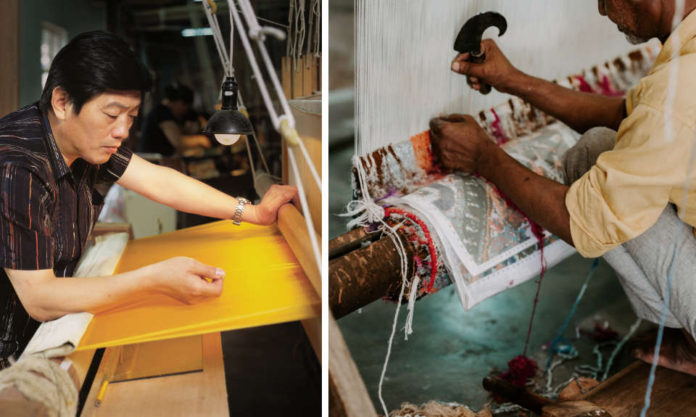



The Paisley Pattern is well known the world over. Its hallmark teardrop motif, created by the draw looms that also give us Nanjing Brocade, caught the eye of Queen Victoria, while The Beatles helped to encapsulate the design into that era of psychedelia; the 1960s.
佩斯利图案闻名于世。 它的标志性泪滴图案,由拉织机创造,也给了我们南京锦缎,吸引了维多利亚女王的注意,而披头士乐队帮助将设计封装到那个迷幻时代;20世纪60年代。
Hitherto, the then-unknown Scottish town of Paisley, just outside of Glasgow, was put on the map by an invention made over 1,800 years earlier and 9,000 kilometres away; in China.
迄今为止,格拉斯哥郊外的苏格兰小镇佩斯利(Paisley)在1800多年前,在9000公里外的发明在中国被列入了地图。
Key to our story is the draw loom.
我们故事的关键是拉织机。
Many would contend that the intricate and beautiful hand-woven designs of the shawl for which Paisley would become infamous originated in India in the 11th century.
许多人会争辩说,佩斯利臭名昭著的披肩的复杂而美丽的手工编织设计起源于11世纪的印度。
The Nanjinger begs to differ.
南京人不同意。
The key to this argument lies not in archeological sources, but in a Chinese poem. “Rhapsody on Women Weavers” (机妇赋) was written by Wang Yi (王逸) early in the 2nd century.
这一论点的关键不在於考古來源,而在于一首中国诗歌。 《女织女狂想曲》(机妇赋)是王逸在2世纪初写的。
Its subject was the draw loom, still employed in Nanjing in the production of brocade, and that which gave way to its mechanised (jacquard) version responsible for the Paisley Shawl.
它的主题是拉织机,仍然在南京用于生产锦缎,并让位于负责佩斯利披肩的机械化(提花)版本。
In Rhapsody on Women Weavers, Wang uses metaphor to describe the loom with a tower that needed two people to operate it, as revealed in Maryta M. Laumann’s “The Secret of Excellence in Ancient Chinese Silks” (1984):
正如Maryta M. Laumann的《中国古代丝绸的卓越秘诀》(1984年)所揭示的那样,在《女织布工的狂想曲》中,王用隐喻来描述需要两个人操作的塔的织布机:
Two high–rising figure towers stand there,
两座高耸的人物塔矗立在那里,
Gazing downward (as if) on a clear water pond,
向下凝视(仿佛)一个清澈的池塘,
(It appears like) fish catching on to their bait,
(看起来像)鱼抓住了他们的诱饵,
(It sounds like) waves splashing rhythmically against the shore.
(听起来像)海浪有节奏地溅到岸边。
When the pulleys rise in togetherness
当滑轮一起升起时
All the fine silk threads move downward.
所有细丝线都向下移动。
Reminiscent of (the movements of an astrological map)
让人想起(占星图的运动)
With its varied lines some contracting (some) extending
凭借其不同的线条,有些收缩(有些)延伸
(Thus it goes) One forth one back,
(这样)一个向后一个,
Without ever getting wearied
从未感到疲倦
Wang’s words were further compounded by an exceptional archaeological discovery that was made much more recently, in Tianhui Town of Jinniu District in Chengdu City in July and August of 2013. In the Han Dynasty (206 BCE–220 CE) burial ground at Laoguanshan (老官山) were 620 archaeological finds, stars among which were four looms made of bamboo and wood capable of weaving patterns.
2013年7月和8月,最近在成都市金牛区天汇镇发现了一项特殊的考古发现,这进一步加剧了王的话。 在汉朝(公元前206年-公元220年),老官山的墓地有620个考古发现,其中有四面由竹子和木材制成的织布机,可以编织图案。
By the time of the Tang Dynasty (618-907 CE), the draw loom had been perfected. In the weaving process, silk threads and cotton threads were woven according to patterns that were recorded by means of tying knots.
到唐朝时期(公元618-907年),拉织机已经完善。 在编织过程中,丝线和棉线是按照通过打结记录的图案编织的。
Here in Nanjing is the only place on Earth where this fascinating traditional craft can be found in action today. At the Nanjing Brocade Institute can be seen that which is at first glance to the casual observer merely a tangle of string. In fact it is a complex code that contains every instruction necessary for the loom to be able to weave the fabric, or put another way, the world’s first piece of programming.
在南京,是地球上唯一能在今天找到這種迷人的傳統工藝的地方。 在南京锦缎研究所,乍一看,对普通观察者来说,这只是一根纠结的绳子。 事实上,这是一个复杂的代码,其中包含了织布机能够编织织物所需的所有指令,或者以另一种方式,这是世界上第一部编程。
More precisely, the aforementioned tangle of string and the loom for which it is intended has its earliest known technical description in the encyclopaedia “Tian Gong Kaiwu” (天工開物; The Exploitation of the Works of Nature), compiled by Song Yingxing and published in 1637. The illustration of the draw loom therein was just one of thousands of detailed drawings invaluable to historians for their understanding of ancient Chinese production processes.
更准确地说,上述弦和织布机的纠结在《天工开物》百科全书《天工开物》中有其最早的技术描述,该百科全书由宋英兴汇编,于1637年出版。 绘图机的插图只是数千张详细图纸中的一幅,对于历史学家来说,他们对中国古代生产过程的理解是无价的。
As the dynasties passed, Chinese brocade became ever more complex, while its dynamic lines, rich colours and designs began also to exhibit reverence for happiness, life and death, marriage, ancestry, nature, heaven and earth. As such, just like the setting sun, the beauty of brocade garments became famous across the world.
随着朝代的过去,中国锦缎变得越来越复杂,而其动态的线条、丰富的色彩和设计也开始表现出对幸福、生与死、婚姻、祖先、自然、天地的崇敬。 因此,就像夕阳一样,锦缎服装的美丽闻名于世。
Egypt, Syria and Palestine were all early adopters of the loom for creating patterns, likely later in the second century. Then Europe took it to the next level that saw its zenith in the famous Mozac Hunter Silk in Lyon, France. Dated 671 CE, the masterpiece employed one of the most sophisticated technologies of the time, the loom had at least 800 draw cords and 2,700 different combinations of warp threads.
埃及、叙利亚和巴勒斯坦都是创造图案的织布机的早期采用者,可能是在二世纪后期。 然后,欧洲将其提升到了一个新的水平,在法国里昂著名的莫扎克猎人丝绸中看到了它的顶峰。 这部杰作可以追溯到公元671年,采用了当时最复杂的技术之一,织布机至少有800根拉绳和2700个不同组合的经线。
Then the learned Scots enter our narrative. For they and the Chinese were to be the world’s draw loom consummate craftsmen.
然后,有学问的苏格兰人进入了我们的叙述。 因为他们和中国人将成为世界织布机的完美工匠。
The Scottish Enlightenment was a period from the late 18th to the early 19th centuries in Scotland, which saw intellectual and scientific accomplishments emerge en masse. As such, there was a disproportionate contribution from Scottish writers in many fields of study, expertise and vocation.
苏格兰启蒙运动是苏格兰从18世纪末到19世纪初的一个时期,当时智力和科学成就大量涌现。 因此,苏格兰作家在许多研究、专业知识和职业领域都做出了不成比例的贡献。
Among them was the “Practical and Descriptive Essays on the Art of Weaving” by Glasgow textile manufacturer, John Duncan, published in 1808. Therein were brief descriptions of the different types of draw loom in use at the time as well as the principles on which they operated. He was joined by John Murphy, also of Glasgow, who in 1827, published “A Treatise on the Art of Weaving”. Now regarded as one of the classics in weaving literature, the treatise contains that era’s best known description of the draw loom.
其中有格拉斯哥纺织制造商约翰·邓肯于1808年出版的《关于编织艺术的实用和描述性文章》。 其中简要描述了当时使用的不同类型的拉织机,以及它们运行的原则。 同样是格拉斯哥的约翰·墨菲也加入了他,他于1827年出版了《编织艺术论文》。 现在被认为是编织文学的经典之一,该论文包含了那个时代最著名的拉织机描述。
All this well placed Paisley to be at the centre of the weaving revolution.
所有这些都让佩斯利处于编织革命的中心。
Everything changed for the town as Paisley Pattern designs sprung up all over western Europe. That which began as an imitation of the Kashmir shawl soon became the Louis Vuitton or Prada of their day, a symbol of wealth and status among upper-class women.
随着佩斯利图案设计在西欧各地如潮,小镇的一切都发生了变化。 最初是克什米尔披肩的模仿,很快就成为他们那个时代的路易威登或普拉达,是上层阶级女性财富和地位的象征。
When the young Queen Victoria in 1842 was said to have purchased 17 of them, the Paisley Shawl became the de facto fashion garment for discerning ladies everywhere. With the onset of the 1860s, Paisley had no less than 71 shawl manufacturers, churning out not only the stuff of royalty, but also affordable and accessible versions for people across the world.
当年轻的维多利亚女王在1842年购买了17件时,佩斯利披肩成为各地挑剔的女士的事实上的时尚服装。 隨著19世紀60年代的開始,佩斯利有不少於71家披肩制造商,不僅生產了皇室用品,還為世界各地的人們生產了負擔得起和可獲得的版本。
Bringing our story up to date, in the Year of History, Heritage and Archaeology that was 2017, the Paisley shawls were named as one of 25 objects that shaped Scotland’s history.
在2017年的历史、遗产和考古学年,佩斯利披肩被列为塑造苏格兰历史的25件物品之一,使我们的故事更新。
Nanjing has a sister city in England in York, but not one in Scotland. There is a powerful case to be made for the twinning of Nanjing and Paisley; as producers of perhaps the most iconic garments ever made, the two would indeed sit comfortably at opposite ends of the axis of global textile trade.
南京在约克是英格兰的姐妹城市,但在苏格兰没有。 南京和佩斯利的孪生是强有力的理由;作为可能是有史以来最具标志性的服装的生产商,两者确实会舒适地坐在全球纺织贸易轴心的两端。