Author: Laura Schmitt

  • Nanjing Olympic Tramline; Enjoy a free ride

    Nanjing Olympic Tramline; Enjoy a free ride

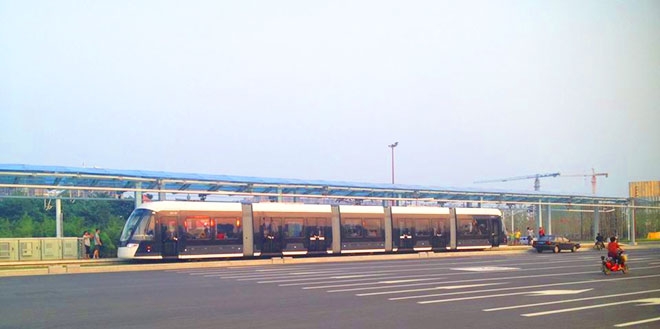
    From 2nd August until 8th August citizens get a free taster of the new tramline. Passengers can enjoy a ride from the Olympic Stadium (East) to Jiangshan Dajie, the stop for the Youth Olympic village or vice versa.

    The service runs from Olympic Stadium (East) between 8am and 6pm and from Jiangshan Dajie between 8.30am and 6.30pm, departing every 30 to 40 minutes. On the approximately 20 minute ride the tram strolls past the Youth Olympic Cultural Center, the Fairmont hotel and of course the Olympic Stadium, providing the comfort of the Nanjing Metro overground, which makes for an enjoyable trip of Nanjing’s most recent architectural accomplishments.

    If you decide to jump on the bandwagon, be aware that according to the official statement, ID checks can be carried out at any point in time; although none was witnessed on this occasion and one has the slight suspicion that this announcement is more a formality than a fact.

    With the tram taking lengthy breaks between runs, this also offers passengers an opportunity to step out and kick into “model mode” for a full blown photo session beside, in front of but hopefully not under the tram carriage.

    On the basis of the Nanjing Metro; the two are so similar one can in fact hardly tell the difference if it were not for all the natural sunlight and the buildings flitting by outside; there have been a number of upgrades. Most attention-grabbing are undoubtedly the tram staff, surprisingly pretty young women impeccably dressed in shiny, new uniforms and alarmingly well-mannered; they are the most obvious indication that Nanjing is pulling out the big guns for the international sporting event that will see the entire globe judge the city of Nanjing and its YOG performance.Undoubtedly, the end of the Games will coincide with a disappearance of the Tram Meinü, so the fellas might want to take up that free-ride offer just for the sake of enjoying the view(s).

    Furthermore, as the pictograms in the carriage will inform you, littering, running and most importantly eating and drinking are not allowed on the Olympic vehicle; one cannot help but remember the infamous clash on the Hong Kong metro between natives and nourishment-consuming mainlanders; it almost seems like a peace offering towards the colonized neighbours.

    Finally, the cash collectors beside the tram entrances, while following the design of the red-rimmed bus boxes have been further equipped with a see-through window through which passengers can follow their money dropping down into the box and a collection of coins gathering at the bottom. The thought process behind this seems a bit of a mystery, since generally one would think that a box full of coins staring potential robbers in the face would be rather tempting; then again the transport authorities might be counting on the “petty cash” being too insignificant to truly incite petty thefts and vandalism.

    The designers of the tram line seem to have taken Nanjing’s “green city” motto quite literally and so the tracks run through patches of grass, making them almost invisible to the eye and giving the overall system a lovely, natural look.

    While the taster session runs only between Youth Olympic Village and Olympic Stadium, the full tramline actually reaches much farther south, almost as far as the Qinhuai New River estuary. Whether the full line will be open during the YOG’s or whether it will be limited to the village-to-stadium route is at this point anyone’s guess. What is known is that the tram intersects with Nanjing’s new metro system at four stops; Olympic Stadium East for Line 2, Yuantong for Lines 10 and 2 and two further stops connecting to the S3 Intercity Line, which is currently still under construction.

    With the tram soft opening what is becoming increasingly tangible though is the “Olympic mood” that is spreading with the completion of countless shiny new buildings and modes of transport.

  • Being Out is In; 2014 Asia Outdoor Expo Exhibits Industry’s Success

    Being Out is In; 2014 Asia Outdoor Expo Exhibits Industry’s Success

    Outdoor sports is a fairly young market in China, yet its popularity has been growing steadily over recent years. The numbers speak volumes. According to the China Outdoor Market report 2013 published by the China Outdoor Association (COA), the core market amassed a value of ¥15.38 billion last year, constituting a 16.2 percent growth compared to 2012. Throughout the last decade the market has expanded from being merely worth¥0.5 billion in 2003 to 30 times that amount, a growth rate that some of the experts have even been calling unhealthy.

    (more…)

  • Xi’s China Football Dream; Inspiration or Illusion?

    The FIFA world cup once again illustrated how much China loves football. Yet, the national team’s lack of ability is infamous.; are a new school and Xi Jinping about to change the football state of the nation?

    China loves football. Despite the horrid time difference that saw a majority of matches being broadcast at 4am, the entire country was glued to the screen to see 16 teams, once again not including their own, compete for the cup. Four years ago, with the time difference between South Africa just as harsh, China accounted for the largest single-country audience, with an average of 17.5 million viewers per live match. Illicit soccer gambling has been called endemic; estimations place its worth at billions of Yuan.

    And yet, China’s national football performance is wanting to put it politely. Occupying 103rd place in the Fifa World rankings and only ever qualifying for the world cup once, 12 years ago in 2002, Chinese football has a long way to go to be able to compete with European and South American grand masters.

    A large part of that is the lack of internationalism amongst Chinese teams; while top European league clubs such as Arsenal have around five English players in their team, the rest composing star players from all over the world, in China the situation is reverse. Nanjing’s very own Jiangsu Sainty has only five foreign players and one foreign trainer on their team, while even the first Chinese club to win the AFC Champions League, Asia’s premier football league, Guangzhou Evergrande also employs only five foreign footballers; at least the Cantonese club sports an almost all-Italian team of trainers, suggesting that the presence of foreign football talent is indeed a recipe for moderate success.

    While the country surely has the money, an issue that has discouraged international players from signing with Chinese clubs is undoubtedly the corruption in the field, which the administration is currently fighting hard to overcome. Former Chelsea star Didier Drogba stayed at Shanghai Shenhua for just one season; the club was reportedly found guilty of offering bribes to officials to secure a 4-1 victory against Shanxi Guoli. The worst display of such illicit behaviour saw a team trying to score an own goal minutes before the match was out in an attempt to reach the fixed score.

    China, though, has been eager to prove its progress in the football anti-corruption campaign in the hope that this crackdown will provide the necessary standards to attract more foreign talent; 33 players and officials were banned in February 2013 as a result. In a move to further reconstitute the glitz and glamour of the sport in the Middle Kingdom, Beckham was announced as ambassador for Chinese football the previous year, right after the bribery scandal. His tour of the country was meant to inspire a young generation of talent, as with foreign footballers often not even lasting six months on Chinese territory, the country can only rely on homegrown players to progress the national standard.

    This is where the Evergrande Football School comes into play. Located just outside of Guangzhou, the school looks like something out of a Harry Potter movie; Hogwarts for footies so to speak. With world-class sporting facilities including swimming pools, tennis courts and 42 full-sized football pitches, the school claims to be the world’s largest sporting academy. The billionaire owner of Guangzhou Evergrande football club, real estate tycoon Xu Jiayin, has spared no expenses in his endeavor to create a grassroots football movement and so a team of Real Madrid coaches is responsible for providing the 2,300 boarding school students with international standard training, shouting out their instructions in Spanish while their personal interpreters repeat them in Chinese.

    The entire project cost a breath-taking ¥1.2 billion, and due to the claims of the backing of President Xi Jinping, whose love for football even became subject of a comic that went viral on the internet, the school’s representatives are promising it will be a grand success. “Chinese President Xi Jinping has three wishes,” the school’s headmaster, Liu Jiangnan told the BBC. “To qualify for, to host and to win the World Cup.”

    Xi’s China Football Dream does not seem entirely unrealistic. With Qatar’s bid for the 2022 World Cup being drenched in bribery controversy, a revote seems possible and the Chinese web is filled with predictions that China will become the Ersatz host nation.

    Now it all depends on whether or not the Evergrande Football School is enough to combat the serious problems the sport faces in China, which beyond corruption and lack of foreign talent include the pollution present in most Chinese cities, making outdoor sport downright dangerous, and more importantly the high-pressure education that leaves no time for extra-curricular activity. This lack of support for football talent is the most prevalent reason why the world’s most populous country is unable to find 11 people to make up a successful national team. Statistically, one great footballer will emerge out of every 200,000 players. Currently, China has anywhere between 7,000 and 50,000 children involved in football, according to the Chinese Football Association, which amounts to only one quarter of a world-class Chinese player.

    While EFS might not be enough to win the World Cup within the next couple of years it could undoubtedly make at least some contribution in raising profile and quality of the nation’s football. Yet, with tuition fees of over ¥37,000 per year and very few scholarships available, the question is whether the school can attract enough talent in the first place; especially considering that the world’s top footballers such as Beckham and Messi stem from decidedly working class backgrounds. Due to the low local salaries in China it will be impossible for many parents to afford the high fees. Add to that the fact that many Chinese parents prefer their children to enter stable and “realistic” professions in the financial, business or medical sector, it seems a substantial shadow of doubt hangs over the success of the elite school, begging the question whether, in the end, Xi’s China Football Dream is merely an illusion.

  • Maiden voyage; Nanjing’s new metro lines open on schedule

    Maiden voyage; Nanjing’s new metro lines open on schedule

    Nanjing life just got more convenient and stylish. Today, 1st July 2014, saw the opening of two long-awaited metro lines; number 10 and the airport line. Mixed with the excitement of improved transport is the frustration that everything comes at a price; a new pricing system to accommodate longer routes.

    (more…)

  • Shutting Up Shop; Hong Kong To Limit Mainland Visitors?

    Discussions this month amongst Hong Kong leadership on cutting the number of mainland visitors by 20 percent illustrate the tensions between China’s two systems. The resistance against the mainland presence in the ex-colony has been long-standing, increasing over recent years with numerous clashes between locals and mainland tourists due to cultural differences.

    (more…)

  • Stealing Content or Loyalties; Clampdown on Piracy

    The removal of four leading US shows last month from Chinese streaming sites was greeted with confusion and anger; now the latest “Anti-piracy campaign” is revealing a “clean-up” of unprecedented scale.

    (more…)

  • World Book Day; China Reading too much into it?

    Yesterday the world celebrated World Book Day. For China with its complex language system reading and literacy are especially hot topics, even more so considering the country’s turbulent history throughout the 20th century.

    (more…)

  • Out with Pudong, in with Pukou

    Out with Pudong, in with Pukou

    Nanjing plans on joining the elite group of State-Level Development Zones according to a statement by the local government made on Wednesday.

    (more…)

  • Queuing it Right, Watch out for Pre-YOG Queuing Instructors

    Queuing it Right, Watch out for Pre-YOG Queuing Instructors

    It is being widely reported that in the coming months, Queuing Inspectors will oversee the queuing process at metro stations and high-speed railway stations in order to leave visitors to the forthcoming during the Youth Olympic Games suitably impressed.

    (more…)

  • Qingming Festival; Honouring Ancestors, If You Can Get There

    Saturday, the 5th of April marks China’s Tomb-Sweeping Festival. Get ready for burning piles of paper money and traffic mayhem that will persist over the entire coming week.

    (more…)