
Are non-reusable chopsticks a thing of the past? In its latest initiative to make China more green, the government is proposing to pass a new regulation which would see the wasteful eating instruments outlawed. If the plan goes through, restaurants could in future face fines if caught handing out disposable chopsticks.
Author: Laura Schmitt
-
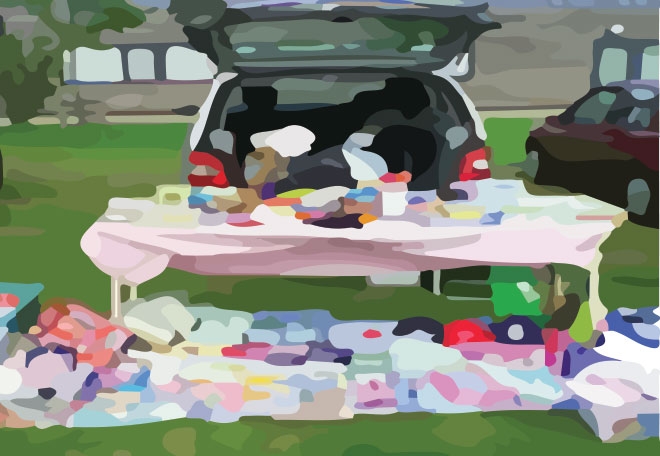
Importing British Culture, Nanjing’s First Car Boot Sale
While to locals, true British culture mostly consists of the Queen, Sherlock Holmes and Big Ben, the epitome of upper-class, it is now time to introduce another side of Britishness to Nanjingers; the carboot sale.
The second hand-markets are probably the exact opposite of the glitz and glamour locally associated with the regal island, yet they are just as representative of its culture as Diana or Benjamin Cumberbatch.
An eco-friendly social occasion that promotes recycling, car boot sales are a form of second-hand market at which individuals come together to sell used goods, ranging from clothes to DVDs and CDs, antiques or even handicrafts.
The event is being organized by the Community Clubhouse (NICC) in cooperation with sponsors Novotel, Nanjing International Club and the British School of Nanjing, and is open to charities, individuals and companies.
Community Clubhouse’s website describes the event as “a great opportunity to get rid of some of those rarely used things at the back of your cupboard just taking up space. Those ice skates the kids only wore once, the clothes they have grown out of or that teddy they no longer play with; bring them all along and help them find a new home.”
Angela He, operations director of Community Clubhouse, explains
“As far as we know, a car boot sale has never been done before in Nanjing. We like being involved in interesting cultural exchanges that introduce the multi-faceted culture of the West.
To make things a bit more interesting, we have tweaked the original concept to provide entertainment for kids, delicious food stalls and the opportunity for charities to get involved, giving the whole event more communal as well as entertainment value.
We plan on running many more events introducing European and other cultural concepts to Nanjing’s internationally-minded community.”
In fact, Nanjing is just another step on the road for the “car boot craze”. Having originated in the United Kingdom, the second-hand market has also become popular in many European countries and even has travelled as far as Australia.
The popularity can certainly be traced back its many advantages such as purchasing goods at a considerably reduced price to save money in difficult economic times as well as promoting a more sustainable consumption pattern by recycling items that would have otherwise landed straight in the bin.
To Nanjing’s expats there is of course the added state of flux in which many live their lives. The season to return home is nearing at great speed and the car boot is a fabulous opportunity to get rid of all those items the departing expats will not be taking back home. As such, one can probably expect to find much newer and less used items at Nanjing’s very first car boot sale than at your ol’ Sunday morning event in Oxford.
The event will take place on 7th June at the Nanjing Novotel East Suning Galaxy Car Park. Registration for a parking space is completely free. 50 spaces are available in total, pre-registry is required. To register send an email to info@yournicc.net.
-

Locals Sceptical of Gov’s Housing Dream
July will see the introduction of a new house-ownership scheme under which the government shoulders up to 50 percent of the cost. Yet locals fear it is just a PR stunt.
-

7 Jiangsu Officials Among Skynet Fugitives
China has publicly released a 100-name strong list of corrupt officials who have fled the country as part of the Skynet initiative. The list includes 7 Jiangsu officials.
-

Solar Impulse 2 Finally Lands In Nanjing
Yesterday at 11.28 pm Nanjing finally welcomed Solar Impulse 2. Pilot Bertrand Piccard flew the solar-powered airplane from Chongqing, a distance of 1,190km that took over 17 hours, thereby successfully completing the sixth leg of the world tour.
The plan was meant to leave chongqing three weeks prior, however due to the light material and design of the plane it is highly susceptible to winds, which caused the delay. The fact that the plane was able to leave Chongqing yesterday was a stroke of luck as Piccard posted on his Twitter account: “Today’s flight was like a miracle, because the weather was bad yesterday and will be bad tomorrow.”
Bertrand Piccard was the unintended pilot for this stretch since his co-pilot André Borschberg had to undergo medical check-ups in his home country Switzerland, having experienced bouts of migraine.
Solar Impulse 2 will spend at least ten days in Nanjing as the plane undergoes servicing. Reports on when it is due to leave Nanjing are conflicting.
Mission director Raymond Clerc said in a statement, ”We need to wait for a good weather window. That could be three days; we could have to wait three weeks – because this leg is really the most important and is very complex.”
Local media news outlet JSChina on the other hand suggested the pit stop was scheduled to take three weeks, closer to the one month stay that had been planned by the team before the unplanned stay in Chongqing.
No matter what official plans are, in the end it is again all down to the weather. While simulations done last year suggested the weather conditions would be acceptable rather quickly, the long and unforeseen stop in Chongqing shows that where weather is concerned, there are a lot of incalculable variables.
Once the plane leaves Nanjing, it is in for a long ride. The Pacific leg will be broken down into two stages, the first stop being Hawaii; the distance between Nanjing and the Aloha state is 8,000km. Since the plane cannot gather high speeds, it will take up to five days and nights to reach its next destination.
Aside from technical preparations, the pilot further needs to mentally prepare for the journey. In an interview with Nanjing Expat, Elke Neumann, press representative of the Solar Impulse 2 project, explained the mental preparation the pilot needs to undergo in order to make the long journey traversing the Pacific; including self-hypnosis tactics, yoga and meditation.
In the meantime, we hope Bertrand Piccard and his team will enjoy their stay in Nanjing. Though we are very curious to know what kind of food supplies will be going on the plane for the Pacific crossing. Will Piccard introduce the Hawaiians to Jinling Salted Duck?

Image Source: JSChina
-

Breaking News: Yangzi Petrochemical Factory Explosion in Liuhe
This morning at 6:05am a major explosion took place at the BASF-YPC factory in Liuhe. An oil refinery tower refining ethylene was the source of the explosion.
-

Taxi Wars: New Long Distance Fee for Nanjing
The taxi wars continue. Nanjing’s cabbies are looking forward to a new pricing system to be introduced end of April, whereby trips farther than 20km will see the price/km go up by 50 percent.
-

Internet Killed the Literary Star
The rise of the Internet has many merits, connecting the globe and making information available to anyone with the technology to go online. The figures speak volumes. Cracking the benchmark of over 3 billion users in 2014, online penetration has reached over 40 percent worldwide, with almost 50 percent of users in Asia. Unsurprisingly, China has a clear lead in the total user number. At over 640 million last year, more people are online in the Middle Kingdom than places two through four (US, India and Japan) combined.
With such a vast audience, it is now possible to reach previously inconceivable amounts of readers; if your content is written in an Internet-friendly manner. This little “if” has influenced in no small amount the way in which professional writers draft their articles.
SEO
Search Engine Optimisation. Just three fatal letters have brought down an entire generation of creative writers and headline enthusiasts. In order for content to be found by as many people as possible, it is vital to achieve a high ranking in search engines such as Google, with the aim that, when anyone searches for “Nanjing boy swallows 18cm skewer”, your article is the one they will find. To achieve this goal, writers need to observe two main rules; headlines and keywords. Under no circumstance is the literary professional allowed to get creative with headlines. A talent formerly indispensable with printed papers in order to grab an audiences attention, fancy and unconventional headlines in the online world result in the death of the article through invisibility. Don’t you dare give in to the temptation of entering “A story hard to swallow” in that title field! “Nanjing boy swallows 18cm skewer” is the only option in our SEO-obsessed times (unless your desired readership is the intelligentia, then replace “swallow” with “ingest”). When it comes down to drafting an article, those little bots who decide what topic you are writing about and whether it should pop-up in anyone’s search engine will crawl their way around a piece of writing looking for key words; i.e. “Nanjing” “boy” “swallow” and “skewer” in our case. Therefore, make sure you sprinkle lots and lots of keywords in your article, including the most commonly used synonyms for the above. Keep in mind not to get too creative please, as chances are no user will go searching for “Jiankang youngster ingurgitates metal brochette”. In this way, SEO strategy forces the writer to limit their vocabulary to commonly used words, discouraging high-level, experimental or ridiculous use of language. In the end, one might argue, it is the writer’s own choice; be funny and unconventional or be read.
WTF
The next challenge a writer might face in the online world is WTF, or “write to fit” (what were you thinking?!). Since a page will feature a certain, fixed layout with set spaces allocated for headlines, content and the like, an issue often faced by authors is the inability to use the headline that conveys the content of the article best because it is, in most cases, too long. Similarily, each word cannot be too lengthy or it might end up cut-off in a rather awkward way, as last letters of the word are being pushed into the next column with a result along these lines: Nanjin g boy swallow s skewer Does not look too snazzy, does it? In traditional print media, if there was a convincing reason to have a large headline across the page, or a lengthy one such as “Traditional Typesetters Turn in Their Graves”, or anything that is not particularly standard, the page layout could be rejigged; to the dismay of the designer of course, yet it was possible. While in the olden days content dictated page layout, in the online world of HTML and line spacing, content forever has to bow down to the almighty emperor website design.
F
Aside from writing, the Internet has had an even more serious effect on reading. As early as 2006, the Nielsen Norman Group discovered that users read online content in an F-shaped pattern, focusing on the words on the top right of the page, the first few paragraphs, while attention drops off the further down the users get, registering only on the first words of the lower paragraphs on the left-hand side of the page. Closely related to this reading habit is skimming. Due to the information overload of the web, readers tend to skim quickly over articles, not taking them in thoroughly, before moving on the next page in high speed. Cognitive neuroscientists have warned that the brains of the digital era are being rerouted to accommodate this type of reading, making it increasingly difficult for the younger generations to read even print texts in a deep, thorough way based on understanding and reflection. People’s online reading habits have in turn had a drastic effect on online writing, as authors pen content tailored to skimming. Initially, it was a matter of inserting clear headlines between paragraphs to break up texts, allowing users to easily jump to the headlines of each paragraph and select any that caught their attention. However, the art of writing easily digestible content has culminated in recent years in the so-called “5 Things I Love About X” style. Wherever one looks on social media these days, it seems that a majority of new media sites feel the need to break their articles down in such a schematic, simplified way. The dark and dreary conclusion is that the online world has trained our brains to be unreceptive to content any more complex than “10 Reasons Why Nanjing is Awesome”. Mr. Tolkien, I am sure, is joining the typesetters in making circular motions within his final resting place.
OP
What the Internet has done for the world is to create a platform allowing for open publishing. With website templates available for free, nowadays anyone with a laptop and a wifi connection is able to become a publisher of content. Gone are the days when print media held the monopoly and the power to decide who could write about what. Today, everyone can be a reporter; even those fools over at Nanjing Expat. This has reinvigorated the age-old debate of quantity over quality. After all, to be blunt, just because everyone can become an author, that does not necessarily mean they should. Similarly, just because one owns a plunger, it might not be the best idea to go around trying to fix toilets. The end result, in both cases, could likely be a flood of something not so pleasant.
That being said, this author has to admit to having bowed down to pretty much all of the above in the quest for online readership (despite the headlines; after all, what is an article without a flashy headline?).
We can only take solace in the fact that worrying reports on Millenials losing the ability to read rather than skim have given rise to the Slow Book Movement. Under the umbrella of the Slow Movement, the SBM advocates slow reading; turning off that pad and picking up a book without the dings of incoming mails and notifications to distract from the task at hand. Considering this is a major challenge for today’s readers, imagine what it could do to us writers!
This article was first published in The Nanjinger Magazine, April 2015 Issue. If you would like to read the whole magazine, please follow this link.
-

Death of the Empress
When the One-Child Policy was introduced in 1979, no one could have foreseen its side effects that would drastically change the face of China, leading to the advancement of women’s position in society.
-

The Pukou Connection; Line 3 Opening Great Success
Today, Nanjing once again strengthens its infrastructure with the opening of Metro Line 3, marking a serious improvement for residents of the Pukou area.