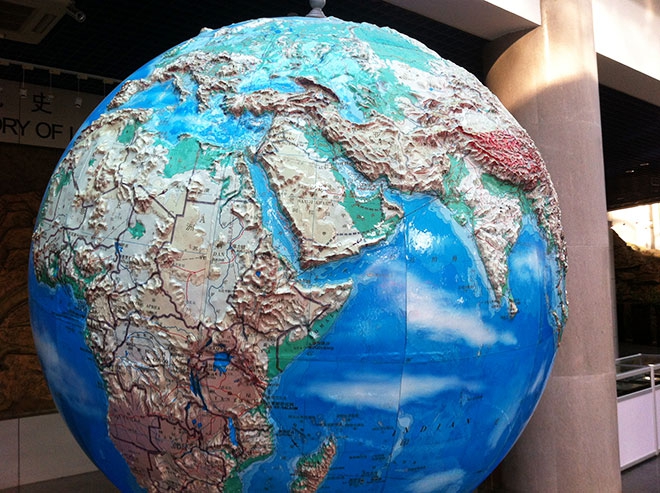
Despite its address being on Beijing Dong Lu, Nanjing Museum of Paleontology lies just down the road from Ji Ming Temple. Home to many fossils and even full skeletons, the museum is an educational delight wherein one can learn not only about the fossil record in general, but also much of the geology of the area around Nanjing. The museum is also likely the best choice when looking for something to do on the weekend that doesn’t involve crowds. The only drawback is, like much that is great in China, the whole place feels a little unloved and there is very little English. Tickets are ¥20, plus another ¥10 for those who would like to wacth a 20 minute 3D film. Half priced concessions are available for students. Most important to note is that the museum is only open to the general public on Saturday and Sunday. All other days, the doors open only for groups who have made an appointment.
Author: admin6
-

Jinghai Temple
Near Yue Jiang Lou, the Jinghai Temple is divided into three themed parts. First: Zheng He’s voyages; second, where the Treaty of Nanjing was signed; and third, the First Opium War in China. Also included are Hong Kong’s return and other scenic and historical areas including the Three Days Accomodating Crag, the Mazu Tablet and the Warning Bell.
The Memorial Hall of Zheng He contains Zheng He’s statue and a painting his voyage, articles he brought frm other countries, and models of his fleet from the voyage.
In the Nanjing Treaty Exhibition Hall there is a restoration of the Nanjing Treaty meetings, a painting by British a soldier, and a medal Queen Elizabeth distributed. Also here are information about the First Opium War in China, Hong Kong’s return, and datas about this history.
The Three Days Accomodating Crag is famous for a general in Song Dynasty who defeated strong enemy with much fewer people. The Mazu Tablet commemorates a sea god in Chinese legends who also protected Zheng He’s voyage.
-

Presidential Palace/Zong Tong Fu
The Presidential Palace is one of the most famous historical sites in Nanjing (if not Jiangsu), and marks one of the largest historical transitions in modern Chinese history. The palace itself was the residence of Dr. Sun Yat-sen, the revolutionary who broke the reign of the Qing Dynasty, created the Republic of China, and is considered the father of the modern nation. Inside, tourists can see the offices and living quarters of China’s former president, as well as a variety of gardens. Additionally, just outside the palace is 1912, the popular bar and restaurant district.
A visit to the palace and Zhongshan Ling is ideal for those who are interested in modern Chinese history. Tickets to Presidential Palace are 40 RMB for the general public, 20 RMB for students.
-

Nanjing Brocade Museum
Visitors can observe professionals working on wooden looms making the finest brocade on earth.
-
Nanjing Drug Art Museum
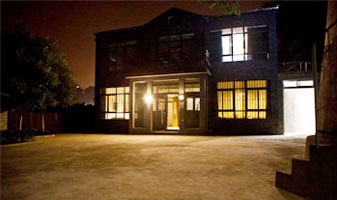
Perhaps best summed up as social experiments with local and foreign artists, Nanjing Drug Art Museum is one of the last few remaining private art galleries in the city. A creation of local artist and entrepreneur Peter Huang, Drug Art is unlike anything else you will find in Nanjing; completely unfurnished with plain white walls, this large space of winding corridors places its emphasis directly on the art.
-
Nanjing Aquarium
The aquarium (also known as “Underwater World”) boast a variety of 200 different types of marine animals and a total of more than 10,000 creatures.
Nanjing Aquarium features an array of aquariums and live performances by dolphins and sea lions. The highlight is a pedestrian walkway that tunnels through a large aquarium that includes sharks, rays, fish and o?ne very big turtle.
In 2007 they started a new exhibit called “Polar World”. This includes a polar bear, arctic foxes, penguins and at least one sickly looking reindeer.
The Jellyfish Aquarium has also become a part of the Nanjing Aquarium.
The aquarium entrance fee has gone up to ¥150yuan for adults, ¥80 for children 1.2m-1.5m tall, FREE for children shorter than 1.2m.
-
Zheng He Treasure Shipyard
For those who have checked out the Zheng He exhibit at Jinghai Temple, the Treasure Shipyard might be a good afternoon trip. Near where the Qinhuai River meets the Yangtze in the north of the city, the Treasure Shipyard has a few interesting archaeological pieces, a treasure ship “replica” by a loose use of the word and a series of bronze steles depicting Zheng He’s journeys. The “docks” where Zheng’s boats were built have been partially restored to their original condition.
-
Nanjing Massacre Memorial Museum
I’ve heard that Auschwitz in Poland has been preserved intact as a memorial to the hundreds of thousands of people who died there; and that thought conjures images of a dirty, realistic reminder of past atrocities that is a stark contrast to the slick, professional presentation of the Nanjing Massacre Memorial. But how DOES one fittingly commemorate such a dark chapter in history, in which 300,000 people were butchered (or worse) in one city in barely over a month?
Despite the facade of the world-class-museum look of the NJMM, much of the necessary symbolism and messages to convey this are intact. Although some of the language is unmistakably bias (referring to the Japanese invaders as “the devils” before you even enter the gate), the horrors of the 1937 massacre are irrefutable.
A couple of general things about the museum is that it’s big…for instance, there’s a large photo gallery section, which has information and photos of the massacre as well as the foreign people behind the “International Safety Zones” established in the CBD during the month-plus-long slaughter (I’ll mention these zones later). Somehow, I managed to completely bypass this section on my first visit by just following another route. A second feature is that there’s a continual soundtrack everywhere on the grounds, sounding like the music from a gothic horror film. It’s fitting.
The reality of the massacre hits home in two main ways – firstly, the fact that these events happened in 1937, ie this is not ancient history. In fact, some of the witnesses and survivors helped in the excavation of the “Mass Grave of 10,000 Corpses” in 1984, and some survivors gave their footprints to a memorial walkway within the museum as recently as 2002 (on the 13th of December 2002, on the 65th anniversary of the invasion, to be exact). So this reinforces the notion that these events happened merely a couple of generations ago.
And the second sobering revelation is given via a courtyard path adorned with large stones, each one commemorating victims who died in certain areas of Nanjing during the massacre…areas which, to someone living in Nanjing like me, are instantly familiar. For instance, thousands of people apparently died at Wu Tai Mountain, or Wutaishan (???), which today is an unashamedly upmarket area with restaurants, outdoor stadiums, bars and even a golf course…and barely a block away from where I live. Thousands more died at Qing Liang Mountain, or Qingliangshan (???), which is barely a half-hour walk from my front door. Again, this makes reality hit home – this isn’t fiction. (In fact, there’s another small, modest but important museum hiding on Guangzhou Lu, near Wutaishan, which was not only one of the aforementioned International Safety Zones, but was also the residence of John Rabe during the Japanese occupation. John Rabe, along with Minnie Vautrin, were two foreigners in Nanjing during the massacre, and are now highly revered characters in Chinese history because of the hundreds of thousands of lives they managed to save. Visiting this other museum, barely ten minutes walk from Wutaishan, gives a realistically sobering reminder that roughly seventy years ago, the bustling corner of Shanghai Lu and and Guangzhou Lu was one of the epicentres of the one of the worst massacres in modern history. This museum is on the corner of Guangzhou Lu and XiaofenQiao (???1?).
Back to the primary massacre museum, the most macabre attraction here is, of course, the display room of skeletons. Neon-lit legends around the pit directly and intentionally point out the skeletons of young women, children and elderly women, and informing us what forensic evidence shows was done to them. Yes, that’s intentionally bias to point out only the women and children, but the message is made totally clear nonetheless.
Following the skeleton display, there’s a room pitch black save for candle-like lights suspended from the ceiling, with a reconciliatory poem writ large on the far wall (the background music changes from goth film to contemplative piano in this room). A 30-metre-high statue dedicated to peace awaits you in the courtyard following this, completing the conceptual symbolism. This emotional transition is a simple thematic device, but simple ideas are often the most effective.
A last interesting point I’ll make is that all the information in the museum is given in three languages – Chinese, English and Japanese. Interpret what you want from that.
It’s so unfortunate that the Japanese invasion of Nanjing is one of the main reasons the world knows about the city – Iris Chang’s 1997 book “The Rape of Nanking” told the world (however subjectively) of “the forgotten holocaust”.
But, I think, the bottom line is that you can’t visit Nanjing without paying your respects to the victims of this truly barbaric invasion.
Ashley Brown is an Australian arts journalist currently teaching in Nanjing.