
Picture framing service and art related supplies.

The first thing you see at Qingliang Shan depends on what day you get there – if it’s a weekend, you find a bustling marketplace as soon as you pass the gates, all of which selling polished stones and carvings, ranging from a few centimetres big, to things you decorate the entrance to your restaurant or the foyer of your hotel with. Of course, none of them have pricetags, so this is hardcore haggleville, which, if you’ve been in China for more than ten minutes, you’ll know is a huge part of their culture.
In China, you can bargain for anything and everything that doesn’t have a barcode. On other days, an empty courtyard greets you here, but in either case, beyond this area is a surprisingly green hill, covered in trees, small bamboo forests, relaxing public park areas and, surprisingly again, art galleries. Not just that, but even an art school and what seems like a commercial design studio. This is all a rather artistically-honed area, all with the backdrop of nature. And as you explore the bush, it dawns on you that there’s quite a lot of it to explore – from roads designed for cars, to decades-old stone paths, to overgrown goat tracks. It really is good to have a stroll around this area and get at least vaguely lost in it if all you’ve seen lately has been concrete, glass and plastic. The area isn’t as quiet as, say, Ming Tombs, but that’s just because it isn’t as big. But it’s picturesque nonetheless, and the artistic slant throughout makes for an enjoyable afternoon.
The galleries are dedicated to a couple of (presumably) famous artists – Wei Zi Xi (???) and Li Jian Chen (???), both of whom are, curiously, from Henan province, not Jiangsu. These modest little galleries are humble yet quite beautiful, considering their surroundings. It has their biographies and photos from their history, but there’s no English to be seen here, so you need either decent Chinese or a guide if you want to read anything about them. These galleries are open from 8.30 to 4.30 (or until no-one is around). The only English in the place is on the occasional direction sign, but beware, these can be red herrings – on top of the hill there should be another art gallery and an orchid garden of some sort, but when you get to the top of the stairs you find someone’s little bush dwelling, with an awning so low you expect a hobbit to step out. So you kind of turn back… There’s also “Zhonghua strange stone gallery”, where you can buy decorative stones, ranging in price from 2,400 yuan to over a million. One of the latter is a magnificent whole polished trunk of fossilised tree, which is certainly worth seeing if that kind of thing interests you. If you happen to own a hotel that needs its foyer decked out, this gallery’s number is 8372 4839, and fairs are apparently held there regularly. And if, after all this peaceful walking and exploring isn’t enough for you, there’s another area – the Wu Long Tan scenic area (?????) only about twenty minutes’ walk from Qingling Shan, which is another scenic area, this one being centred around a lake. Just go out the main gate of Qingliang Shan, turn left, cross the road, and keep walking. You’ll find it. Entry to the park is free

Qixia Mountain is a bit of a way outside of Nanjing, but makes for a good day trip. On the mountain is a a temple of the same name and overlooks the Yangzi River, several pavilions, a series of Buddha statues carved into a cliff, and many paths through the mountain itself. Some paths are little more than a small trail through the forest, while others are a full fledged roads which are wide enough for cars to drive on. Qixia is famous for its foliage in the autumn, and is far enough away from the city center to have relatively blue skies. One drawback, however, is the fact that the whole mountain is surrounded by many heavy industrial complexes, which can ruin the atmosphere a bit. Tickets into the park cost 15 RMB per person.

From all the photos I’d seen of Jiming Temple, I thought it was basically just a pagoda. But China is full of surprises – it’s far from a single building. It’s actually a series of temples, buildings and shrines dedicated to the Buddhist faith. I’ve been to many such temples all over China, from one-room shrines with cold cement walls to grandiose architectural and aesthetic marvels, and so I can tell you from all this experience that, if you’re new to the country, Jiming Temple is a very worthy introduction to the cultural and aesthetic wonders of Buddhist temples in China.
The most curious aspect of this whole place is its name – Jiming translates as “chicken call”. How did that name come about? Well, according to one person I asked, the story is this…there’s a small piece of land between the city wall near the temple, and Xuanwu Lake (which will be mentioned later). Apparently years ago there were some peasant villages on this strip of land, and they had, well, chickens. So every morning, the emperor who lived here during the Ming dynasty was woken up by, well, chickens and roosters. When abouts this became the name of the place I don’t know, but that’s the story. Apparently…
After paying a mere five kuai to get in (for those new to China, “kuai” is the local slang word for yuan – it’s exactly analogous to calling dollars “bucks”), you walk up some steps and find yourself in the first of many beautiful courtyards, with little buildings housing individual shrines, complete with kneeling cushions before all of them. I couldn’t help but notice there was a cat fast asleep on one of those cushions, which was a rather funny sight to see. Buddhist kitty.
Continuing your journey uphill, you find another courtyard, and you can hear Buddhist chanting as you approach it. With a drum tower to your left and a bell tower to your right, you find the source of the chanting – it’s a full-on Buddhist worshipping ceremony in the “Jeweled Hall of Vairocana”. Unfortunately, the doors were closed, but you could see the proceedings through the doors. Everyone’s back is turned away from you, but because of the nature of what’s going on inside, you kind of assume it’s rude or at least inappropriate to come in. So you just look through the doors, and wow, what a sublime, magnificent hall it is.
Looking into this flamboyantly decorated room, with a truly grand golden Buddha in the centre, with statues of a dozen other figures bookending the room, with bona-fide Buddhist monks chanting and bowing in unison, you can’t help but think, yeah, this is the China that I came here to see. Maybe the doors were shut because it was a (very) cold day, maybe not. But you could see enough from the outside to be impressed. Oh, if this means something to you, this room had “Bodhisattvas images of Manjushri Bodhisattva and Samanta-Bhadrayuh Bodhisattva”, according to the bilingual introduction to it. It was built in 1994, and the main Buddha is called the “sacred image of Vairocana Buddha”. Then you proceed uphill again, up to the main pagoda, which is called the Bhaisajyaguru Pagoda (note that none of this language is Chinese, it’s clearly Indian). You pay another five kuai to get into this place, and you get a ticket with information in Chinese and English, although the Chinese introduction is clearly more informative than the English translation – you don’t even need to be able to read any Chinese to figure out that the pagoda dates back to 300AD, and has had a few significant dates in its life. This information is neglected in the English version (I found out from the aforementioned friend that this building was one of the many places levelled by the bombings of the Japanese army in 1937). Regardless, it’s a very cool seven-storey pagoda with another huge statue of Buddha in the first floor (apparently this statue used to live in Beijing, and it moved here in 1972), with the walls surrounding him being covered in miniature versions of him in small glass cases.
Going up floor by floor, you are greeted with more Buddhist effigies, and once at the top you are presented with not just a great view of not just Xuanwu Hu (Xuanwu Lake), but also a huge section of the remaining city wall, stretching from the temple below you to another small hill a few kilometers away. There’s a few other things in the temple, like an art gallery full of paintings and calligraphy, and “The Great Mercy Hall”, which is adorned with four identical, truly impressive twenty-four armed Goddesses of Mercy (Sahasrabhujasahas Ranetra). I’ll admit, I’m a bit of a sucker for Buddhist temples – they always look so damn good, and the ones in the cities always have the dichotomous foible of being tranquil, Zen-ed out zones surrounded by urban chaos. So if that interests you, or any other aspect, whether it be aesthetic, religious or just plain curiosity, this is well worth ten kuai and an hour or two of your time.
UPDATES…during warmer months, the general entrance fee goes from five to ten yuan. Also, there’s a back entrance out of the Temple that leads to the Nanjing Historical Museum of Ming Dynasty City Wall , and also there’s a vegetarian restaurant within the temple. Check them out.
Ashley Brown is an Australian arts journalist currently teaching in Nanjing.
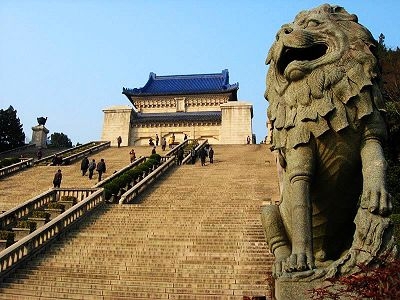
If you live in Nanjing there is a very high chance that at some point, you have or will see Dr. Sun Yat-Sen’s Mausoleum. Considered the founder of modern China, Dr. Sun is very highly respected in Nanjing and across China. His mausoleum is undoubtedly the most famous tourist spot in the city, and one of the biggest attractions in China.

When I got to Nanjing just over two months ago, the first place my boss suggested I go to was Xuanwu Hu, not only because it’s beautiful but also because it’s close to where I live. In fact, when you go there, especially if you go by way of Hunan Road and you’re a newbie like me, you’ll likely be surprised to find this tranquil oasis hidden in the middle of bustling Nanjing.
As someone who lives downtown, I certainly didn’t expect to find open skies, a vast body of water and green nature minutes away from home on the 23rd floor of a commercial/residential block. I mean, I was used to waking up and looking out at a view so busy that it was almost suffocating. Directly facing me is a skyscraper, towering over a crowd of gray buildings not too small in size themselves. To put my sense of disorientation in context, I had just moved from Bordeaux, France, where the sky is sometimes as blue as the Haier mascot and often the tallest buildings you see are Medieval bell towers (and there aren’t many of them).
So, when I decided to drop by Xuanwu Lake on a lazy afternoon, I was happy to come just in time to catch the sunset. After passing through the ever-busy Hunan Road and a fascinating cluster of tofu, baozi and bin stalls, I was met with a scene that reminded me a little of suburban America: wide streets, a green park, a coffee shop and restaurants. I felt lost. Then I walked further, past more restaurants and some tourism shops, to be greeted by a very imposing GATE. After passing through, I found something that made my eyes bulge: almost a little slice of paradise.
After paying a fare of 20 RMB, I walked towards an island (Xuanwu Hu Park) where I discovered a rose garden, a really old gingko tree, tree-lined paths that border the lake, a zoo, more gardens… The place was mostly occupied by elderly people, joggers, bikers and students doing military training. As I sat down on a wooden bench right in front of Xuanwu Hu, I looked up and admired the skyline. While you can’t get away from the eternal rhythm of nail and hammer and firecrackers you seem to hear everywhere in downtown Nanjing, they are much softer and, that day, I was lucky enough to hear an old man singing popular Chinese songs into a microphone, accompanied by background music emanating from a boom box (his performance was so impressive I thought I was listening to the radio at first). Seeing the round red sun set amongst the tall buildings in the distance, with a lone traditional pagoda making its reverable appearance, I felt like I had discovered the first Nanjing treasure the cheesy tourist inside of me had been yearning for. While I circled most of the park, I don’t think I enjoyed anything more than just sitting there on that bench, listening to that free concert, letting go and watching the sun go down.
I think, on a nice day, the spacious green lawn where there’s an elaborate floral dragon sculpture, might be a nice place to sit and have a picnic (if that’s authorized) with friends and/or family. Otherwise, if you have a bike or just want to go for a brisk walk or nice jog, this would be a good place to wind down. For those of you who might want to lay it even a bit more low, paddle boats and golf carts are available as alternative means of transportation.
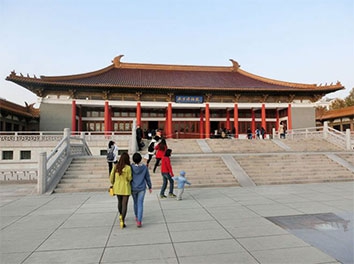
After being closed for four years to facilitate a complete overhaul, the Nanjing Museum reopened its doors in November 2013 revealing a world class facility befitting its status as a national level museum, one of only three in existence; the others being in Beijing and Taipei. Spread over 85,000 square metres and with more than enough attractions to keep the visitor occupied for an entire day, the museum’s six original historical and art exhibition halls are joined by four newly-built halls that reflect modern times and fashion, including the Intangible Cultural Heritage Hall, Digital Hall and Republic of China Hall. Admission is free with valid ID.

Works of local artists, exhibits changed frequently.
Jiangsu Art Gallery is the largest gallery in Nanjing, with exhibition of best traditional artwork and Chinese traditional painting. From time to time, this gallery will hold some art shows such as photos, writing, paintings, drawings by mainly local artist, once the local paper cut artist, she was over 80 years old, showing us how to use the normal scissors to make a complex picture with houses, trees and kids playing around.
Some of these artworks are buy able, so if you like one of them and the price is good, you could take a real Chinese art back. These are inspiring artistic establishment.
It`s quite easy to find the location, the famous 1912 entertainment district in Nanjing is about 100 meters away to the west.

Thanks to a complete interior refit in 2010 what was frankly a little grubby place to buy knock off antiques is now a truly world-class museum and must-see in Nanjing.
Six exhibition halls, five of which permanent, present ancient pottery and earthenware, calligraphy, clothing, jade, golden buddahs and so on, most of which originating from the area around Nanjing. One such treasure is valued at over ¥10 billion. Upon instruction from the Nanjing Mayor himself, photography inside the museum IS permitted. He said, “This is a museum for the people.” With beautiful architecture dating from the mid 1800’s, the Nanjing Municipal Museum lies within the Chaotian Palace at the southern end of Wangfu Da Jie. While most signage is only in Chinese, English speaking guides are available upon request.

Some people told me that there’s not much to see here, but if you see this along with some places close to it, it can be part of a great day out.
To set the record straight, the main “museum piece” is the wall itself. Stretching between Jiming Temple and Jiuhuashan, running along the south shores of Xuanwu Lake for some three kilometres or so, this really is an impressive relic of this ancient city’s past. The walk along the wall gives great views of the lake on one side, and the city on the other, with Jiming Temple decorating one end and the stupa on the hill on the other end (although you can’t access it, more on that later).
Yes there IS an actual museum…it’s just one underground room, but there’s enough to see to give you an appreciation of the wall you’re walking on. There’s a chart telling you about the longest city-surrounding walls in the world’s history, and Nanjing ranks number one, clocking in at over 35 kilometers long (remember this used to be China’s capital, so that’s not surprising). There’s also a model of ancient Nanjing, which is very interesting if you’re familiar with and interested in the modern Nanjing.
You can access the wall from a street, but it’s too small to be listed on the average map anyway, so naming it won’t mean much to most people…so the best way is get there via Jiming Temple. Go to the entrance of Xuanwu Lake area (the Gulou Plaza side), hit the wall, and follow it for maybe twenty five minutes on foot. It’s a nice walk along a really nice area, so it’s time well spent. The wall entry is on your left just before Jiming Temple.