
The Pakistani and Indian Restaurant opened by the owner of Kohinoor is hidden away in the new food court next to Carrefour. While a common complaint about food stemming from this realm is that every dish tastes just a little bit similar, at Baba you can rest assured that this is not the case at all. Whether it is spicy ‘n’ sweet, spicy ‘n’ savoury or just plain spicy you are after, Baba has an immense selection of dishes that taste nothing alike. To be exact his menu come to a total of 200 dishes, so expect a certain amount of time to be spent on simply browsing through all the delicious items with accompanying pictures. Especially recommended are the Prawns Masala and the Qeema Shimla Mirch; minced mutton cooked with capsicum and an array of spices. Be sure to wash it down with a Mango Lassi as these dishes are nothing for weak stomachs. Occasional sweating is to be expected; even in December. Just the way we like it.
Author: admin6
-
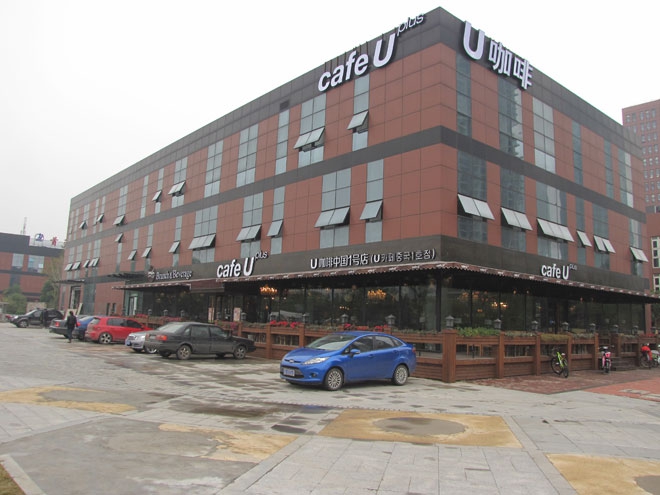
Cafe U Plus
Just a skip and a jump from BenQ Hospital, as a self-proclaimed Coffee and Italian Ice Cream specialist, the Korean Cafe U Plusis a step-up for café dwellers that are fed-up of the ever-identical chains of Starbucks and Co. Cafe U Plus offers a selection of hot and cold beverages, of which the Hot Chocolate with Marshmellows is especially recommended; the perfect drink to warm you up on a cold, Autumnal day. If you are hungry, there is a range of Western food to chomp away at. A highlight is definitely their Italian Gelato Di Natura; original Italian ice cream. The atmosphere invites you to linger and relax amidst comfy chairs, extravangant chandeliers and personal floor lamps at each table. Technologically, Cafe U Plus is up to modern standards with free WIFI and QR-codes on each table to add their Chinese social media. All in all, an ideal place to take a break from the daily bump and grind.
-

Banana Leaf
Thai restaurants in Nanjing are thin on the ground. They come, they go, but the only one that has weathered the storms of economic hardship and fashion sense is Banana Leaf. A quick glance through the menu and the reason is self evident; Banana Leaf has stuck the right chord between Thai and Chinese cuisine, while presenting the former in a manner familiar to the local market. In a setting that is almost exquisite (albeit in a slightly kitch way), Banana Leaf makes for a very pleasant out-of-the ordinary dinner after picking up some shopping at the city’s north western Metro outlet (housed in the same mall).
-
Franck Provost
Franck Provost, a wholly French owned hair salon, is ranked as No. 1 salon in Europe and No. 2 salon in the world. Headquartered in Paris, Franck Provost has opened more than 2400 salons in 25 countries worldwide, serving 30 million clients each year.
Franck Provost has opened 6 salons since it started its business in China 2008. Due to huge market demands, FRANCKPROVOST China is growing and we expect you to join and grow with us.
We offer competitive package and career development plan for our employees. Interested applicants, please send your cover letter with your resume in confidence. Data collected is for recruitment purpose only. We call contact you if we think you might match the qualifications and skills we are looking for this position. No phone calls please.
We have had a French stylist for a long time!
Shampoo blowdry – 100RMB
Haircut for man – from 180RMB
Haircut for woman – from 220RMB
Hair treatment – from 300RMB
Chignon – from 350RMB
Highlight – from 380RMB
Coloration – from 580RMB
Perm – from 880RMB
-

Decathlon Sports Megastore
The sports megastore that is the French Decathlon has shops in most major cities in China, and two in Nanjing. While it offers clothing and accessories for just about every sport under the sun, of most interest to the expat will likely be the range of swim wear, biking equipment and large shoes with sizes up to and including 48. Helpful, friendly and knowledgeable staff are on hand and will explain special offers such as free skating lessons for kids when you buy a complete set of skate wear.
The second outlet in Nanjing is in Jiangning District, located next to Metro, at 286 Ning Li Lu 宁溧路286号.
-

Zhuzi Art Center
Zhuzi Art Center fills a void in the west of Nanjing for visual art exhibition space. occupying two floors in a new purpose built complex off Jiangdong Bei Lu. The contemporary design of the first floor is offset by a futuristic windowless second floor and a side shop/tea garden in which one can browse/buy a fascinating selection of art books
-
Ming Tombs (Ming Xiao Ling
Not even an hour away from the bustling commercial centre of Xinjiekou (???) is Nanjing’s massive tourist magnet, Purple Mountain. It’s a really strange to find that, so close to a place with an unending soundtrack of car horns and thousands of unrelated conversations floating past you, you can actually find a place so incredibly quiet that you can hear your own breathing (or in my case, tinnitus).
Purple Mountain is massive, and has many attractions, the most famous of which is probably Zhongshan Ling, or the tomb of Dr. Sun Yat-Sen. That area is a day or two’s worth exploring by itself, but another major area is the Ming Tombs.
The name “Ming Tombs” is, of course, in relation to the Ming Dynasty, and in fact this tomb is the resting place of the founder of it. He goes by several different names, but his final name according to the tomb is Ming Tai Zu (???). He was notable for a few reasons (not just founding a dynasty) – he was one of the only two emperors in Chinese history who wasn’t born into the throne (he was a farmer, among other things), and also, he is regarded as the ugliest emperor who ever sat in a Chinese throne. And after you see his portraits, you can kind of see why…
This mausoleum, which was completed in 1405, is a really massive area, with dozens of things to see. Just past the main gate is the iconic path adorned with massive statues of camels, elephants, horses and mythical lions, all placed there to guard the tomb from evil spirits. An impressive introduction. (However, I don’t think Ming Tai Zu ever woke up one morning and thought “hey, I bet this’ll be a tourist attraction one day”).
So as not to keep you in suspense (if you’re in any at all), there’s no actual tomb to see…it’s monument after monument, symbolism after symbolism, dedication after dedication, and at the end of the road there’s a huge wall which tells you (in old Chinese, of course, which means it’s going from right to left) that he’s actually buried in the mountain somewhere behind the wall in front of you. (Going by the multilingual map, this is called the “Treasure Mound”). But the things you see before this are grand and impressive, for instance a huge stone turtle with a lion’s face, with a massive stone tablet on its back, made by the emperor’s son in dedication to him.
And there’s tons more to see. There’s the “Purple Clouds Lake”, a tranquil man-made reservoir, surrounded by wooden bridges, stone bridges, and a basic but impressive pavilion overlooking the lake (built in the Qing dynasty, showing that Purple Mountain has been used through the dynasties), that was presumably just used to hang out on while drinking tea and playing chess. There’s also massive areas dedicated to Plum Blossoms, the famous seasonal beauties of Asia…but because they’re seasonal, make sure to time your visit if you want to see them! I went on a very cold January day, and there weren’t any flowers to be seen (I think they bloom around May, just google it. The correct name is Sakura, a Japanese word I believe).
There’s also a stunningly quiet area dedicated to Yan Zhenqing (???), one of the most famous calligraphers in Chinese history, who lived in the eighth century AD. His style, Yan, was incredibly influential, and is regarded as one of the standard styles of calligraphy today. There’s also many other areas I didn’t get around to seeing, for instance two other lakes and a dozen other little areas. Like I said, the place is BIG. If you live in Nanjing, something that might interest you is that you can get a yearly ticket into this area for 150 kuai (remember, kuai is slang for yuan). This is definitely a good option if you want to see the whole area, and you’d like to escape the bustle of the CBD on a regular basis. (The same offer applies to the Zhongshan Ling area, which is eighty kuai to get into).
A last interesting point about this place is that it’s a reminder that Nanjing has been the home of six emperors in Chinese history (Xi’an has the record with thirteen). So over the last couple of thousand years, the emperors of ancient Chinese dynasties were sitting up on what’s now called Purple Mountain, reigning over a city that bears almost no resemblance to the one we see now.
There seems to be no official website, but you can google it for more information…just google its official full title, “Ming Xiaoling Mausoleum”
Ashley Brown is an Australian arts journalist currently teaching in Nanjing.
-
Zhonghua Gate
As many of you would know, every major Chinese city used to be enclosed in massive stone walls to protect them from invading armies. After historical events such as globalisation made the walls somewhat redundant, it was up to the individual cities to decide what to do with the stone monoliths surrounding them. Different cities did different things; for example, Wuhan all but destroyed its wall, whereas Xi’an’s wall was kept intact, and now serves as a tourist attraction. Here in Nanjing, huge sections of the wall remain in various parts of the city, and Zhonghua Gate, the southernmost gate in Nanjing, is reportedly special due to it being the largest city wall gate in all of China (remember Nanjing – which translates as “south capital” – was the country’s capital until 1950).
The route I took to get there was via the Metro line to the Zhonghuamen station (Nanjing really has a world-class Metro system, it’s great), and the gate is about a half hour walk from there, and along the way you pass the Cemetery for Fallen Revolutionary Martyrs, which I didn’t know was so close to where I was going (so stay tuned for a review of this).
So you could easily dedicate a full day to explore this whole area. Back to Zhonghua Gate…what’s meant by the words “large gate” is that Zhonghuamen is basically a military stronghold; it’s a huge medieval-style courtyard divided into three sections by overhead walkways, and, apparently, it hides twenty-seven “caves” that can hold up to 3,000 soldiers during wartime, or vast amounts of supplies during non-turbulent times (You can find a few of these cavernous corridors – one of which has a wall lined with what look like cannonballs the size of basketballs, so what they were launched from is beyond me).
Bookending the entire complex are two “horse paths” (ma dao – ??), which are paths that horses can use to get to the top of the fortress quickly in case of sudden attack. From a military viewpoint, it’s simple but effective, and today these “horse paths” are lined with life-sized fibreglass soldiers, clad in the military uniforms of the day, and all proudly sporting Ming (?) flags. I’m guessing these fibreglass statues are major photo fodder during the holiday seasons….but on this cold January day, I had the place almost all to myself.
Of course, there’s the multilingual introduction board, and this informs you that the gate was commissioned by Zhu Yuanzhang (the founder of the Ming dynasty), it took twenty years to build, and was finished in 1386. It gives all its measurements, finishing by saying that its total area is 15,168 square metres (there’s some amusing Chinglish on this introduction board, in fact, there’s quite a bit around this complex, for instance a sign on the staircase advising you “Careful watch your stairs”). While walking up, down and around the gate, you can definitely feel a medieval atmosphere around you, even despite the fact that you can see and hear a sprawling modern metropolis just outside.
So what’s actually there to see and do, I hear you ask (yes, I heard you)? Well there’s few things, but to be honest the main attraction is the atmosphere that the structure itself gives. If you’re after non-stop entertainment, look elsewhere…even though this place has some information halls, shops, bonsai gardens, hidden chambers, and even a small archery range (very curious, but yes – ten yuan for six shots), the main reason you’re here is to see some Chinese history.
This place is quality over quantity, which is actually refreshing, because quite a few things in China, it could be argued, are the opposite. One thing I found interesting about this place is that costs 25 yuan to get in – I guess in Nanjing terms that’s cheap, but Jiming Temple is just ten, and there’s debatably more to see there (the most expensive place I’ve been to in China is Zhongshan tomb here in Nanjing, which is 80 kuai – even Xi’an’s Terracotta Warriors were only 65). In fact, come to think of it, maybe the reason they don’t make this whole place just public space is that people would nick off with the fibreglass soldiers. This is not to say that it’s not worth a visit, though. If you’re in the area – for instance, the Martyr’s Cemetery or Confucius Temple are both very close – this is definitely worth a couple of hours of your time, especially if you’re interested in medieval Chinese military history.